Oriental stork dies during bird-release ceremony in Gimhae
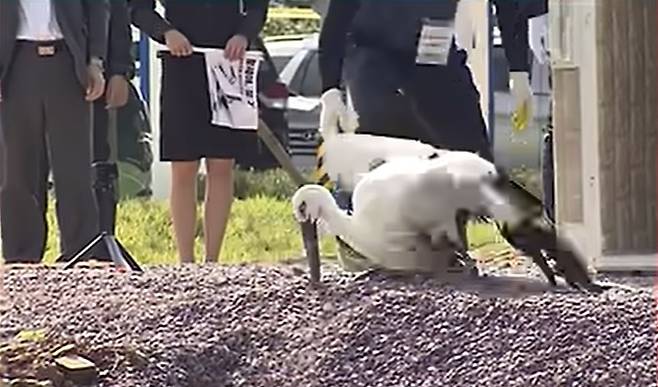
Gimhae City came under fire after an Oriental stork died during a bird-release event held last week to celebrate the opening of the city’s new museum, according to news reports Sunday.
The dead stork was one of three that were confined for about an hour and 40 minutes in wooden box-like cages roughly 30 to 40 centimeters wide before being released, following speeches by the mayor, lawmakers and others, during the opening ceremony of the Hwapocheon Wetland Science Museum held on Oct. 15 in Gimhae, South Gyeongsang Province.
Two female Oriental storks reportedly flew off normally, but the male failed to take flight, stumbled and fell to the ground. Staff on site quickly moved the bird to an aviary for emergency care, but it eventually died.
Hwapocheon Wetland, which was added to the Ramsar List of Wetlands of International Importance earlier this year, is the nation’s largest riverine wetland, home to more than 800 species of wildlife, including 24 endangered species. The bird-release ceremony was held to mark the opening of the museum, established to highlight the wetland’s ecology and promote nature conservation.
Environmental groups argued that the stork died from prolonged exposure to a humid, warm environment inside the cage, even though the outdoor temperature at the time of the event was relatively mild, at around 22 degrees Celsius.
“The inside of an enclosed space like a cage can easily reach 30 degrees Celsius or higher under direct sunlight, even if a car window is slightly open. We assume that the bird died from exhaustion,” Jeong Jin-yeong, a senior official at the Gimhae Environmental Movement Association, told The Korea Herald.
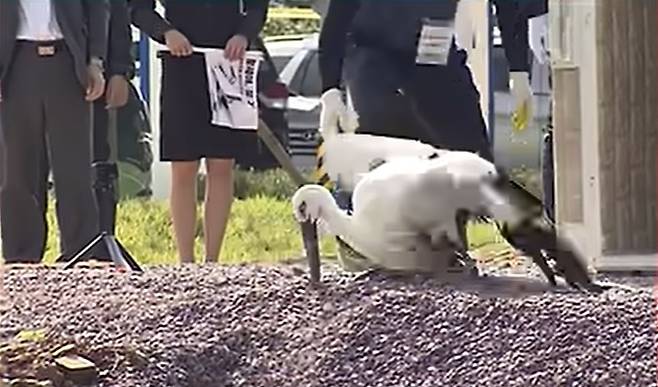
The group condemned the incident as one of “animal abuse” and called on the city to take full responsibility.
“The city must take responsibility for the stork’s death, thoroughly investigate the cause and circumstances, and ban the use of animals for show in all future public events," Jeong added.
Designated as Korea’s Natural Monument No. 199 in 1968, Oriental storks are classified as an endangered species by both the Ministry of Environment and the International Union for Conservation of Nature. Fewer than 3,000 of the birds are believed to remain in the wild worldwide.
In 1996, the Cultural Heritage Administration launched a stork restoration project, and since then, the species has been bred in captivity and released into the wild. Gimhae was selected in 2020 as one of 11 local governments taking part in the national stork restoration program.
Gimhae City denied the animal abuse accusations, arguing "proper management" was in place.
“The cages where the storks were kept were equipped with ventilation features. Veterinarians were also present to monitor the storks throughout the ceremony. They regularly opened the cages to check on the storks’ condition while they were waiting,” a city official said.
The city said it is working with the National Heritage Administration on follow-up measures and investigating the cause of the stork’s death.
Copyright © 코리아헤럴드. 무단전재 및 재배포 금지.