Berlin court upholds order to remove ‘comfort women’ statue
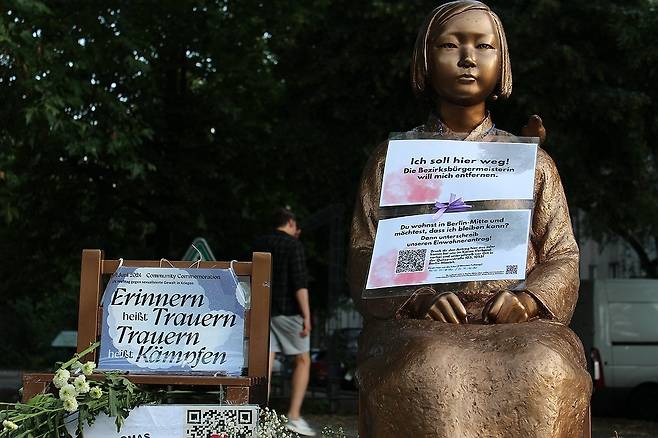
A Berlin administrative court on Tuesday upheld a district order to remove the Statue of Peace, a memorial commemorating victims of Japan’s wartime sexual slavery, rejecting an appeal by the civic group that installed it.
The bronze statue, depicting a young girl in traditional Korean attire seated beside an empty chair, was erected in 2020 by the Berlin-based civic organization Korea Verband under a temporary permit. The permit has since expired, and the Berlin Mitte District Office ordered its removal, citing concerns of diplomatic friction with Japan.
Korea Verband refused to comply and filed an injunction to keep the statue in place. In its latest ruling, the Berlin Administrative Court dismissed the group’s petition, stating that the district office had the right to limit public art installations to a maximum of two years “to ensure fair use of public streets by other artists.”
The court added that Korea Verband failed to demonstrate a continuing legal right to keep the statue on public streets.
However, the court also struck down part of the district office’s notice imposing a 3,000 euro ($3,500) fine should the group not remove the statue voluntarily.
Following Tuesday’s court decision, the civic group said it plans to appeal, claiming that other public artworks in the district had been granted exceptions to the two-year limit.
The civic group said that moving the statue to a different location could make it difficult to host anti-wartime sexual slavery rallies and educational activities.
The Statue of Peace was first installed in front of the Japanese Embassy in Seoul in 2011, and replicas have since spread across South Korea and abroad, becoming flashpoints in Korea-Japan relations. Overseas installations tested diplomatic ties in particular, as Japan frequently pressures host countries to prevent their erection or to have them removed.
Controversies surrounding the Berlin statue erupted in October 2020 when the Mitte District Court revoked the statue’s initial permit, just a month after its installation. The civic group filed an emergency application with the administrative court, halting the removal, while over 300 people rallied, demanding that the statue remain.
In the following years, Korea Verband managed to secure a series of extensions on the permit, the last of which ended on Sept. 28.
Copyright © 코리아헤럴드. 무단전재 및 재배포 금지.