Far-right anti-China banners upset majority of Koreans, including conservatives
이 글자크기로 변경됩니다.
(예시) 가장 빠른 뉴스가 있고 다양한 정보, 쌍방향 소통이 숨쉬는 다음뉴스를 만나보세요. 다음뉴스는 국내외 주요이슈와 실시간 속보, 문화생활 및 다양한 분야의 뉴스를 입체적으로 전달하고 있습니다.
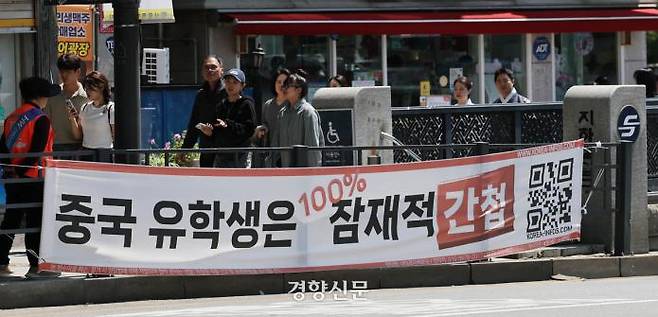
A recent survey shows that eight out of ten Koreans who have seen far-right and anti-China banners displayed across the country report feeling uncomfortable.
The poll, conducted by WinGKorea Consulting on behalf of Democratic Party of Korea (DPK) lawmaker Lee Hae-sik, surveyed 1,004 citizens aged 18 and older nationwide from September 29 to 30. Among 683 respondents who said they had seen banners containing phrases such as “rigged election” or “refusal to accept presidential election results,” 542 (79.4 percent) reported feeling discomfort. The survey was conducted via automated mobile responses, with a margin of error of ±3.09 percentage points at a 95 percent confidence level.
These so-called far-right, anti-China banners surged during the 21st presidential election and continue to appear nationwide. Most are posted under the name “Tomorrow, Future Party” through requests submitted on the “Patriotic Banner Campaign” website. Many carry conspiracy-laden messages, including: “Mothers beware of abductions, kidnappings, and organ harvesting! Stop Chinese visa-free entry!” “Is mentioning election fraud considered treason in Korea?”
Of the 1,004 survey respondents, 683 (68 percent) said they had seen such banners. By region, the proportion was higher in Seoul (79.2 percent), and Gangwon Province/Jeju Island (81.7 percent). Across all regions, more than half of respondents reported seeing banners with references to election fraud or hate speech.
Among the 683 who had seen the banners, 79.4 percent (542 respondents) reported feeling uncomfortable or displeased. The proportion was higher than the national average in Seoul (82.7 percent), Busan/Ulsan/South Gyeongsang Province (81 percent), and Gwangju/South and North Jeolla Province (79.5 percent), while 73.2 percent in Daegu/North Gyeongsang Province also reported discomfort.
By political orientation, 65.2 percent of self-identified conservatives reported feeling uncomfortable, compared with 83.7 percent of moderates and 88.4 percent of progressives.
Regarding whether such banners exacerbate social conflict, 672 respondents (66.9 percent) agreed. The perception was higher among people in their 40s (79.7 percent) and 50s (79.4 percent) and lower among those aged 70 and above (41.3 percent) and in their 20s (59.5 percent).
Furthermore, 715 respondents (71.2 percent) agreed that political party banners should be restricted from containing false information, baseless slander, or hate speech.
Lawmaker Lee Hae-sik commented, “While the Constitution and laws guarantee the freedom of party activities, this does not mean allowing the spread of falsehoods or slander that fuels social conflict. With seven out of ten citizens supporting restrictions on false or hateful content in party banners, I will take the lead in establishing effective measures.”
※This article was translated by an AI tool and edited by a professional translator.
Copyright © 경향신문. 무단전재 및 재배포 금지.
- [영상] 트럼프, 만찬장 총격범 영상·사진 공개···“보안 요원 밀치고 돌진”
- [속보] 트럼프, 곧 백악관서 기자회견 예정···“내각 구성원 모두 무사”
- [속보] 국민의힘 대구시장 후보로 추경호 확정…김부겸과 맞대결
- [속보]총격 피신 후 SNS 글 올린 트럼프 “총격범 체포···정신없는 저녁이었다”
- “나랑 애인해도 되겠어” 20대 여성 등산객 얼어붙게 만든 노인
- 민주당 최고위원들 “쿠팡 이유로 안보협의 어렵다?…한국은 미국 속국 아냐”
- 29명 목숨 앗아간 제천 화재 참사···9년 만에 지급되는 사고 위로금
- 사드 배치 10년···사드 반대 단체 ·“불법 배치 철거하라”
- 내일부터 ‘1차 고유가 지원금’ 신청·지급···등초본 발급 수수료 한시 면제
- 미성년 투자자 보유주식 가치 3조원 육박…제일 많이 담은 종목은 삼성전자