North Korea rehearses Friday night military parade for Worker’s Party Anniversary: JCS official
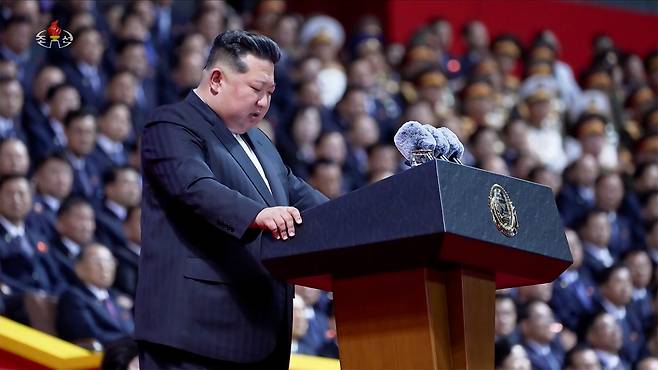
North Korea is expected to stage a large-scale military parade late Friday night to mark the 80th anniversary of the founding of its ruling Workers’ Party, with signs pointing to the mobilization of missiles and other heavy weaponry, an official at South Korea’s military said.
The official from the South’s Joint Chiefs of Staff told reporters around noon that the North “appears to be conducting rehearsals with equipment and missiles mobilized,” adding that “the possibility of the parade taking place tonight is high.” The official noted that while adverse weather could affect aerial displays, “the parade should still be possible” despite the light rain — about 1 millimeter per hour — forecast across North Korea in the evening.
Since 2020, the North has held all seven of its major parades at night, favoring elaborate, torch-lit processions that highlight its newest military hardware. Seoul’s military estimates that tens of thousands of troops have been preparing for the latest event in Pyongyang’s Kim Il Sung Square.
Attention is on whether the regime will unveil the new Hwasong-20 intercontinental ballistic missile, which it recently claimed to be developing. Weapons and launchers believed to be part of the parade have been observed covered by tarps in satellite imagery, fueling speculation that Pyongyang could showcase advancements in long-range missile technology aimed at the US.
Speculation is also mounting over whether Kim Jong-un’s daughter, Kim Ju-ae, will appear at Friday's military parade. Her attendance would likely signal an official acknowledgment of her status as Kim’s successor, observers say. Ju-ae has not appeared in state media since accompanying her father to China last month, with her last public sighting recorded during their arrival in Beijing on Sept. 2 and return to Pyongyang on Sept. 5.
Observers say her participation would carry strong symbolic weight, given the political importance of the anniversary and the presence of foreign dignitaries. They note that factors such as her seating position, titles and treatment by state media could offer further clues to her evolving status within the regime. However, some experts believe Kim may opt to exclude her from the event to maintain focus on the party’s achievements, as she was also absent from Thursday evening's celebrations.
On Thursday night, Kim Jong-un attended a celebratory event ahead of the planned nighttime military parade, using the occasion to signal his intent to broaden North Korea’s diplomatic reach beyond China and Russia to Southeast Asia, engaging more actively with countries such as Vietnam and Laos.
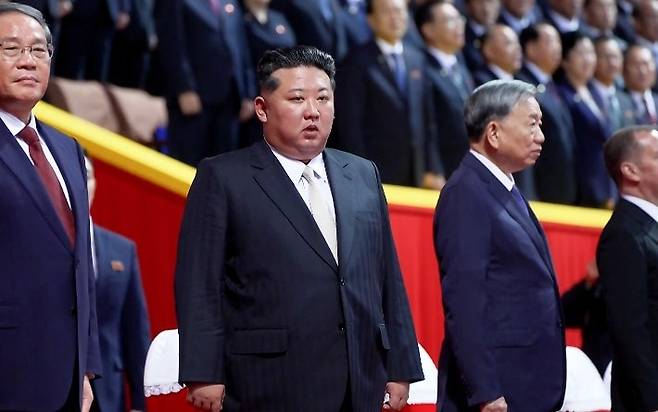
Footage broadcast by Korean Central Television showed a carefully choreographed seating arrangement at the commemorative rally in Pyongyang’s May Day Stadium that underscored this strategy. Chinese Premier Li Qiang sat to Kim’s right — the position of highest honor — while Nguyen Phu Trong, general secretary of the Communist Party of Vietnam, was seated to his left. To Trong’s right sat Dmitry Medvedev, deputy chair of Russia’s Security Council, placing Vietnam symbolically between two of North Korea’s most powerful partners.
Earlier in the week, Kim also met with Thongloun Sisoulith, president of Laos, to discuss ways to deepen bilateral cooperation. Though the Lao leader returned home the following day and did not attend Thursday’s festivities, he had earlier toured an arms exhibition showcasing North Korea’s domestically developed weaponry — a display held in defiance of international sanctions.
The anticipated show of force comes as North Korea deepens ties with Beijing and Moscow amid a prolonged freeze in relations with Washington. Pyongyang has largely abandoned diplomatic engagement with the US since the collapse of denuclearization talks in 2019, turning instead toward China and Russia for political backing and economic survival.
Pyongyang’s deepening alignment with Beijing was underscored by the visit of Chinese Premier Li Qiang to the North Korean capital on Thursday — the first trip by China’s second-ranking official in 16 years.
According to the North’s state media, Korean Central News Agency, Kim Jong-un and Li held talks on expanding “high-level exchanges, strategic communication, and multifaceted cooperation,” pledging to advance their “friendly and cooperative relations” in broader, more substantive ways. Li reaffirmed that nurturing relations with Pyongyang remains a “consistent and unwavering strategic policy” for Beijing, while Kim lauded China’s progress toward building a “modern socialist state” and vowed to pursue closer “joint struggles” with China to strengthen socialist solidarity.
China’s state-run Xinhua News Agency described the relationship as “unbreakable,” quoting Kim as stressing that consolidating ties with Beijing is the “unchanging position” of the Workers’ Party and North Korean government, regardless of shifting global dynamics. Kim also voiced strong support for the “one-China principle,” opposing “separatist acts of Taiwan independence” and aligning with Beijing’s stance on Hong Kong, Xinjiang and Tibet.
In a separate message marking the Workers’ Party’s 80th anniversary, Chinese President Xi Jinping extended congratulations to Kim, reiterating that Beijing would “defend, consolidate and deepen” China-North Korea relations. Xi said his “in-depth discussions” with Kim during the latter’s visit to Beijing last month “set the direction for further development” of bilateral ties.
Copyright © 코리아헤럴드. 무단전재 및 재배포 금지.