Samsung’s Exynos to return in Galaxy S26, but still falls short of Snapdragon in test
![Brand image of Exynos 2600 processor [SAMSUNG ELECTRONICS]](https://img1.daumcdn.net/thumb/R658x0.q70/?fname=https://t1.daumcdn.net/news/202510/10/koreajoongangdaily/20251010070251202cakd.jpg)
[NEWS ANALYSIS] The long-anticipated comeback of Samsung Electronics’ Exynos mobile processor, likely to power the upcoming Galaxy S26 series, will be a significant test of the company's chipmaking capabilities and a strategic move to cut costs and dependence on Qualcomm. In the first half alone, the Korean electronics giant spent 7.8 trillion won ($5.5 billion) for purchasing mobile application processors — the bulk of which went to San Diego-based Qualcomm, as the Galaxy S25 series relied heavily on the U.S. chipmaker’s Snapdragon platform.
It is widely expected that both Snapdragon and Exynos processors will be used simultaneously for the Galaxy S26 lineup, with deployment varying by model and region.
Multiple local media outlets reported on Thursday that Samsung has begun mass production of the Exynos 2600, with the first shipments projected for late October or early November.
Still, early benchmark tests reveal a performance gap between the Exynos and Snapdragon chips. Leaked Geekbench results showed single-core and multi-core scores of 3,309 and 11,256 for the Exynos 2600, placing the chip behind the Snapdragon 8 Gen 5, which scored 3,831 and 12,459, respectively.
The chipset is built on Samsung’s new 2-nanometer gate-all-around (GAA) technology, which replaces the Fin Field-Effect (FinFET) architecture that dominated previous process nodes. Unlike FinFET, which surrounds transistors on three sides, GAA transistors wrap the gate entirely, promising tighter control, reduced leakage and improved efficiency.
Final packaging and testing are being handled internally by Samsung, while initial wafer testing has been outsourced to partners.
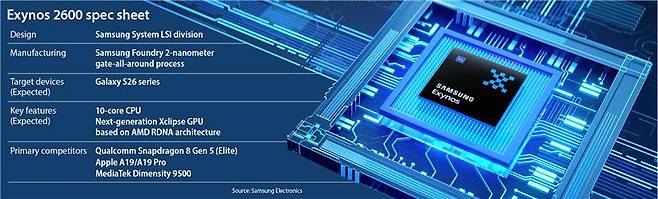
Exynos rebound vs Snapdragon stronghold For years, Samsung had pursued a dual-chipset strategy for its flagship smartphones until the S24 model: Snapdragon chips for the United States and other premium markets, and Exynos variants for Europe, the Middle East and India. The approach, however, has been dogged by complaints — particularly overheating in Exynos-powered models — prompting Samsung to ship all Galaxy S25 models globally with the Snapdragon 8 Elite.
This year, however, marks a break in that trend. In July, Samsung deployed the Exynos 2500 across all markets for its Galaxy Z Flip 7, marking the first time an Exynos-powered flagship was sold globally.
“Building on that momentum, the upcoming Galaxy S26 is also expected to feature the Exynos 2600 globally,” noted CTT Research in a recent report. While Z Flip 7 sales are forecast to remain modest at under 4 million units, the S26 lineup is projected to ship more than 25 million units, signaling a clear scaling point for Samsung’s chip strategy.
The shift also matters beyond smartphones. By embedding Exynos in its flagship lineup, Samsung creates a reference design to attract external customers for its foundry, thereby reinforcing its dual role as both a device maker and a contract manufacturer.
Samsung has been aggressively pursuing big-ticket foundry deals to compete with TSMC. Recently, the company secured contracts to supply memory chips for OpenAI’s $500 billion Stargate project — an ambitious plan to build next-generation AI data centers. It also signed a $16.5 billion deal with Tesla to supply AI6 chips for autonomous vehicles and robotics, and partnered with Apple as part of Cupertino’s $100 billion U.S. investment initiative, believed to involve image sensors for upcoming iPhones.
Beyond its role as a smartphone chip, the Exynos 2600 serves as a litmus test for Samsung’s foundry competitiveness at advanced node levels.
Competition, pricing and multi-foundry trends Rival Qualcomm has signaled its own strategic flexibility. At the Snapdragon Summit 2025 in Hawaii, Senior Vice President Alex Katouzian told Korean media that Qualcomm is open to a multi-foundry strategy, working with both TSMC and Samsung. While current Snapdragon 8 Elite and X2 Elite chips are produced at TSMC, Katouzian stressed that the company has the flexibility to switch foundries.
Pricing could tilt the field. Industry reports, including those from Sammobile, suggest that Samsung is undercutting TSMC by slashing its 2-nanometer wafer price by a third, to approximately $20,000 per wafer, compared with TSMC’s expected price of $30,000. That pricing advantage may help Samsung lure customers, although the Korean producer still lags in overall performance and power efficiency.
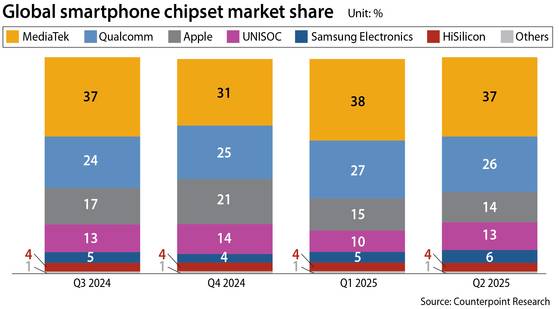
Overheating, efficiency, and yield A longstanding weakness for Exynos chips has been overheating. Analysts now believe Samsung has partly solved the issue by separating the application processor (AP) from the modem, reducing thermal loads.
“By separating the AP from the modem, Samsung is expected to minimize overheating risks that have long been seen as a weakness, which would mark a positive development for foundry utilization rates,” said Ryu Hyung-keun, analyst at Daishin Securities.
However, separating the modem also increases the overall chip area, which could in turn hurt power efficiency. Samsung claims its 2-nanometer GAA process delivers a 12 percent performance boost and 25 percent efficiency gain over the 3-nanometer process. But the fundamental determinant will be yield — the percentage of usable chips produced per wafer. According to The Bell, Samsung’s 2-nanometer yield has surpassed 50 percent, considered a cautiously promising milestone.
“Yield is always better the higher it goes. But what counts as an acceptable level depends on the targets set,” explained Lee Jong-hwan, professor of system semiconductor engineering at Sangmyung University. “If yield and reliability falter again at 2-nanometer, Samsung’s foundry business could be in real trouble. Success at this node is seen as a double-edged sword: if it works, it’s a breakthrough; if it fails, it could damage credibility and stall future momentum.”
BY LEE JAE-LIM [lee.jaelim@joongang.co.kr]
Copyright © 코리아중앙데일리. 무단전재 및 재배포 금지.
- Trump may have 'ended seven wars,' but Nobel odds remain low, say online betting sites
- Chinese tourist faces backlash for allowing child to defecate in public at Jeju natural monument
- NIRS fire destroys government's cloud storage system, no backups available
- Korean activist transferred to ‘notorious’ Israeli prison as Korean government advocates release
- Lotte Group chief makes first inspection tour of U.S. bio campus since 2023 acquisition
- North's Kim reinforces authority in comments ahead of 80th anniversary event
- Korea set for toughest challenge of year vs. Brazil, with Son Heung-min on verge of history
- Trump, Xi's schedules threaten to dash South Korea's APEC ambitions
- Korean fury over Tesla battery error builds as gov't mulls subsidy review
- Korea set for tactical test against Brazil at int'l friendly in Seoul