Korea’s pickup sales roar back as Kia, KG roll out fresh models
Korea’s pickup market is seeing its first rebound in six years, fueled by domestic carmakers rolling out new models that have spurred fresh competition in the mid-range segment.
According to industry tracker Carisyou, 17,136 units of pickups were sold in Korea between January and August, up 74.9 percent from a year earlier. The figure has already far surpassed the 2024 annual total of 13,954 units.
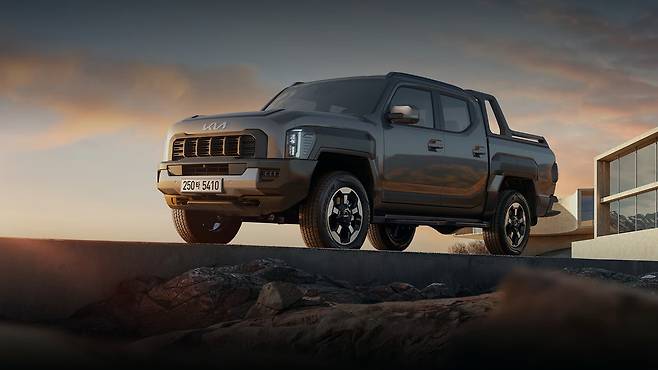
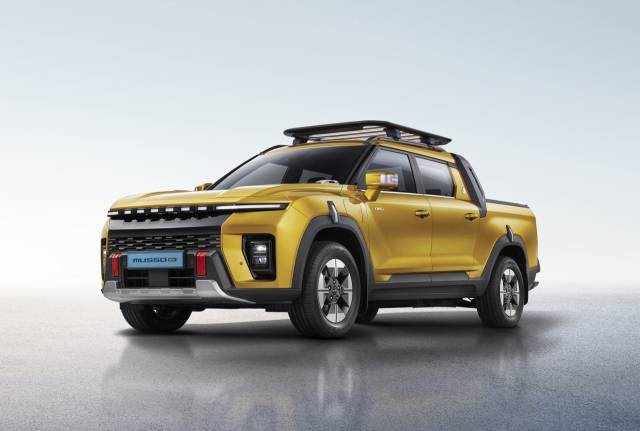
Leading the sales surge is Kia’s Tasman, the company’s first pickup in over 50 years. It sold 5,937 units between its February launch and August. KG Mobility’s Musso EV, introduced in March, followed with 4,889 units sold.
Korea’s pickup market had been in steady decline since peaking at 42,147 units in 2019. Once buoyed by interest in camping and leisure activities, the segment lost momentum due to limited choices.
Industry insiders note that the launch of long-awaited new domestic models has drawn renewed public attention.
Before the Tasman’s debut, KG Mobility was Korea’s sole domestic pickup maker, and neither of its earlier pickup models, the Rexton Sports introduced in 2018 and the Rexton Sports Khan introduced in 2019, had undergone a full change since launch. Both internal combustion models were renamed Musso Sports and Musso Khan in 2025.
The lack of mid-range models combining affordability with advanced features has been cited as another factor behind the market’s long-term decline.
“While KG Mobility has offered budget options in Korea, imported US pickups dominated the high end, leaving the mid-range segment empty,” said Kim Pil-su, an automotive engineering professor at Daelim University.
“But American pickups, with their low fuel efficiency and oversized bodies, were not well suited to Korea’s circumstances. ... Consumers had long been waiting for a more practical choice with better-equipped features.”
The Tasman now fills that middle ground, with trims priced between 37.5 million won ($26,596) and 52.4 million won. It appeals to individual drivers with advanced driver-assistance features, while its frame-on-body construction and off-road capabilities demonstrate strength on uneven terrain.
Around 80 percent of Tasman buyers were private consumers, with 19 percent registering the vehicle for business use, according to Carisyou.
The Musso EV, Korea’s first electric pickup, is also competing in the mid-price segment. It starts at 48 million won, with the effective cost further reduced through central and local government EV subsidies.
By combining electric efficiency with KG Mobility’s established pickup expertise, the model helped push the company’s total domestic pickup sales past 10,000 units by September.
Both models are also spearheading the push of Korean pickups into global markets, where growth has long been limited.
As of August, Kia had exported 10,356 units of the Tasman -- nearly twice its domestic sales -- with shipments bound for the Middle East, Africa and, since July, Australia.
The Musso EV also began exports in June, accounting for 20 percent of the Musso lineup’s 1,300-unit overseas sales in August, even as global EV adoption in the pickup segment remains slow.
Experts say mid-range pickup options are likely to continue increasing in Korea as the country’s carmakers focus more on the high-value-added segment to penetrate global markets.
“Korea’s pickup market is largely driven by enthusiasts, so growth is unlikely to be explosive,” said Kim. “But carmakers are using the domestic market as a test bed while sharpening their competitiveness for overseas expansion.”
Copyright © 코리아헤럴드. 무단전재 및 재배포 금지.