Escape rooms — and palaces — are a breakout hit among tourists
전체 맥락을 이해하기 위해서는 본문 보기를 권장합니다.
"At the time, escape rooms were flourishing in Singapore, but there were none in Korea," said Oh, who launched Real Escape Challenge with her Singaporean husband, Justin Yong, in 2015. "So my husband came up with the idea to open one here. It was very popular in the beginning. Reservations were fully booked for months."
The KTO has partnered with local escape room companies to roll out new multilingual experiences, including the "Gyeongbok Palace Monster Tour."
이 글자크기로 변경됩니다.
(예시) 가장 빠른 뉴스가 있고 다양한 정보, 쌍방향 소통이 숨쉬는 다음뉴스를 만나보세요. 다음뉴스는 국내외 주요이슈와 실시간 속보, 문화생활 및 다양한 분야의 뉴스를 입체적으로 전달하고 있습니다.
![A participant in an escape room game at Real World Seongsu solves a mission using a smartphone. [REAL WORLD SEONGSU]](https://img2.daumcdn.net/thumb/R658x0.q70/?fname=https://t1.daumcdn.net/news/202510/02/koreajoongangdaily/20251002130225768nrkr.jpg)
Enter a room — or, these days, not — search for hidden clues and unravel a mystery. That's how a growing number of tourists are choosing to spend their time in Korea these days.
Foreign visitors' spending on escape rooms skyrocketed 1,419 times in the first half of this year compared to the same period last year, according to the Korea Tourism Organization (KTO), with the trend especially clear in tourist-heavy areas like Hongdae.
"At least one team a day is foreigners, and sometimes we get four groups in a row," said Oh Sae-saem, who co-runs the escape rooms Deepthinker and Real Escape Challenge in western Seoul's Hongdae. At Deepthinker, which opened in 2023, 20 to 30 percent of players are foreigners, while Real Escape Challenge sees a higher proportion at nearly half. Some come with Korean friends, while others are all-foreigner groups.
"We are seeing steady reservations from independent travelers, working holiday visitors and exchange students," said a representative from Keyescape, one of Korea's largest escape room operators with numerous branches nationwide. "The number has risen sharply since late 2023, while many in 2024 came after enjoying K-content like BTS or Squid Game, saying they wanted to experience Korean culture firsthand."
X Escape's Hongdae Playground branch, which offers four themes in English, is also noticing the change, with "more tourist players visible, particularly this year," according to a staff member.
![Foreigners walk past an room escape in Hongdae in western Seoul on Sept. 29. [WOO JI-WON]](https://img3.daumcdn.net/thumb/R658x0.q70/?fname=https://t1.daumcdn.net/news/202510/02/koreajoongangdaily/20251002130227364bbjl.jpg)
Escape rooms fit perfectly into the growing trend of "dailycations," where foreigners try everyday activities that locals enjoy. Recognizing this demand, escape room companies — and even the government — are racing to make the games more creative and foreigner-friendly.
With the long Chuseok holiday just around the corner, there's no better time to give one a try. Escaping through Korea's stories
Korea was a latecomer to the escape room craze, with the first ones opening around 2015, years after the trend had taken off in Japan, Singapore and the United States.
"At the time, escape rooms were flourishing in Singapore, but there were none in Korea," said Oh, who launched Real Escape Challenge with her Singaporean husband, Justin Yong, in 2015. "So my husband came up with the idea to open one here. It was very popular in the beginning. Reservations were fully booked for months."
![Real Escape Challenge in western Seoul's Hongdae [REAL ESCAPE CHALLENGE]](https://img1.daumcdn.net/thumb/R658x0.q70/?fname=https://t1.daumcdn.net/news/202510/02/koreajoongangdaily/20251002130229016siki.jpg)
Real Escape Challenge in Hongdae remains popular with foreigners today, offering all five of its rooms in both English and Korean.
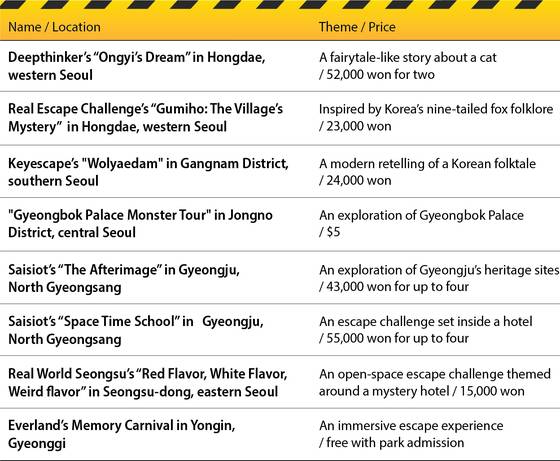
Created by the couple, one of its most distinctive storylines is "Gumiho: The Village's Mystery," based on Korea's nine-tailed fox folklore. "Because Gumiho is a Korean monster, some foreign visitors choose that theme just for the cultural element," Oh said.
Recreating traditional folklore through modern interpretation, players try to solve a mystery surrounding a village. The game has a challenge level of 4 out of 5 and a fear level of 3.5 out of 5.
The other escape room, Deepthinker, takes a gentler approach with "Ongyi's Dream," a sentimental, fairytale-like story about a cat.
![Deepthinker's Ongyi's Dream poster [SCREEN CAPTURE]](https://img4.daumcdn.net/thumb/R658x0.q70/?fname=https://t1.daumcdn.net/news/202510/02/koreajoongangdaily/20251002130230593rfhr.jpg)
![The escape room Deepthinker in western Seoul’s Hongdae [DEEPTHINKER]](https://img1.daumcdn.net/thumb/R658x0.q70/?fname=https://t1.daumcdn.net/news/202510/02/koreajoongangdaily/20251002130232216wjvf.jpg)
"Typical escape rooms often emphasize thrillers and horror, usually enjoyed by older students or adults," Oh said. "'Ongyi's Dream' has a soft, heartwarming story that people of all genders and ages can enjoy." She added that its "sentimental theme" is a concept she considers unique to Korea.
It is also especially easy for foreign players to understand, as the theme was designed with such audiences in mind. "Because my husband is a foreigner, we naturally thought to create games with consideration for foreign players. We designed the theme so that even those who don't know a single word of Korean can still play," said Oh.
Keyescape also draws on tradition with "Wolyaedam," a modern retelling of Korean folktales in which the player takes on the role of a dolse, a servant from the past. Created by its planning team, it's also serviced in English.
![Keyescape's Wolyaaedam poster [SCREEN CAPTURE]](https://img4.daumcdn.net/thumb/R658x0.q70/?fname=https://t1.daumcdn.net/news/202510/02/koreajoongangdaily/20251002130233722ekod.jpg)
"Today's escape rooms are less about escaping quickly than about immersing yourself in the story," said a Keyescape representative. The best way to enjoy them, according to the source, is to take your time. "The real fun isn't about winning fast, but about following the storyline and enjoying the process. That way, it becomes a much richer and more memorable experience." Keyescape also runs the drama–themed escape room "Have a Good Tape, Dave" in English, in collaboration with the KTO. Outdoor escapes
The summer heat has eased, and for those craving a twist on the classic enclosed escape room, entire neighborhoods, hotels and historic landmarks are now turning into playing fields.
![Participants play ″Gyeongbok Palace Monster Tour.″ [SCREEN CAPTURE]](https://img2.daumcdn.net/thumb/R658x0.q70/?fname=https://t1.daumcdn.net/news/202510/02/koreajoongangdaily/20251002130235197pwmf.jpg)
The KTO has partnered with local escape room companies to roll out new multilingual experiences, including the "Gyeongbok Palace Monster Tour."
Set on the palace grounds, players work with mythical gods to soothe restless spirits haunting the site, solving missions in spots like Geunjeongjeon Hall and the Gyeonghoeru Pavilion.
Available in English, Chinese and Japanese, the game requires only a smartphone and takes roughly two hours. It costs about $5, with a palace admission ticket not included.
![Saisiot's "The Afterimage" kit [SCREEN CAPTURE]](https://img2.daumcdn.net/thumb/R658x0.q70/?fname=https://t1.daumcdn.net/news/202510/02/koreajoongangdaily/20251002130236706qyxo.jpg)
![Participants play ″Space Time School″ [SAISIOT]](https://img3.daumcdn.net/thumb/R658x0.q70/?fname=https://t1.daumcdn.net/news/202510/02/koreajoongangdaily/20251002130238346buag.jpg)
In Gyeongju, North Gyeongsang, Saisiot's "The Afterimage" takes players on a mission that spans the city's heritage sites, from Donggung Palace and Wolji Pond to Woljeonggyo Bridge.
Also available in English, Chinese and Japanese, the game includes a kit and mobile link, with admission fees to the palace and pond covered by the purchase.
"It was designed so players can understand the region's history by solving escape problems," said Kim Kyung-min, head of Saisiot. Originally created for locals in Korean, the program, which blends education with entertainment, is popular among Koreans, particularly students.
Saisiot has also experimented with unusual settings, like its "Space Time School" inside Kolon Hotel Gyeongju. "The hotel has many features, like a museum and exhibitions," said Kim. "Players walk through the building and solve puzzles along the way."
The Seongsu-dong Foundation for Arts & Culture in eastern Seoul recently hosted an outdoor escape "The Scout in Seongsu" in partnership with Uniquegood Company as part of its Creative X Seongsu project.
!["The Scout in Seongsu" organized by The Seongsu-dong Foundation for Arts & Culture [SCREEN CAPTURE]](https://img2.daumcdn.net/thumb/R658x0.q70/?fname=https://t1.daumcdn.net/news/202510/02/koreajoongangdaily/20251002130239845pbna.jpg)
For one week, participants roamed the Seongsu neighborhood, using a kit to solve missions tied to installations across the area. Marking its third year, the project debuted outdoor room escapes in 2023, briefly switched to an outdoor scavenger hunt, then returned this year in full escape-room style.
"People preferred the escape room style, so we switched back to real escapes this year," said an official from the foundation. Some 10,000 participants took part in the event. Reinventing the escape
Escape rooms are also evolving indoors.
Uniquegood Company's escape room "Real World Seongsu" in the eastern Seoul neighborhood was the first to pioneer the "open-style" format four years ago. Instead of being locked in a single room and moving to the next, players roam freely through a large, designated indoor space with multiple rooms. All the doors remain open, and depending on the type of game and their progress, players can enter and exit each room at will.
Spread across two floors, the second level is styled like a hotel. Each room has a unique concept, from a swimming pool to a casino to an art gallery.
![Real World Seongsu [REAL WORLD SEONGSU]](https://img4.daumcdn.net/thumb/R658x0.q70/?fname=https://t1.daumcdn.net/news/202510/02/koreajoongangdaily/20251002130241548wcdt.jpg)
Through the app, participants unlock missions as they progress through the storyline, with the experience enhanced with augmented reality, QR codes and even in-app phone call features. Of its 10 available themes, three are translated into English, Chinese or Japanese.
"We’re aiming to expand our content to attract foreign visitors in Seongsu and meet the rising demand," said a representative from Uniquegood Company. More than 120,000 people visit Real World Seongsu’s open-space escape rooms annually.
Its games range from 30 to 120 minutes, with varying difficulty levels. Prices start at 7,500 won ($5) and go up to 25,000 won. Because players can participate individually without occupying an entire room, the games are more flexible with time. And since the space is open, participants can also take photos inside — something rare in typical escape rooms.
Even Korea's largest amusement park, Everland, has embraced the trend — but on a much larger scale.
Citing strong interest from millennial and Gen Z foreign visitors, Everland created a 1,450-square-meter (15,607-square-foot) escape zone featuring 14 themed rooms, actors and cinematic staging.
![Everland staffers at the immersive escape room "Memory Carnival" [EVERLAND]](https://img2.daumcdn.net/thumb/R658x0.q70/?fname=https://t1.daumcdn.net/news/202510/02/koreajoongangdaily/20251002130243283umln.jpg)
"Memory of Poppy," for example, challenges three to six players to solve a fire mystery in 75 minutes, while "Memory of Tony" is a shorter 30-minute game for smaller groups. "Memory of Ricky" takes a different format, allowing up to 60 people to play together in a kit-based, self-directed format. Reservations can be made either online or on-site, though the service is not available in English.
What makes Korea's escape rooms stand out and appealing to foreign tourists, insiders say, is their unique themes and storytelling.
Lee Ji-won, a veteran staffer at Deepthinker with 10 years of experience in the industry, said that unlike in the West, escape rooms in Korea have grown increasingly immersive, using electronic devices, sensors and even actors to create experiences that go beyond padlocks and safes. One of the most renowned venues, Seoul Escape in Hongdae, features rooms with waterfalls, automatic false walls, custom-designed computer software for solving clues and sets that resemble full-scale blockbuster film productions.
"Many people also play them because Korean escape rooms explore themes that are far from reality, like Admiral Yi Sun-sin and fantasy horror," Lee said.
This narrative-driven, fun approach is what draws tourists.
"I have never done an escape room before, but I have heard a lot about them and would try it in Korea because it looks fun," said Virginia Hodgkinson, an Australian visiting the country to see friends.
BY WOO JI-WON [woo.jiwon@joongang.co.kr]
Copyright © 코리아중앙데일리. 무단전재 및 재배포 금지.
- Over four years, more than 18,000 Korean men renounced their nationality to avoid military duties
- Father who beat 11-year-old son to death with baseball bat gets reduced sentence
- Elle UK under fire for cropping Rosé out of Saint Laurent event photo
- From last-minute casting to breakout success: Lee Chae-min shines as epicurean tyrant in 'Bon Appétit, Your Majesty'
- Samsung, SK hynix to supply chips for OpenAI's $500 billion Stargate project
- NIRS fire destroys government's cloud storage system, no backups available
- China's Seoul hotel cancellation casts doubt on Xi's potential state visit during APEC summit
- Wedding guests-for-hire cash in as Korean families put image over reality
- BTS Suga's Min Yoongi Center for patients with autism spectrum disorder opens at Severance Hospital
- Korean Air offers 1:1 Asiana mileage conversion, 10-year retention ahead of merger