Seoul, Washington reach foreign exchange agreement
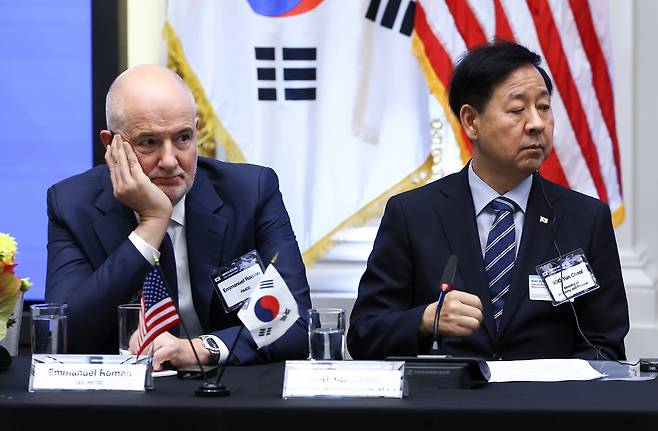
South Korea is poised to announce a new agreement reached in its foreign exchange consultations with the United States as early as next week, as all eyes are on whether the announcement could tame foreign exchange market fears, amid ongoing trade deal negotiations involving South Korea's $350 billion investment in the US.
Koo Yun-cheol, South Korea's deputy prime minister and finance minister, said Saturday upon his return from the US at Incheon Airport that South Korea "reached a settlement with the US on foreign exchange and is set to make an announcement soon."
Koo did not elaborate on the agreement, but presidential spokesperson Kang Yu-jung told reporters Sunday that the agreement is not related to ongoing talks on South Korea's proposal to establish new currency swap lines before it signs a deal to cut US tariffs on most South Korean goods from 25 percent to 15 percent in exchange for South Korea's $350 billion investment in US projects.
"As far as I know, there has been a (US) judgment that South Korea is not a currency manipulator," Kang said.
Japan, which has already signed a trade deal with the US, jointly reaffirmed with the US earlier in September that exchange rates must be market-determined and that manipulation of rates should be prevented.
As for a trade deal that could involve a significant foreign reserve outflow, Koo told reporters Saturday that he explained to his US counterpart, Treasury Secretary Scott Bessent, during a meeting in New York last week that a new currency swap deal must be reached for South Korea's upfront cash investment to be realistic.
Market jitters have emerged in South Korea since the revelation of differences in understanding between South Korea and the US over the $350 billion investment.
The South Korean won weakened over the past four trading days through Friday, with the dollar-to-won exchange rate reaching 1,412.4 won as of 3:30 p.m. Friday, the highest in over four months, since mid-May, according to Seoul Monetary Brokerage Services.
President Lee Jae Myung, during his US visit last week to attend the United Nations General Assembly, conveyed his stance to Bessent on Wednesday that talks over the trade deal must proceed in a way that is "commercially feasible" from Seoul's standpoint, according to Lee's office. This echoed his remarks in a recent interview with Reuters that South Korea would be doomed to a financial crisis similar to the one in 1997 if it concedes to the US demand for upfront cash investment in equity for most of the US projects Seoul commits to.
President Lee's national policy aide Kim Yong-beom also told reporters in New York on Wednesday that South Korea had sought to structure its US investments mostly as loans and guarantees, but was later faced with the demand for cash upfront.
But US President Donald Trump's remarks Thursday renewed the demand that cash should be paid upfront to get the trade deal done. "We have in Japan -- it's $550 billion, South Korea's $350 billion. That's upfront," Trump said.
Responding to Trump, Wi Sung-lac, Lee's national security adviser, told broadcaster Channel A in an interview on Saturday that South Korea's request concerning the trade deal is far from a bargaining tactic.
"We can't pay $350 billion in upfront cash. No one in South Korea doubts that ... We are trying to come up with an alternative, which is currently being arranged," Wi said, adding that the upcoming APEC Economic Leaders' Meeting in Gyeongju, North Gyeongsang Province, in late October, and Trump's possible attendance there, could be when the trade deal is finalized.
Copyright © 코리아헤럴드. 무단전재 및 재배포 금지.