China’s rare earth export controls threaten Korea’s auto and defense supply chain
전체 맥락을 이해하기 위해서는 본문 보기를 권장합니다.
Desperate to secure supplies, the company scoured the globe and recently identified a potential mine in Southeast Asia. But when it sought financing from a state-run bank to seal the deal, officials rejected the request, saying the company "lacked existing revenue from mining projects."
Industry observers warn that "if small suppliers fall, large corporations could be next."
이 글자크기로 변경됩니다.
(예시) 가장 빠른 뉴스가 있고 다양한 정보, 쌍방향 소통이 숨쉬는 다음뉴스를 만나보세요. 다음뉴스는 국내외 주요이슈와 실시간 속보, 문화생활 및 다양한 분야의 뉴스를 입체적으로 전달하고 있습니다.
![Workers use machinery to dig at a rare earth mine in Ganxian county in central China's Jiangxi province on Dec. 30, 2010. [AP/YONHAP]](https://img3.daumcdn.net/thumb/R658x0.q70/?fname=https://t1.daumcdn.net/news/202509/26/koreajoongangdaily/20250926173322805pibv.jpg)
A tightening Chinese chokehold on heavy rare earth exports is forcing Korean manufacturers to the brink, exposing cracks in Seoul's strategy to secure critical minerals.
Star Group Industry, a Daegu-based manufacturer of rare earth magnets, a type of permanent magnet, for EV motors, may have to suspend operations next month. Since Beijing imposed export controls on seven types of heavy rare earths on April 4, imports of key materials — namely dysprosium and terbium — have plunged. Over the past five months, the company imported only 2.5 percent of its needs, or 100 kilograms (220 pounds).
Desperate to secure supplies, the company scoured the globe and recently identified a potential mine in Southeast Asia. But when it sought financing from a state-run bank to seal the deal, officials rejected the request, saying the company "lacked existing revenue from mining projects."
"The government seems oblivious to how dire the situation is for companies like ours," an official said.
A small defense contractor in North Gyeongsang, meanwhile, is facing similar challenges. The firm produces samarium-cobalt magnets, which belong to the category of rare earth magnets, used in tank propulsion systems and radar for air defense interceptors — all critical components in Korea’s defense exports. With raw materials running low, the company is considering halting production. It has asked its major defense conglomerate client to cooperate on a joint response but has yet to receive an answer.
Industry observers warn that “if small suppliers fall, large corporations could be next.”
China's export curbs, now in their fifth month, are squeezing Korean firms that depend on these strategic minerals for EVs and defense production. Critics say the government has done little to intervene.
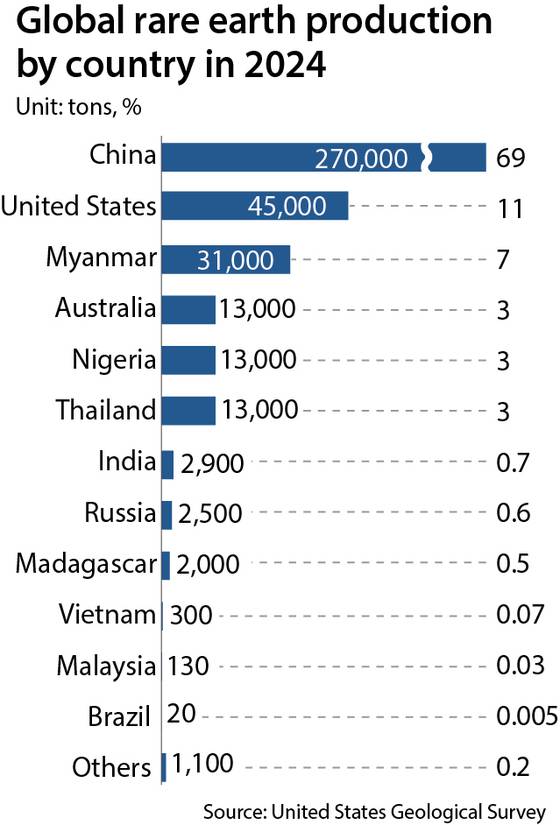
China’s dominance Beijing remains the undisputed giant in the global rare earth supply chain. Consulting firm AlixPartners estimates China accounts for 70 percent of global exports, 85 percent of refining capacity, and 90 percent of alloy production. For the seven heavy rare earths targeted under the new controls — samarium, gadolinium, terbium, dysprosium, lutetium, scandium, and yttrium — China supplies 97 percent of the world’s output.
Among them, dysprosium and terbium are crucial for maintaining the magnetic strength of neodymium magnets used in EV motors, while samarium is essential for samarium-cobalt magnets in military applications.
Kim Tae-hoon, a researcher at the Korea Institute of Materials Science, said Korea’s auto industry could stumble without a steady supply of heavy rare earths. Samarium ensures magnets retain their properties even under extreme heat — a must for defense systems.
Mounting supply chain pressure
![A mine operated by Serra Verde Mining in Minacu, Goias state, Brazil, pictured on July 28, produces rare earth elements, including neodymium, praseodymium, terbium and dysprosium which are essential for the production of permanent magnets. [AP/YONHAP]](https://img1.daumcdn.net/thumb/R658x0.q70/?fname=https://t1.daumcdn.net/news/202509/26/koreajoongangdaily/20250926173324248euay.jpg)
Korean firms say sourcing these materials has become increasingly difficult. Import volumes have plunged, and customs clearance — once completed in a week — now takes over two months.
Monthly rare earth exports fell from 7,742 tons in June to 5,994 tons in July and 5,791 tons in August, according to China’s General Administration of Customs.
The defense sector is equally strained. Many component suppliers have long relied on finished magnets imported from China, but those have been restricted since April. Companies now survive by applying for piecemeal export licenses.
Choi Gi-il, a professor of military studies at Sangji University, warned that a "full export ban from China could severely undermine Korea’s defense industry."
Small firms bear the brunt
Small- and medium-sized enterprises (SMEs) have been hit the hardest. Unlike large corporations, which stockpile rare earths, SMEs lack the capital to maintain reserves, leaving them exposed to immediate production disruptions. Suppliers say major corporations that source rare earth components from smaller firms fail to grasp the gravity of the situation.
One SME official said, "Big companies only care about delivery schedules and treat supply chain issues as 'your problem, not ours.'"
"With limited cash flow, smaller firms cannot weather prolonged export restrictions," the official said.
![This 2024 file photo provided by MP Materials shows an aerial view of the company's mine in Mountain Pass, California. [AP/YONHAP]](https://img3.daumcdn.net/thumb/R658x0.q70/?fname=https://t1.daumcdn.net/news/202509/26/koreajoongangdaily/20250926173325722tzml.jpg)
Despite mounting pressure, critics say the government's response remains inadequate. The Korea Mine Rehabilitation and Mineral Resources Corporation (KOMIR) holds modest rare earth reserves, but experts call them a stopgap measure. The government's 10 trillion won ($7.1 billion) supply chain stabilization fund, created last year, cannot directly invest in foreign mines. Meanwhile, KOMIR's authority to pursue overseas mining ventures has been constrained since controversies over resource diplomacy during the Lee Myung-bak administration.
In contrast, the United States and Japan are taking direct action. In July, the U.S. Department of Defense acquired a 15 percent stake in MP Materials, a major rare earth producer, to rebuild its domestic supply chain. Japan’s state-backed JOGMEC invested 200 million Australian dollars ($131 million) last year in Australia’s Mount Weld mine, securing preferential access to 65 percent of its output.
Kang Jung-shin, a professor of energy and mineral resources engineering at Seoul National University, said the Korean government must partner with state-run lenders and private investors to secure "at least a decade-long supply line through overseas mining investments."
"At the same time, there must be greater funding for next-generation magnet technologies that reduce rare earth dependence," Kang said.
This article was originally written in Korean and translated by a bilingual reporter with the help of generative AI tools. It was then edited by a native English-speaking editor. All AI-assisted translations are reviewed and refined by our newsroom. BY KIM HYO-SEONG,LEE SU-JEONG [kim.juyeon2@joongang.co.kr]
Copyright © 코리아중앙데일리. 무단전재 및 재배포 금지.
- Get ready to slay and play at 'KPop Demon Hunters' zone set to open at Everland
- Ukraine reluctant to send North Korean POWs to South, says unification minister
- Korea's oldest tiger-magpie painting goes on view at Leeum
- Pianist fined 1 million won for purchasing sex at massage parlor, court denies challenge over evidence
- Army officer sentenced to five years, six months for death of soldier during pack drill
- Korean President Lee rings the New York Stock Exchange opening bell, woos U.S. investors
- Korean Gen Z drifts to Galaxy as ‘young 40s’ cling to iPhone
- Korea Life Science Week 2025 to spotlight global bio, regenerative medicine innovation
- KakaoTalk redesign faces significant user backlash
- Former President Yoon attends court hearing for obstruction of official duties charges