Businesses forgo bank guarantees due to rising currency costs
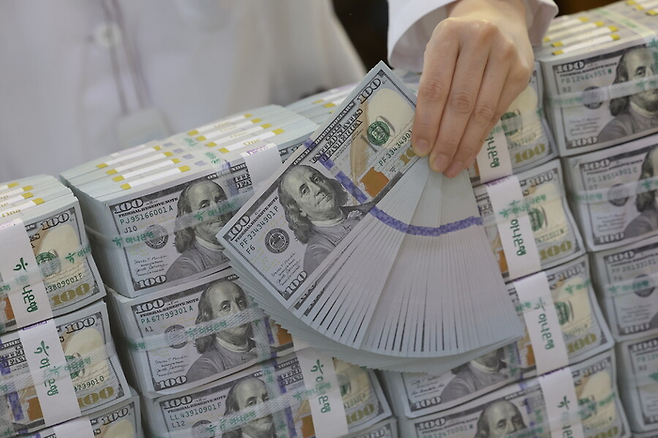
According to the country’s four major commercial banks on Monday, their combined outstanding balance of purchased foreign exchange stood at 15.7 trillion won ($11.26 billion) as of the first half of this year, down more than 10 percent from 17.52 trillion won at the end of last year.
The four banks are KB Kookmin, Shinhan, Hana, and Woori.
The figure has dropped by more than 8.5 trillion won compared with 24.22 trillion won in the first half of 2022.
Purchased foreign exchange is a type of foreign currency asset held by banks.
It increases when export companies, through letter of credit (L/C) transactions, use export bills of exchange from those trades to receive advance payment from banks.
L/C transactions are a form of trade where banks guarantee the creditworthiness of both exporters and importers, thereby reducing risk.
It is similar to a safe transaction on a secondhand goods platform, where the platform guarantees payment.
Importers are protected against the risk of not receiving goods, while exporters are protected against the risk of not receiving payment.
In this process, banks receive various fees in return for reducing exporters’ risks, with the largest share being discount charges - essentially prepaid interest - collected when banks pay exporters on behalf of importers in advance.
The sharp decline in purchased foreign exchange over the past three years is attributed directly to the fall in the value of the won.
When the won weakens, exporters must pay higher discount charges to receive advance payment from banks, since these charges are tied to U.S. dollar interest rates.
The won has depreciated from 1,298.4 won per dollar in the first half of 2022 to 1,376.7 won last year. The value plunged to 1,472.5 won at the end of last year amid the martial law crisis.
Though the exchange rate appeared to stabilize recently, it again threatened the 1,400 won level as of Monday.
The U.S. Federal Reserve’s steep rate hikes also contributed to the decline in L/C transactions.
Since discount charges are based on U.S. dollar interest, they rise in proportion to U.S. rates.
The Fed’s benchmark rate jumped from 0.25 percent at the end of 2021 to 4.5 percent at the end of 2022, and has remained high for three years.
For exporters, the combined pressure of a weaker won and high U.S. rates has made it increasingly difficult to engage in L/C transactions.
Banks, meanwhile, are worried about the shrinkage of their foreign currency assets.
Korean banks are seeking to expand globally - including ventures into stablecoins - and thus need more foreign currency assets than before.
Since won-denominated assets have limited utility in international business, they must increase their dollar-based holdings.
Given that coin issuers and fintech firms evaluate counterparties based on foreign currency assets, Korean banks’ negotiating power will inevitably weaken if their foreign currency asset base continues to erode.
Copyright © 매일경제 & mk.co.kr. 무단 전재, 재배포 및 AI학습 이용 금지
- 오늘의 운세 2025년 9월 23일 火(음력 8월 2일) - 매일경제
- “너무 못생겨서 못사겠다”…‘현대차 폭망’ 진짜 틀렸다, 기아도 멋짐 폭발 [최기성의 허브
- “바가지 논란에 폭망”…관광객 외면하는 속초 대포항, 어느 정도길래 - 매일경제
- 올해만 7번 우승했는데…‘배드민턴 최강’ 안세영, 얼마 벌었나 보니 - 매일경제
- “주식으로 돈 복사하기, 너무 쉽잖아?”…밥먹듯 주가 조작한 사회 엘리트들 - 매일경제
- 액상담배도 ‘담배’ 된다…합성 니코틴 법안 통과 땐 가격 인상 불가피 - 매일경제
- [단독] 근로기준법 확대에 자영업자 반발...“문 닫으란 얘기” 비용만 年3조원 - 매일경제
- “이번 추석엔 시댁 대신 여행”…가장 많이 찾은 명절 인기 여행지는? - 매일경제
- “서울서 6억 이하 아파트 찾기 쉽지않네”…10년새 81%→16% ‘뚝’ - 매일경제
- ‘성관계 몰카 촬영’ 황의조, 韓서 축구로 설 자리 없다…대한축구협회 “준 영구제명, 선수·