SK On completes pilot plant, fast-tracks all-solid-state battery to 2029
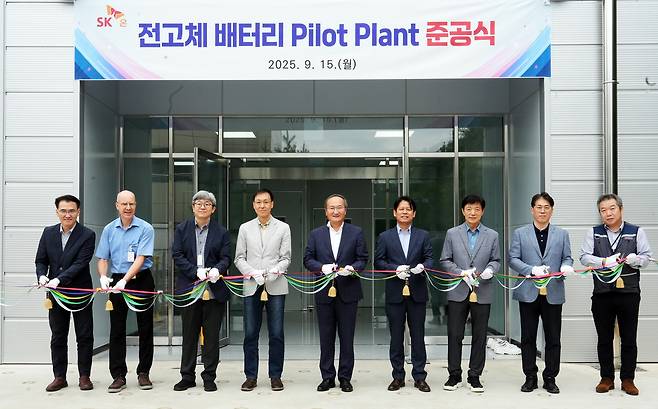
SK On said Tuesday that it has completed the construction of its pilot plant for the next-generation all-solid-state batteries, accelerating commercialization by one year to 2029.
All-solid-state battery cells are considered game-changers as they dramatically reduce the risk of battery explosion and electric vehicle fires compared to conventional lithium-ion battery products.
SK On held a completion ceremony Monday for its all-solid-state battery pilot plant at the Future Technology Institute in Daejeon. Attendees included SK On CEO and President Lee Seok-hee; Park Ki-soo, head of the institute; and Andrea Maier, head of Solid Power Korea, the company’s research partner.
Covering roughly 4,628 square meters, the pilot plant will produce prototypes for client companies, while serving as a testing ground to evaluate and verify product quality and performance before full-scale production.
SK On plans to develop sulfide-based all-solid-state batteries at the facility, while dedicating part of the line to lithium metal battery research and development. Lithium metal cells, a next-generation technology, replace the traditional graphite anode with lithium, reducing weight and volume to achieve higher energy density.
With this technological advancement, SK On now aims to commercialize all-solid-state batteries by 2029, earlier than its previous 2030 target. The company’s initial goal is to achieve an energy density of 800 watt-hours per liter, with a long-term target of 1,000 watt-hours per liter.
Notably, the battery maker has used its Warm Isostatic Press technology for the first time in Korea. The process applies uniform pressure to electrodes at 25–100 degrees Celsius, improving the density and performance of the battery cells.
While WIP technology reduces heat reactions and extends battery lifespan, it typically faces challenges with low productivity due to the need for sealed cells and limited automation capability. SK On overcame these drawbacks by implementing unique cell design techniques and combining WIP with conventional press processes, thereby preserving the technology’s advantages while boosting production efficiency.
The company optimized mixing techniques for active materials — key components that enhance battery performance — and conductive additives, which enhance charge rate and cycle stability. These improvements reduced internal resistance and heat generation.
Additionally, refining electrode–electrolyte bonding and press conditions lowered interfacial resistance, enabling smoother electricity flow, enhanced stability and longer battery life.
“The completion of this pilot plant is a crucial milestone for SK On to become a resilient company capable of overcoming any external challenges,” stated Lee. “We will lead the commercialization of all-solid-state batteries ahead of others and drive the acceleration of the electrification era.”
Copyright © 코리아헤럴드. 무단전재 및 재배포 금지.