Autonomous A2Z gears up for APEC debut, taking on Waymo, Tesla
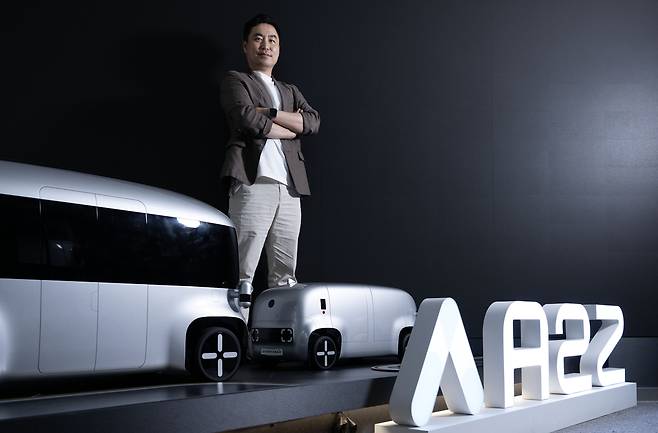
Who would have imagined that Autonomous A2Z, a startup with just 220 employees in South Korea, would rise to become the official operator of self-driving vehicles for the 2025 APEC summit?
From its humble beginnings in 2018, led by CEO Han Ji-hyeong and three colleagues who left Hyundai Motor Group, the company has quickly emerged as a global pioneer in Level 4 autonomous driving, competing head-on with tech giants Waymo and Tesla.
For the upcoming APEC summit, slated for Oct. 31–Nov. 1 in Gyeongju, North Gyeongsang Province, where leaders from economies including the US and China are expected to attend, Autonomous A2Z will deploy eight self-driving vehicles. These include Kia’s PV5 — Hyundai Motor Group’s first dedicated purpose-built vehicle — as well as A2Z’s own unstaffed shuttle, ROii, and a modified KG Mobility bus, all integrated with the company’s autonomous driving software.
“Our company holds Korea’s largest domestic record in autonomous driving, having logged more than 743,842 kilometers, and has validated safety through extensive trials with the general public. This proven technological capability and track record earned us higher scores compared to competitors,” said Han in a recent interview with The Korea Herald at the company’s research center in Pyeongchon, Gyeonggi Province.
Han added that more than 96 percent of the automotive parts used in its ROii were sourced locally, aligning with the city of Gyeongju and the Ministry of Transport’s push to showcase autonomous vehicles developed predominantly with domestic technology.
Autonomous A2Z is also emerging as a key partner for Kia, with plans to expand collaboration into global markets such as Singapore, the United Arab Emirates and Japan.
Han stressed that leadership in autonomous driving requires deep collaboration between software providers like Autonomous A2Z and automakers. Most carmakers retrofit autonomous systems onto existing models, which often limits software performance and compatibility.
“This is because vehicle hardware was engineered for human drivers, not for the specific demands of autonomous software,” Han explained. “As a result, software firms often resort to reverse engineering vehicle systems. But this caps efficiency at 80 to 90 percent.”
By contrast, Kia’s purpose-built PV5 was designed from the ground up for autonomous integration. Kia has signed a vehicle supply partnership with Autonomous A2Z, ensuring that A2Z’s autonomous driving software is integrated into the PV5.
Autonomous A2Z has already gained international recognition.
In 2024, it ranked 11th on the Automated Driving Leaderboard by Virginia-based research firm Guidehouse as the only Korean company in the top 20 — ahead of Tesla, which ranked 20th.
While acknowledging Waymo and Tesla for their progress in autonomous passenger vehicles, Han said Autonomous A2Z is targeting countries that need unstaffed public transit solutions. Compact urban markets like Korea and Singapore, equipped with dense smart infrastructure such as surveillance camera networks, provide fertile ground for safer and more reliable autonomous driving.
Singapore has become a strategic hub. In 2024, Autonomous A2Z formed a joint venture with Kilsa Global and, in July, partnered with Grab to launch a Level 4 autonomous shuttle service — capable of operating without human intervention in most conditions.
Other key markets include the UAE, where driverless mobility is a pillar of smart city projects, and Japan, which is facing a shortage of 20,000 bus drivers by 2030. To address this, Japan plans to deploy 20,000-30,000 autonomous shuttles across rural areas by the end of the decade. Europe, too, is in Autonomous A2Z’s sights, as its aging population and high labor costs increase demand for safe, adaptable autonomous technology.
With artificial intelligence advancing rapidly, Autonomous A2Z, Waymo and Tesla are all adopting hybrid systems that combine end-to-end deep learning with rule-based safety controls. But Han argued Autonomous A2Z’s approach is safer and more adaptable.
“Tesla’s FSD (full self-driving) assumes a human is always there to supervise, relying mainly on camera-based AI,” he said. “Our system targets fully driverless operation from the start, integrating cameras, radar, lidar and infrastructure support to prevent accidents.”
Compared with Waymo, whose software is tied to only a handful of vehicle models, Autonomous A2Z has tested its platform on 13 models, from compact electric vehicles to shuttles and buses. This unified software platform is currently the most versatile in the industry, Han said.
Han also urged the Korean government to play a stronger role. “Uncertainty about profitability is deterring private investment. If the government signals support through subsidies or public procurement, investment will follow,” he said. "This is the most critical issue right now."
In line with Seoul’s commercialization initiative, Autonomous A2Z plans to launch the ROii shuttle bus by early 2026, supplying over 40 pilot zones nationwide. The company has already raised 82 billion won ($59.1 million) in cumulative investments and is preparing for a Kosdaq listing next year.
Copyright © 코리아헤럴드. 무단전재 및 재배포 금지.