Rewriting Shim Cheong as requiem for sacrificed daughters
전체 맥락을 이해하기 위해서는 본문 보기를 권장합니다.
But in the hands of Germany-based opera director Yona Kim, the story has taken on a daringly fresh life — bold, provocative and, by some measures, "controversial."
And Kim was clear from the start: "There is no fantasy or romance here. The original happy ending, in which Shim returns from the underwater to become queen, is gone."
이 글자크기로 변경됩니다.
(예시) 가장 빠른 뉴스가 있고 다양한 정보, 쌍방향 소통이 숨쉬는 다음뉴스를 만나보세요. 다음뉴스는 국내외 주요이슈와 실시간 속보, 문화생활 및 다양한 분야의 뉴스를 입체적으로 전달하고 있습니다.
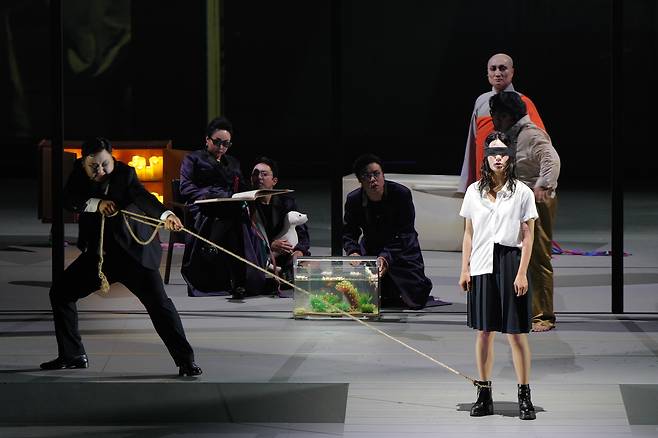
In Korean folklore, Shim Cheong is the very embodiment of filial devotion — so much so that she is often called “hyonyeo (filial daughter) Sim Cheong.” In the tale, she sells herself to sailors as a human sacrifice to calm the sea, the payment in rice to be offered to Buddha so that her blind father might see again.
The story takes a miraculous turn: Moved by her filial piety, the Dragon King of the Sea saves her, sending her back to the surface in a lotus blossom. She is discovered by a king who falls in love, the two marry, and at their royal banquet, Shim is reunited with her father, whose sight is restored. It is also one of only five surviving pansori epics.
For centuries, this tale of filial devotion and selfless sacrifice has been retold many times on stage and screen.
But in the hands of Germany-based opera director Yona Kim, the story has taken on a daringly fresh life — bold, provocative and, by some measures, “controversial."
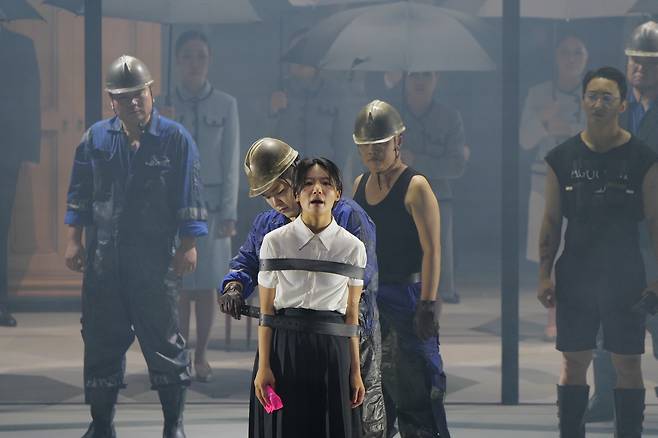
Kim's new staging, “Pansori Theater Shim Cheong,” co-produced by the National Changgeuk Company of Korea and the Jeonju International Sori Festival, was met with cheers and a standing ovation when it premiered on Aug. 13 in Jeonju. But some 70 audience members walked out, with some traditional gugak masters and pansori enthusiasts expressing bewilderment at the new interpretation of the beloved "filial daughter."
The same production will get a Seoul run from Wednesday through Sunday at the National Theater of Korea.
The production, which took three years to complete at a cost of 1 billion won ($718,900), had already generated high anticipation, not least because acclaimed opera director Kim — resident director of Germany’s Mannheim National Theatre — both adapted the text and directed the piece. Several of her longtime European collaborators on the creative team also joined the project.
And Kim was clear from the start: “There is no fantasy or romance here. The original happy ending, in which Shim returns from the underwater to become queen, is gone.”
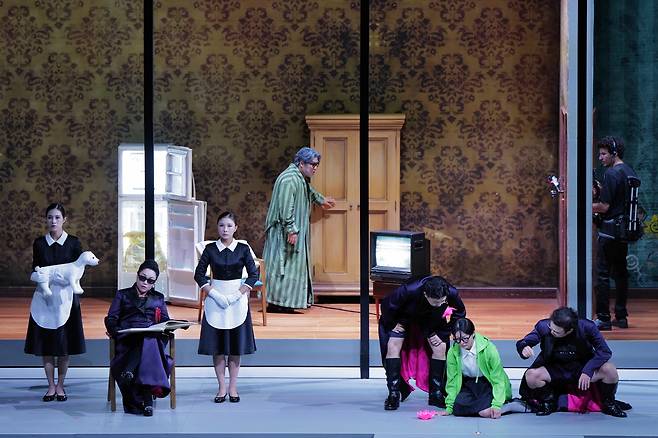
During the premiere, the curtain hadn’t even risen before some 60 young girls rushed to the stage and then turned back to run outside, screaming — a jarring prelude that immediately shattered any fairy-tale expectations. The action then shifted to a modern setting, furnished with a TV and refrigerators.
Gone is the passive, obedient heroine. Kim’s Shim Cheong resists. She grabs her sleeping father by the throat, writhing in anguish at the sacrifices he has forced upon her. She embodies not only the plight of daughters compelled into sacrifice but also the countless victims of societal violence, echoing the doomed daughters of Greek tragedy: Electra, Antigone and Cassandra.
In Kim’s version, Shim is driven to the sea by neglect, abuse and indifference. The father, long pitied as a helpless blind man, is revealed to be selfish and abusive, more concerned with his mistress than his child. In one wrenching reversal, the audience gasps as he hurls aside the baby in his arms. What might once have been a comic villain in the traditional tale becomes a predator. Madame Bbaengdeok delivers Shim to a high official’s household, where she is exploited by her sons.
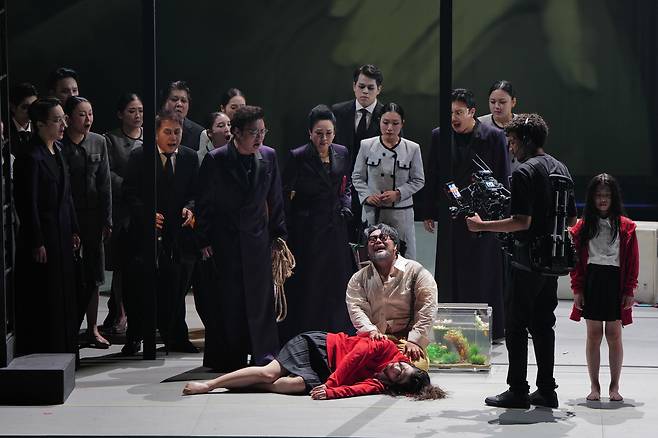
The pansori lyrics remain exactly the same, but under Kim’s staging and the actors’ performances, the story is reinterpreted from an entirely new perspective in a different context.
“I see it as my task to change the context of the story. While preserving the emotional intensity of the music, I placed those moments in unfamiliar settings,” Kim said.
For Kim, the most significant aspect of her adaptation is the bold removal of the fantasy and romance in the latter part of the folk tale — the traditional notion that Shim is rewarded for her suffering by becoming queen and finding glory and happiness.
Kim noted that the fantastical elements of the original tale can be seen as stemming from collective guilt over the girl’s sacrifice.
“This work is a requiem for the countless unnamed victims, especially daughters, who died in silence. It is because of all these Shim Cheongs that we can undertake a project like this in the 21st century,” she said.
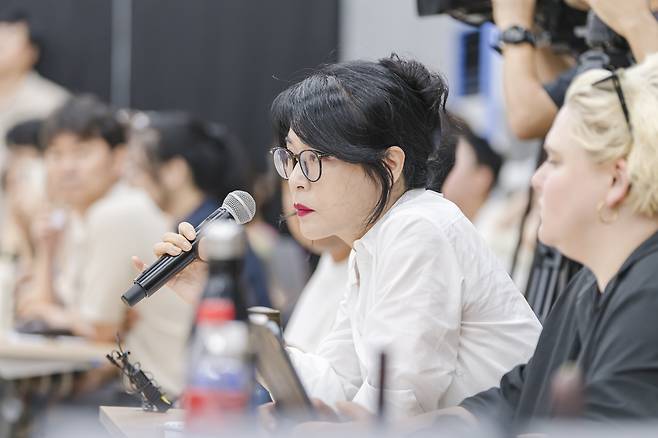
Rather than following the traditional moralistic structure in which everyone is redeemed through Shim’s sacrifice, Kim’s adaptation focuses on the individual flaws and deficiencies of each character.
“The blind father is consumed by self-pity; Shim Cheong is driven by blind filial devotion; and Madame Bbaengdeok is blinded by greed,” Kim explained. “I wanted to pose the question: Aren’t we all, in some way, blinded by something?”
The production marshals a cast of 157, including dancers, child actors and a chorus. Live cameras capture performers’ expressions in real time, projecting them onto screens in cinematic fashion, while the staging weaves metaphors and symbols in a visual language reminiscent of a thriller or a horror film.
“Pansori Theater Shim Cheong” runs Wednesday to Sunday, with English subtitles available on screens positioned on both sides of the stage.
Copyright © 코리아헤럴드. 무단전재 및 재배포 금지.