Gangneung enforces strict water limits
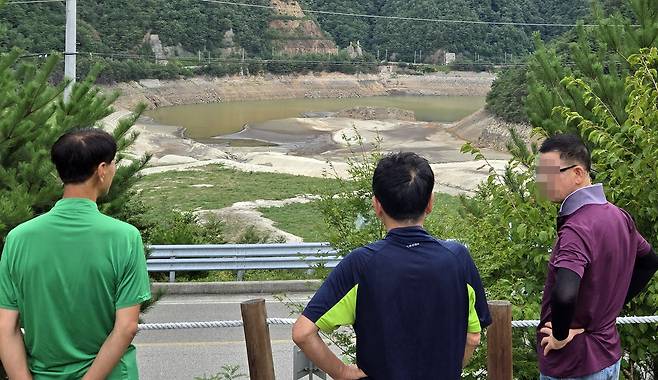
The South Korean government has stepped up emergency drought measures in Gangneung, Gangwon Province, as the city’s main source of tap and industrial water continues to fall to record lows daily, forcing its citizens to endure strict water restrictions.
According to the Ministry of Interior and Safety on Tuesday, the water storage level at the Obong Reservoir — which supplies nearly 87 percent of the city’s household water — fell to 14.2 percent as of Tuesday afternoon, down 0.5 percentage point from a day earlier.
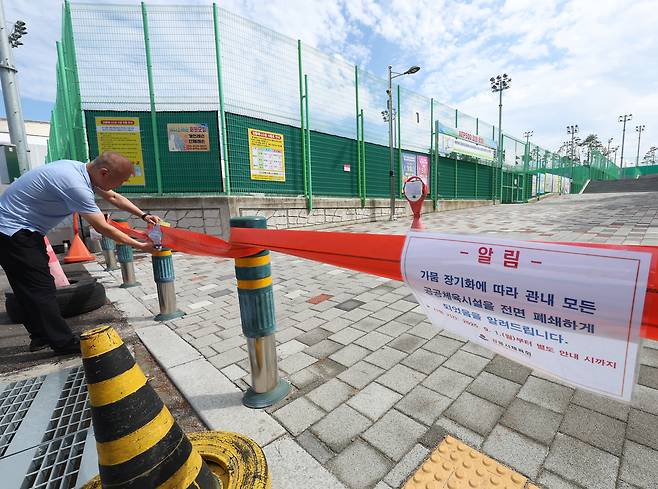
The decline prompted authorities to escalate restrictions, including partially shutting off household meters by 75 percent, closing access to 47 public restrooms and halting operations at three public swimming pools. According to the Gangneung city government, the city began shutting off household meters by 50 percent on Aug. 20.
To coordinate relief efforts, the government has mobilized an interagency emergency response task force dedicated to handling drought conditions, comprising the Interior Ministry, the Environment Ministry, the Gangwon provincial government and the Gangneung city government.
The task force was formed after President Lee Jae Myung declared a “state of national disaster” on Aug. 30, which enabled the central government to mobilize all relevant manpower and resources nationwide to aid the city in drought relief. The declaration also raised the government’s emergency response posture to Level 2 under the Central Disaster and Safety Countermeasures Headquarters’ system.
In Korea, a Level 2 response entails the full-scale mobilization of all administrative resources, with the provincial vice governor serving as the head of the headquarters.
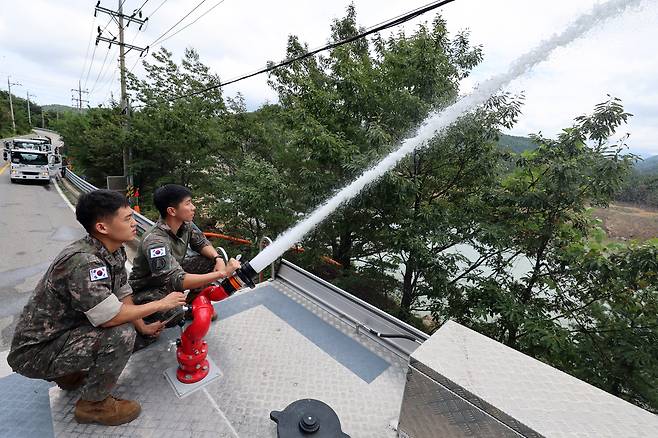
As of Tuesday, authorities have deployed 112 vehicles to tackle the city’s water shortage issue, including 71 fire department water tankers and four military water tankers, to deliver up to 5,071 metric tons of water to Obong Reservoir and Hongje Water Purification Plant.
An additional 20,000 tons of alternative water sources have also been secured, including 5,000 tons of underground water in Gangneung and 1,800 tons of water from nearby cities, including Hongcheon, Jeongseon and Taebaek.
Meanwhile, 1.41 million bottles of water have been stockpiled for vulnerable groups such as senior citizens. Of those, 283,433 bottles have already been distributed to schools and welfare facilities, with plans to expand the distribution to the general public.
Gangneung’s drought marks the first time a state of national disaster has been declared due to a natural disaster. Until now, such declarations were limited to social disasters, such as the Goseong wildfire in 2019 and the Uljin-Samcheok forest fire in 2022.
Despite recent government measures, what Gangneung urgently needs for drought relief is heavy rain. Yet the outlook remains bleak, with no rain forecast for the next 10 days.
While much of the country saw heavy downpours of 80 to 100 millimeters through Tuesday, Gangneung recorded less than 5 mm — far below what is needed to ease the city’s drought. According to Korea Meteorological Administration records, the city received just over 400 mm of rainfall over the past six months, only 40 percent of the long-term average. If conditions persist, officials warn the Obong Reservoir could run dry by the end of September.
With no significant rain forecast through early September, authorities are scrambling to identify backup supplies, including tapping nearby rivers and exploring the use of Pyeongchang’s Doam Dam, which holds 30 million tons of water. However, concerns regarding its water quality as well as long-running disputes over interregional use have delayed its adoption.
Copyright © 코리아헤럴드. 무단전재 및 재배포 금지.