Rerating momentum set to lift Korean banking stocks, says CLSA analyst
전체 맥락을 이해하기 위해서는 본문 보기를 권장합니다.
"I was in the US when the policy was announced, and I was bombarded with calls asking whether it was real," Shim recalled. "Interest was intense, but skepticism lingered. People doubted whether Korean regulators would really change."
"The additions complete Woori's portfolio and ease structural weaknesses in non-banking," Shim said. "It's only a matter of time before Woori closes its roughly 30 percent valuation discount with leading peers."
이 글자크기로 변경됩니다.
(예시) 가장 빠른 뉴스가 있고 다양한 정보, 쌍방향 소통이 숨쉬는 다음뉴스를 만나보세요. 다음뉴스는 국내외 주요이슈와 실시간 속보, 문화생활 및 다양한 분야의 뉴스를 입체적으로 전달하고 있습니다.
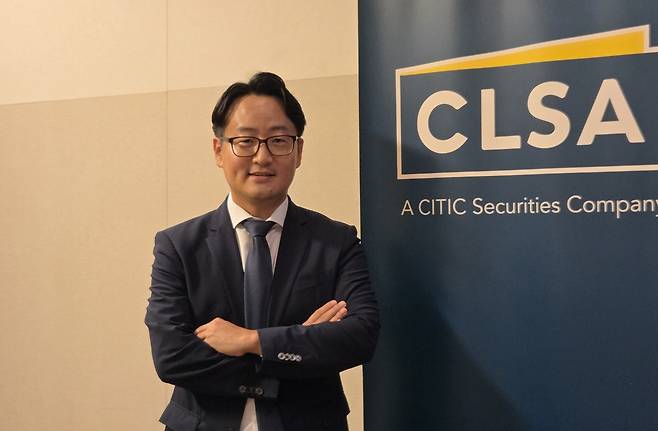
Rerating momentum in Korean banking stocks is far from over and could lift valuations to a price-to-book ratio of 1 within the next two to three years, according to Shim Jong-min, deputy head of Korea research at Hong Kong-headquartered CLSA.
In an interview with The Korea Herald in Seoul last week, Shim said the sharp rally in Korea’s four major lenders — KB, Shinhan, Hana and Woori — has been meaningful but still short of the rerating they deserve. Shares of the banking groups have surged about 40 percent over the past 18 months, yet Shim called the move “only an early step toward value normalization.”
The real catalyst, he argued, was the government’s value-up initiative launched in February 2024 to address the so-called “Korea discount.” The program encouraged companies to boost shareholder returns and transparency, and financial groups were among the first to respond thanks to stronger fundamentals.
“I was in the US when the policy was announced, and I was bombarded with calls asking whether it was real,” Shim recalled. “Interest was intense, but skepticism lingered. People doubted whether Korean regulators would really change.”
The doubts faded as regulators followed through with clearer capital rules, including a 13 percent Common Equity Tier 1 guideline, and took investor roadshows overseas.
“In the past, even what counted as ‘too low’ on CET1 was vague — a major risk for foreign investors. The new clarity gave the final green light for them to move into banks,” Shim said.
At the start of the policy rollout, many overseas investors said they would exit KB Financial once its PBR rose from 0.5 to 0.6. But with the ratio now at about 0.68, foreign investors are still holding. Their stake in KB has climbed nearly 4 percentage points to 77.6 percent, making KB the most foreign-owned of the big four. Its stock has nearly doubled from its trough, with peers not far behind.
Among the top four, Shim sees Woori Financial as offering the most upside. Its full privatization last year removed a longstanding government overhang that had discouraged foreign participation. At the same time, the group has expanded into brokerage and insurance by launching Woori Investment & Securities and acquiring Tongyang Life and ABL in July.
“The additions complete Woori’s portfolio and ease structural weaknesses in non-banking,” Shim said. “It’s only a matter of time before Woori closes its roughly 30 percent valuation discount with leading peers.”
Still, challenges remain. Competing in Korea’s crowded brokerage market won’t be easy, he warned, particularly if the bank’s culture weighs too heavily on the subsidiary. “It’s like telling an Italian restaurant to sell only Korean food,” he said. For insurance, a brand-driven business, Woori should focus on cross-selling and bolstering brand recognition.
Even before these new businesses deliver, rerating is underway. Foreign ownership of Woori, still the lowest among the four, has jumped nearly 10 percentage points since early 2024 to 47 percent — the biggest gain in the sector.
Woori’s key task now is raising its CET1 ratio to the 13 percent benchmark, which would give it more room to expand shareholder payouts. The group’s current payout target is 40 percent, below the 50 percent pledged by KB, Shinhan and Hana. But its CET1 has already risen more than 0.6 point this year to 12.76 percent, a faster-than-expected gain. “It’s impressive they’re proving it with numbers, not just words,” Shim said.
Beyond balance sheets, leadership stability is just as critical, he added. “In the end, it’s all about people. Investors track what executives say over time and compare it with outcomes. They dislike frequent or unnecessary changes at the top.”
Shim pointed to KB’s premium valuation as an example, crediting former chair Yoon Jong-koo, who built trust through more than a decade of consistent strategy, aggressive mergers and acquisitions, and regular engagement with global investors.
Attention now turns to Woori, where Chair Yim Jong-yong’s term ends in March. Shim said the market has viewed Yim positively, praising his rational, market-friendly approach. “Continuity is critical. Shareholders don’t want capable executives replaced,” he said.
Copyright © 코리아헤럴드. 무단전재 및 재배포 금지.