Watery tomb of the king who returned as a dragon to protect the nation
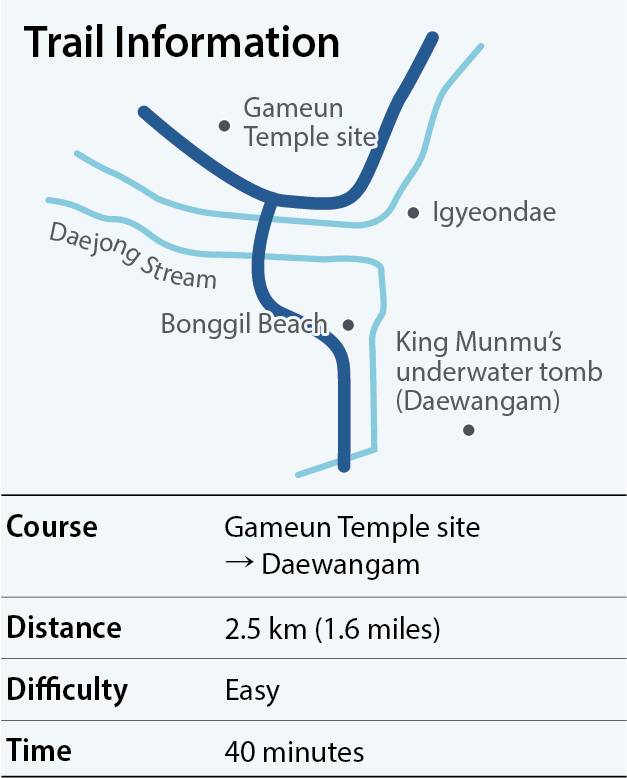
Just beyond the shore of Gampo in Yangbuk-myeon (renamed Munmudaewang-myeon in 2021) lies one of Gyeongju’s most captivating sights: the rocky islet known as Daewangam, said to be the underwater tomb of King Munmu the Great (reign: 661–681).
According to legend, it is where the monarch’s remains were scattered, in accordance with his own wishes. According to the 12th-century history text "Samguk Sagi," the king was clear about this:
“To waste wealth in vain would be subject to criticism in history, and to exhaust the people’s labor would be beyond redemption. This is not what I desire. Ten days after my death, prepare my body according to Buddhist rites, and conduct the funeral with utmost simplicity.”
He is also remembered for another vow. According to another history text, the 13th-century "Samguk Yusa," he said:
“I will become a dragon after death and protect the country.”
![King Munmu's ashes was scattered in the waters around Daewangam. [LEE SO-YOON]](https://img1.daumcdn.net/thumb/R658x0.q70/?fname=https://t1.daumcdn.net/news/202510/30/koreajoongangdaily/20251030171527763bmfd.jpg)
True to these final words, his son and court cremated his body and scattered the ashes in the waters around Daewangam. Crown Prince Sinmun built Gamsun Temple nearby and opened a waterway for the dragon king to pass through. To this day, King Munmu remains one of the most dramatic and enigmatic figures in Silla history (57 B.C. to A.D. 935).
A general’s mind, a monarch’s resolve
King Munmu’s legacy is often overshadowed by his father, King Taejong Muyeol — celebrated as the unifier of the Three Kingdoms. Though Taejong Muyeol was not born of royal blood, his strategic alliances and military leadership earned him posthumous honor as a national hero. Another pillar of the era, General Kim Yushin, also received kingly recognition despite lacking royal lineage. Their achievements are rightly celebrated — but the man who brought their vision to completion was King Munmu.
Crowned in 661, a year after Baekje’s fall, Munmu assumed the throne at a pivotal moment. The wars to unify the peninsula were underway, but his father had died just as victory over Baekje was secured. It was the young Crown Prince Munmu, alongside Kim Yushin, who led the final assault.
In 668, they defeated Goguryeo. On paper, the Three Kingdoms were unified — but the Tang Dynasty, having aided Silla militarily, now sought to exert direct control over the peninsula. In 673, just three years after Kim Yushin’s death, Munmu drove out Tang forces and secured full sovereignty.
His posthumous name, Munmu — meaning “civil and martial” — reflected both intellect and battlefield acumen. Raised as a Hwarang, the elite warrior youth of Silla, he mastered not only the tactics of war but also the delicate art of diplomacy. He had absorbed the grand strategy of his father and the military philosophy of his uncle. After their deaths, he stood alone and victorious.
![Dawn at Daewangam, underwater tomb of King Munmu [LEE SO-YOON]](https://img4.daumcdn.net/thumb/R658x0.q70/?fname=https://t1.daumcdn.net/news/202510/30/koreajoongangdaily/20251030171529951ckoo.jpg)
The royal funeral that broke with tradition
King Munmu’s decision to be cremated marked a dramatic departure from centuries of royal custom. Silla kings were typically laid to rest in monumental mounds that still dot the landscape of Gyeongju. Munmu, however, sought none of that. He asked for a modest ceremony and a Buddhist cremation, citing a desire to spare his people hardship.
The timing of his death was delicate. It came just five years after Silla’s hard-fought victory over the Tang Dynasty. The kingdom was still reeling from the aftermath of unification. Resistance movements by Baekje and Goguryeo loyalists persisted. The populace was weary from decades of war, even as they basked in the glow of national triumph.
And then the king, who had secured true unification, suddenly fell ill. His final act was profound: to forgo a grand burial and offer himself to the sea instead.
![The sacred hill of Nangsan, seen from the sky. [LEE SO-YOON]](https://img1.daumcdn.net/thumb/R658x0.q70/?fname=https://t1.daumcdn.net/news/202510/30/koreajoongangdaily/20251030171532121pngm.jpg)
Munmu was cremated at Nangsan, a sacred hill at the heart of Gyeongju long revered as the cradle of the capital. Queen Seondeok’s tomb rests there, and next to it stands an unusual structure known as Nungjitap.
Rectangular in plan, it mirrors the scale of royal tombs but resembles a stone pagoda more than a burial mound. Intriguingly, the twelve zodiac animal statues surrounding it are more intricate and lifelike than those at Kim Yushin’s tomb. This was no ordinary pyre — it was a royal crematorium, built in defiance of centuries of tradition. In the heart of Seorabeol, as Gyeongju was called back then, the king was returned to ash before the eyes of his people.
![The Neungjitap. [LEE SO-YOON]](https://img4.daumcdn.net/thumb/R658x0.q70/?fname=https://t1.daumcdn.net/news/202510/30/koreajoongangdaily/20251030171534327fgyu.jpg)
The dragon’s final move
Why did King Munmu refuse burial alongside his ancestors? Why scatter his remains in the sea?
Perhaps he feared that, should foreign threats rise again, his tomb might become a target. Maybe he hoped that by dissolving into land and water, he would become inseparable from the kingdom itself — impossible to conquer.
During his reign, Munmu carefully avoided formal diplomatic ties with the Tang Dynasty, while still permitting private trade. He knew Tang politics better than any Silla king. When Tang attempted to depose him and install his younger brother, Kim Inmun, Munmu instead welcomed him back to Silla with an esteemed court post, neutralizing the threat. The Tang court may well have seen Munmu’s death as an opening to reassert dominance.
But Munmu’s final act defied them once again. By proclaiming that he would become a dragon and guard Korea from foreign invasion, he ignited patriotic sentiment and anti-Tang vigilance. Even his death was weaponized in defense of Silla’s autonomy.
Soon after, the Tang Dynasty was consumed by internal unrest. Empress Wu Zetian rose to power, and the empire’s attention shifted elsewhere. Silla endured the moment — and the legacy of its dragon king endured with it.
Ashes that anchored a nation
Founding a kingdom takes generations; losing one can take only moments. King Munmu understood this. He knew that without symbolic leadership — even in death — the dream of unification could unravel. His choice to reject Tang suzerainty and bind himself to the land through ritual and story was nothing short of brilliant.
Munmu’s ashes became a national altar. His watery tomb became a mythic space. And his leadership — as a shrewd monarch who saw through the illusions of empire — remains one of the finest examples of statecraft in Korea’s long history.
If you wish to understand King Munmu not just as a king but as a strategist, reformer and visionary, begin not at the coast but inland. Before visiting the rocky waters of Daewangam, stand first on Nangsan before the remains of the stone tower Neungjitap. There, where the flames returned him to the earth, you may glimpse the measure of the monarch who became the sea.
Sponsored by Gyeongju
Copyright © 코리아중앙데일리. 무단전재 및 재배포 금지.
- BTS to hold 65 shows, over 30 in North America, for 2026 tour: Bloomberg
- Teenage NewJeans fan transferred to juvenile court after illegally fundraising on group's behalf
- EXO whole once more, as subunit agrees to SM Entertainment's conditions
- Hospital that wouldn't perform C-section ordered to compensate family after baby born with disability
- LIVE: Trump departs Korea as Xi joins world leaders in Gyeongju
- Seoul court rules in favor of ADOR in NewJeans contract dispute
- Korea, U.S. finalize bilateral trade deal, agree on $350 billion investment details
- Protestors demonstrate in front of Trump's hotel in Gyeongju, dispersed by police
- China claims J-20 stealth fighter flew over Eastern Channel undetected, exposes Korea's outdated radars
- BTS's RM urges APEC leaders to support creators, cites 'borderless solidarity' as key to band's breakthrough