President Lee reaffirms ‘two-track diplomacy’: Confronting history while pursuing cooperation with Japan
이 글자크기로 변경됩니다.
(예시) 가장 빠른 뉴스가 있고 다양한 정보, 쌍방향 소통이 숨쉬는 다음뉴스를 만나보세요. 다음뉴스는 국내외 주요이슈와 실시간 속보, 문화생활 및 다양한 분야의 뉴스를 입체적으로 전달하고 있습니다.
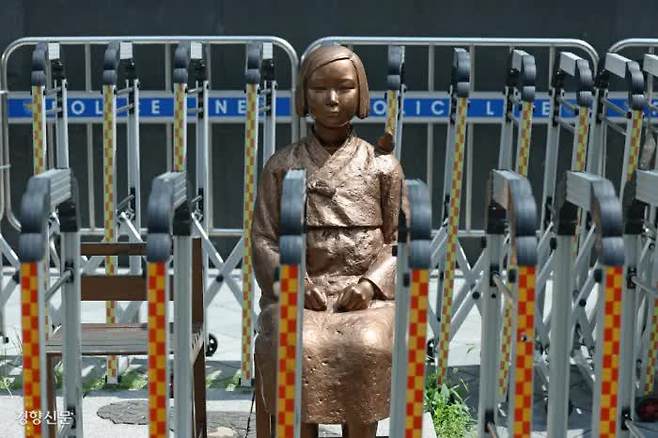
President Lee Jae-myung’s remarks on August 21 that past agreements between conservative governments of Korea and Japan on the issues of wartime “comfort women” for Japanese soldiers and forced labor compensation should not be overturned, since they are bilateral commitments, are being interpreted as a signal of his intent to actively pursue economic cooperation with Japan in line with his principle of pragmatic diplomacy. Following his Liberation Day address on August 15 and two days before the upcoming Korea-Japan summit, Lee reaffirmed his “two-track” approach to Tokyo, saying, “We must face history squarely while also exercising the wisdom to move forward into the future,” thus making clear the separation of historical issues and practical cooperation.
In an interview published the same day in Japan’s Yomiuri Shimbun, President Lee said, “Trust and consistency of policy are essential principles in state-to-state relations,” adding, “Our government’s position remains unchanged that agreements formally concluded between the two governments must be respected.”
In 2015, the Park Geun-hye administration reached an agreement with then–Prime Minister Shinzo Abe’s government, declaring the final and irreversible resolution of the wartime “comfort women” issue. Under the deal, the Korean government received 1 billion yen in contributions from Japan to fund the Reconciliation and Healing Foundation. In 2023, the Yoon Suk-yeol administration proposed a “third-party compensation plan” to resolve lawsuits filed by victims of wartime forced labor, under which a government-affiliated foundation in Seoul would provide payments in place of Japanese defendant companies.
Lee’s remarks are seen as emphasizing that future cooperation should be developed on the foundation of honoring such past commitments between the two countries.
At the same time, Lee also pointed out flaws and limitations in the earlier agreements. He described them as “agreements made by previous administrations that the Korean people found very difficult to accept,” stressing that “historical issues are matters of deep sentiment, and a process of reconciliation is needed to resolve long-standing grievances.” His comments suggest that stressing future-oriented cooperation does not mean brushing aside the past but rather confronting it honestly. Lee added, “An apology should be made sincerely until the wounds of the victims are healed,” and “we must work together to find solutions.” With this in mind, attention is turning to what remarks Japanese Prime Minister Shigeru Ishiba will make at the upcoming summit, after he became the first Japanese leader in 13 years to mention “remorse” in his August 15 speech marking the 80th anniversary of Japan’s defeat in World War II.
President Lee also underlined the importance of future-focused economic and trade cooperation. “We need to build an unprecedented level of economic partnership that goes beyond what we have achieved so far,” he said. He further suggested, “It is time to seriously discuss establishing a firm economic cooperation framework among Pacific Rim countries, including East Asia,” a statement widely interpreted as leaving open the possibility of Korea joining the Comprehensive and Progressive Agreement for Trans-Pacific Partnership (CPTPP), which is led by Japan.
Lee praised the joint declaration made between then Japanese Prime Minister Keizo Obuchi and then Korean President Kim Dae-jung in 1998, saying, “I hope we can carry on that declaration and announce a new joint declaration that goes beyond it.” However, given the limited preparation time for the summit, many observers believe the two leaders may not adopt a new declaration this time but could reach agreement in principle on pursuing one in the future.
※This article was translated by an AI tool and edited by a professional translator.
Copyright © 경향신문. 무단전재 및 재배포 금지.
- [속보]경찰 ‘이 대통령 가덕도 테러 축소’ 김상민 전 검사 송치···“배후 세력은 확인 안 돼
- 아르헨 선수들, 잉글랜드전 승리 뒤 ‘포클랜드는 우리 땅’ 현수막 논란···FIFA 조사 나서나
- 이세돌의 복기 “AI 활용 논쟁 3년 뒤 사라져…결국 신념과 철학 싸움”
- “남편을 데리러 왔습니다”…수천km를 건너온 아내의 마지막 배웅
- 막판 7분 2도움 ‘메시가 또 해냈다’···‘늑대축구’ 아르헨티나, 잉글랜드에 2 대 1 ‘대역전
- ‘통일교 1억 수수’ 권성동 징역 2년 확정…의원직 상실
- IBK기업은행 해외 법인서 800억원대 금융사고···“외부인 사기”
- 1400명 살린 ‘하늘의 응급실’ 충남 닥터헬기, 더 크고 강해진다
- 트럼프 “미 해군 재건 위해 군함 많이 필요”···콕 집어 “한국 기업과 협력”
- [이진송의 아니 근데]‘~노’체 논쟁의 불편한 진실…사투리가 된 혐오, 혐오가 된 사투리