President Lee directs step-by-step implementation of Sept. 19 Inter-Korean Military Agreement
이 글자크기로 변경됩니다.
(예시) 가장 빠른 뉴스가 있고 다양한 정보, 쌍방향 소통이 숨쉬는 다음뉴스를 만나보세요. 다음뉴스는 국내외 주요이슈와 실시간 속보, 문화생활 및 다양한 분야의 뉴스를 입체적으로 전달하고 있습니다.
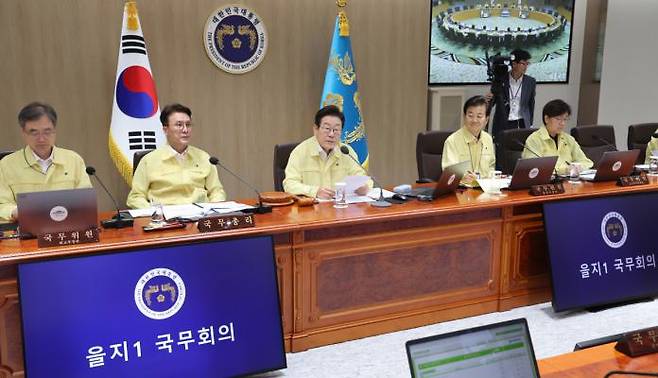
President Lee Jae-myung on August 18 instructed government ministries to “prepare for the gradual implementation of existing inter-Korean agreements starting with what is feasible.” The directive goes a step beyond his Liberation Day address, where he pledged to “proactively and incrementally restore the September 19 Inter-Korean Military Agreement.” Observers see it as a signal of the government’s stronger commitment to easing tensions on the Korean Peninsula. Possible measures under review include halting military drills in buffer zones near the border and reestablishing no-fly zones over the Military Demarcation Line (MDL).
Chairing a full session of the National Security Council (NSC) at the presidential office in Yongsan, Seoul, Lee stressed the importance of inter-Korean relations in a rapidly shifting international environment. “To safeguard Korea’s national interests and expand our diplomatic space, ties with the North are critically important,” he said.
“Real security means preserving peace,” Lee continued. “It is better to win without fighting than to win through conflict, but the most reliable security is a state of peace where fighting is unnecessary. What we need now is the courage to steadily take steps to reduce tensions while maintaining an unshakable defense posture. Small acts of implementation, like pebbles stacking up, will help restore mutual trust, widen the path to peace, and lay the foundation for shared prosperity between South and North.”
Lee also emphasized that the joint South Korea–U.S. military exercise “Ulchi Freedom Shield (UFS),” which began the same day, is defensive in nature. He made clear that “Seoul has no intention of attacking the North or escalating tensions on the Korean Peninsula.”
Presidential spokesperson Kang Yu-jung explained in a briefing that “the closed-door Cabinet meeting had also reviewed which parts of the inter-Korean military agreement South Korea could begin implementing first.”
Attention is now focused on what concrete steps the government will take. In his Liberation Day address on August 15, President Lee said, “Trust is not built on words but on actions. We will restore the September 19 military agreement proactively and in stages.”
Analysts expect the government may consider suspending military drills in buffer zones along the border to meaningfully reduce the risk of clashes between the two Koreas. This could include Marine live-fire exercises near the northwestern islands and Army drills within five kilometers of the MDL. Authorities may also establish no-fly zones for military aircraft and helicopters over areas near the MDL.
The government is expected to gradually reinstate certain provisions of the military accord through Cabinet deliberations, followed by corresponding actions in the field. Adjustments to various training activities in border areas may also be considered regardless of formal structures. The previous Yoon Suk-yeol administration suspended the no-fly zone provision of the inter-Korean military deal in November 2023, and by June last year had halted the implementation of all clauses.
At the same NSC session, officials also reviewed South Korea’s ability to mobilize its total defense capacity in wartime and the transition procedures for government agencies in a conflict scenario.
※This article was translated by an AI tool and edited by a professional translator.
Copyright © 경향신문. 무단전재 및 재배포 금지.
- [단독]“민원인 앞에서도 담배”···박강수 마포구청장·백남환 구의장 금연구역 위반 의혹
- 만찬 총격 용의자 “소아성애자, 강간범, 반역자 범죄 허용 못해”···범행 전 성명서 속 ‘정당
- 1분기 1조원대···영업이익 ‘대박’ 관측에도 정유업계가 못 웃는 이유는
- 행사 30분 만에 ‘탕, 탕’…트럼프, 대피 중 바닥에 주저앉기도
- 이 대통령 지지율 62.2%, 3.3%P↓···민주 51.3%·국힘 30.7%[리얼미터]
- 대통령 ‘X’만 바라보는 국토부···“부동산 ‘대책’만 있지 ‘정책’이 없다”
- “이스라엘 헬기, 레바논 주거지에 중기관총 사격”···휴지조각 된 휴전 협정
- [6·3 지방선거 인터뷰] 박완수 국민의힘 경남지사 후보 “김경수, 도정 실패해놓고 재도전? 도민
- 낚시·조개잡이 관광용 전락한 ‘인천공항 자기부상열차’···타는 승객도 없다
- 김병민 정무부시장 등 오세훈 참모들 서울시 떠난다···“본격적인 선거운동 돌입”