From jobless writer to hitmaker: Director Lee’s “Pretty Crazy”
이 글자크기로 변경됩니다.
(예시) 가장 빠른 뉴스가 있고 다양한 정보, 쌍방향 소통이 숨쉬는 다음뉴스를 만나보세요. 다음뉴스는 국내외 주요이슈와 실시간 속보, 문화생활 및 다양한 분야의 뉴스를 입체적으로 전달하고 있습니다.

A director’s debut film is released after turning 40-years-old. “A comedy disaster film? How does that work? Even the poster looks strange.” When Director Lee Sang-geun, 47, took on his first feature film, Exit (2019), most were doubtful. A change only occurred when the film was finally released. Drawing in 9.42 million viewers, nearly reaching the 10 million milestone, the film catapulted Lee, once an unemployed writer, into a hit director. Without time to bask in the success, he began his second feature, Pretty Crazy, a self-written and directed film. Released on Aug. 13, Pretty Crazy is the only Korean film with an original screenplay to rank within the box office top 10. In a recent interview with The Chosun Ilbo, Lee added, “I was actually glad my debut didn’t surpass 10 million. Falling just short of that goal pushed me to work even harder on my new film.
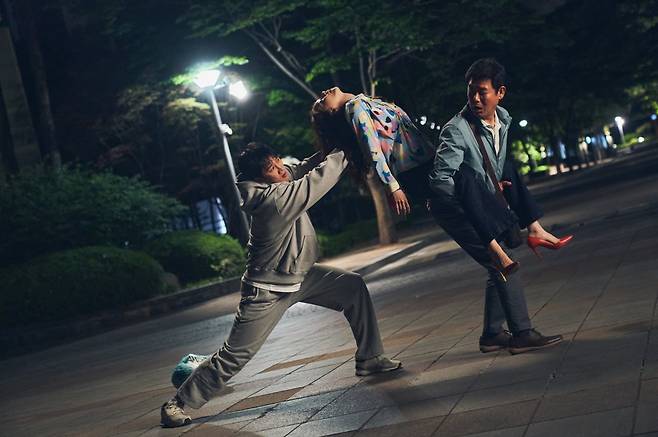
Lee’s new film Pretty Crazy was actually written before Exit. At one point, Lee was an unemployed young man. In his late 20s, he joined production company Filmmaker R&K, working as part of Director Ryoo Seung-wan’s team. After completing a master’s degree at the Korea National University of Arts, he entered the industry, but a debut as director was still a long way off. Though his dream was cinema, his main work became side jobs such as wedding videos and music video shoots. “When I reached my mid-30s, it really scared me. I had been lazy. I was too caught up daydreaming, postponing the moment when I would finally face the audience’s judgment,” he recalled. Determined to make one last attempt, he committed himself to finishing a screenplay, holed up in a study cafe. Living on delivery food, he wrote up to 18 hours a day. That effort churned out Pretty Crazy—a story of a woman who transforms into a devil at 2 a.m. every night, and a man who goes on secret dates with her.
However, writing a screenplay didn’t guarantee an open path forward. Lee still needed a production company. “Fortunately, the CEO of R&K, Kang Hye-jung, saw the script’s potential.” Less added, “Even now, I feel like I could lift her up on my shoulders out of gratitude.” Elements of Lee’s life are woven into Pretty Crazy. During his unemployed years, he became hooked on late-night walks that always seemed to end in front of claw machines. In the film, the male lead (played by Ahn Bo-hyun), also portrayed as jobless, clings desperately to a claw machine, trying to win a doll that seems just out of reach. The doll, with its faint smile, serves as the link between the protagonist and the devil—while also symbolizing Lee’s own dream of cinema, a passion he refused to give up.
Despite it being a romance drama, the film also blended an element of occult and horror, keeping the comedy alive. Lee’s style of comedy is long term—humor that slowly draws one in before landing with impact at the end. “Comedy is the fastest and most precise of emotions, so I try to bring it into any work,” Lee said. “My goal is a kind of comedy that reveals the human condition in the spaces between the laughs.”
The theater landscape today is very different from six years ago: even a rookie director could draw nearly 10 million viewers. When asked whether he worries about box office success, Lee replied, “Blaming external factors feels like making excuses for myself. I believe that if the creator makes something well, the audience will recognize it.” He added, “It’s like the feeling you get after a refreshing bath followed by a glass of milk. That’s the kind of feeling I want to give audiences. When they’re in need of gentle comfort, or weary from seeing the harsher side of the world, I hope they can experience something pure and moving at the cinema.”
Copyright © 조선일보. 무단전재 및 재배포 금지.
- ‘이중 기소’ 공소기각 파기에...김성태, 2심 판결 불복 상고
- 李 “김용 판결 이해 어렵다”... 당내 “표 주라는 메시지”
- “아들뻘 남욱에 구걸하겠나”... ‘50억 클럽’ 박영수 항소심 결심
- 자진 출석한 피의자 불법 긴급체포한 경찰관, 기소 후에야 대기 발령
- 휴대전화 없이 4년 잠적 前 군수도 잡았다… 창원지검, 도피사범 51명 검거
- [만물상] 마지막 보신탕
- 인천·부산 이어 광주로 간 장동혁…권영세 “뭐하는지 우리 당은 아무도 몰라”
- 충주시장 재검표 이변 없었다... 국힘 이동석 시장직 유지
- “美방어 의존하면서 공항 짓고, 복지 증진… 동맹, 세상 달라진 것 알아야”
- 세계유산위 “사도광산 강제노동 알려라” 日정부에 권고