BYD’s global surge hits a speed bump in South Korea
이 글자크기로 변경됩니다.
(예시) 가장 빠른 뉴스가 있고 다양한 정보, 쌍방향 소통이 숨쉬는 다음뉴스를 만나보세요. 다음뉴스는 국내외 주요이슈와 실시간 속보, 문화생활 및 다양한 분야의 뉴스를 입체적으로 전달하고 있습니다.
China’s BYD sold a record 4.2 million electric vehicles worldwide last year, cementing its position as the world’s top EV maker. Yet the Chinese powerhouse has struggled to convert that global momentum into success in South Korea, a market where brand cachet can outweigh price.
The company entered Korea in January with the Atto 3 compact SUV, positioned to undercut local rivals. The debut was promising: BYD briefly topped the imported EV sales chart in April with 543 units sold. But sales have since slumped to about 200 a month. The Korea Automobile Importers & Distributors Association says BYD has sold 1,578 vehicles so far this year, ranking 14th among imported brands.
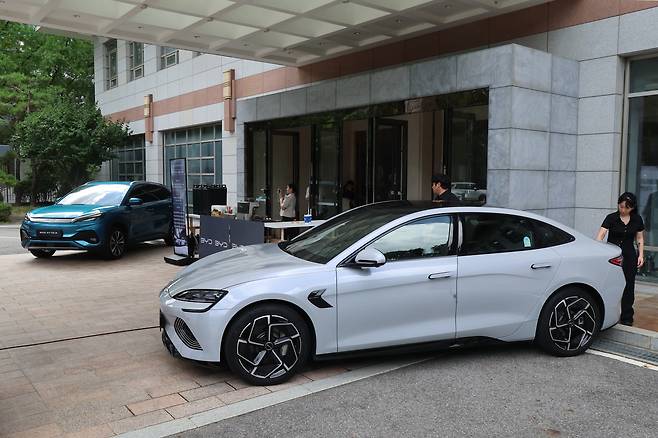
Price remains BYD’s core strategy. The Atto 3 starts at 31.5 million won ($23,300) before subsidies and can be purchased in the high-20 million won range after incentives. With a 321-kilometer range and comparable performance to Kia’s EV3 Standard, the car is about 8 million won cheaper.
But affordability alone has not been enough. Korean consumers, analysts say, are wary of untested Chinese brands in a market where image and after-sales reliability shape purchasing decisions. “Performance isn’t far behind competitors, but the fact that it’s a Chinese car holds it back,” said an executive at a foreign automaker. “In Korea, the ‘image factor’ matters, and unless BYD takes pricing even lower, it won’t overcome that gap.”
BYD is preparing a fresh push in the second half of the year with models aimed more squarely at Korean preferences. The Seal sedan is already available, and the Sealion 7—a midsize SUV positioned against Tesla’s Model Y—will arrive later this year. The company also plans to expand its footprint to more than 30 showrooms and 25 service centers nationwide. While still short of Mercedes-Benz’s 74 service centers, analysts say stronger after-sales infrastructure could bolster BYD’s case as a value-for-money challenger.
Copyright © 조선일보. 무단전재 및 재배포 금지.
- 경남에 나흘간 3만5000t 물 공급... 비 예보에 국가소방동원령 해제
- 최고위원 경선도 친명계 강세...박선원, 친청 최민희 꺾고 1위로
- 김민석, 승부처 호남서 과반 승리... 정청래에 누적 14%p 앞섰다
- 아비뇽 열광 한강 소설 원작 공연, 이자벨 위페르의 ‘새’ 서울 온다
- 아마존 베이조스가 투자한 첫 번째 스포츠 구단은 리버풀
- 이스라엘, 레바논 공습... 7명 사망 ‘휴전 유명무실’
- 15만대 팔렸다, 연기 냄새 없이 혼자 삼겹살 굽는 냄비
- 제주산 양배추 9통을 통째로, 양배추즙 한 달 먹은 후 위 건강에 온 변화
- 이탈리아 수영 샛별 사라 쿠르티스, 여자 배영 50m 세계신
- 시작부터 달랐던 남과 북 ‘1948년 8·15’ 운명의 선택 [역사전쟁]