Redefining fatherhood: Dads in Seoul come together to learn and grow
전체 맥락을 이해하기 위해서는 본문 보기를 권장합니다.
"Research shows that active father involvement improves family happiness, boosts children's self-esteem and emotional development, strengthens spousal relationships and enhances fathers' mental health and life satisfaction."
"This training made me realize that even my impulsive emotional reactions can influence my children," said Noh Hwan-hee, a father of two young children. "I now think that if I can adjust my emotions and express them more thoughtfully, it will positively affect my parenting."
이 글자크기로 변경됩니다.
(예시) 가장 빠른 뉴스가 있고 다양한 정보, 쌍방향 소통이 숨쉬는 다음뉴스를 만나보세요. 다음뉴스는 국내외 주요이슈와 실시간 속보, 문화생활 및 다양한 분야의 뉴스를 입체적으로 전달하고 있습니다.
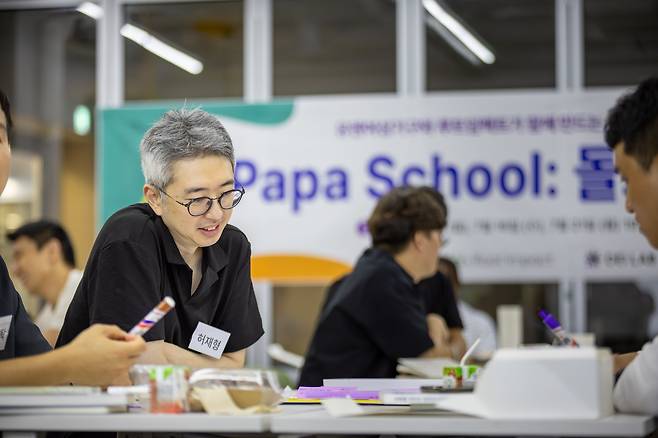
In a quiet but expectant atmosphere, 25 fathers from diverse age groups gathered in a bright meeting room in Seongsu-dong, eastern Seoul, to take a closer look at their lives as parents.
They were participants of the Papa School: Fatherhood Care Capacity-Building Workshop, a three-part series hosted by the UN Women Center for Knowledge and Partnerships, in collaboration with Root Impact, a nongovernmental organization dedicated to fostering an ecosystem for sustainable development.
The program was designed to address a reality that remains prevalent in many societies, including South Korea. Caregiving remains largely concentrated in the hands of women, while men have limited opportunities to learn, practice or be encouraged to take on such roles.
Despite policy improvements, social norms, workplace structures and cultural expectations continue to hinder men’s active participation in unpaid care work. This imbalance not only reinforces gender inequality, but also deprives men of the chance to build deeper family bonds and improve their own life satisfaction, according to Hwang Yun-jeong, director of the UN Women Knowledge and Partnerships Center here.
Recognizing this, the UN Women Center and Root Impact, which recently signed a memorandum of understanding to strengthen their partnership for social change, launched the Papa School to provide working fathers the opportunity to reflect on their caregiving role, develop family communication skills and strengthen emotional connections with their loved ones.
“Our society still has many barriers, from labor market structures and long working hours to fixed gender role perceptions, that make it difficult for fathers to participate in caregiving,” Hwang said during her opening speech at the first session.
“Research shows that active father involvement improves family happiness, boosts children’s self-esteem and emotional development, strengthens spousal relationships and enhances fathers’ mental health and life satisfaction."
"It also helps fathers better manage emotions, reduce stress, and even regain confidence in both work and social life," she added.
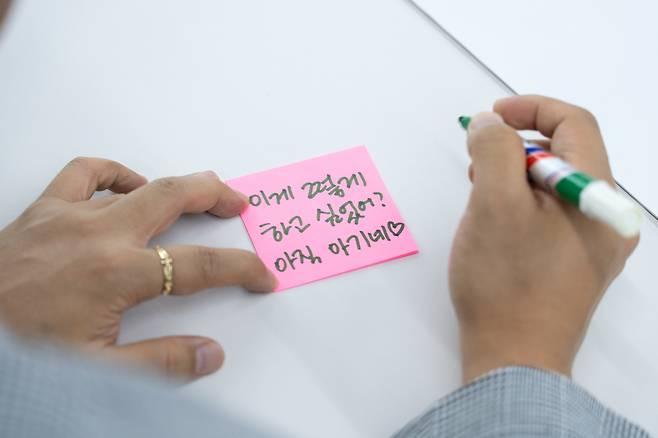
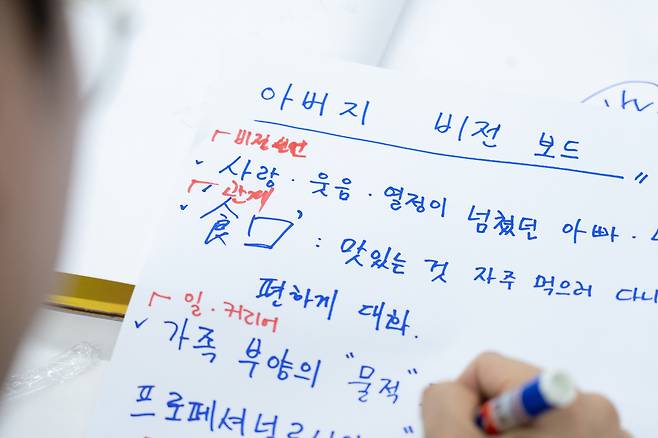
Under the guidance of facilitator Kim Ki-tak, director of the Fatherhood and Care Culture Institute, the fathers paired up to answer the question of what kind of fathers they are.
Answers ranged from fears of losing patience and yelling, to uncertainty about handling a crying child, to struggling with play. Realizing these concerns were shared brought a wave of relief. “Oh, me too!” “Yes, I’ve been there,” several said, nodding in solidarity.
The workshops progressed into practical exercises on communication, emotional awareness and age-specific parenting challenges. Role-playing exercises — switching between parent and child perspectives — proved especially eye-opening, as fathers experienced firsthand how their words and actions might be received by their children.
For many, the program was transformative.
“This training made me realize that even my impulsive emotional reactions can influence my children,” said Noh Hwan-hee, a father of two young children. “I now think that if I can adjust my emotions and express them more thoughtfully, it will positively affect my parenting.”
Another participant, identified as Park, said, “I realized I had approached my relationship with my children too rationally — deciding what a father should be and what children should be — and when reality didn’t match, my emotions would explode or I’d avoid the situation. Now I want to understand my children more, share emotions and keep practicing to improve.”
For Heo Jae-hyung, the father to a 67-day-old baby as well as the CEO of Root Impact, the experience was personal as well as professional. “Beyond changing diapers or soothing the baby, I thought deeply for the first time about what kind of father I want to be. I’ve now set a clearer path for my fatherhood journey, and I’ll work to ensure Papa School continues into its second and third rounds.”
Copyright © 코리아헤럴드. 무단전재 및 재배포 금지.