S. Korea’s brain drain worsens as top scientists flee abroad
이 글자크기로 변경됩니다.
(예시) 가장 빠른 뉴스가 있고 다양한 정보, 쌍방향 소통이 숨쉬는 다음뉴스를 만나보세요. 다음뉴스는 국내외 주요이슈와 실시간 속보, 문화생활 및 다양한 분야의 뉴스를 입체적으로 전달하고 있습니다.
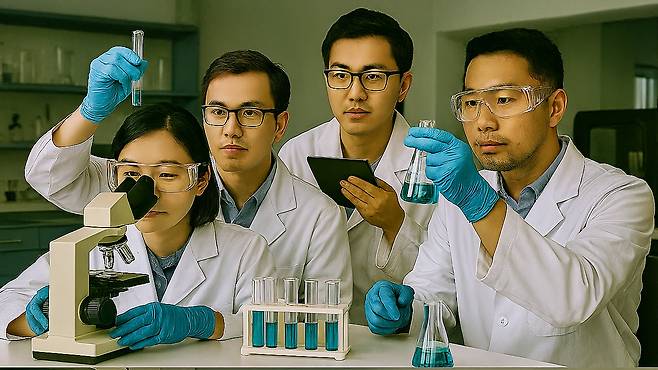
Choi Tae-lim, a leading South Korean scientist in polymer synthesis and now a materials science professor at ETH Zurich, left Seoul National University (SNU) in 2022 after 15 years. Ten postdoctoral researchers from his lab moved with him. He had turned down several overseas offers to “train the next generation in South Korea,” but worsening research conditions eventually pushed him to Switzerland. At ETH Zurich, the 48-year-old received funding to buy over 10 pieces of equipment worth 100 to 200 million won each, which was hard to get at SNU. His former students now earn high salaries and can fully focus on their research.
“South Korea’s science and technology have reached advanced levels, but its research infrastructure hasn’t kept up, so top researchers are leaving,” Choi told the Chosun Ilbo. Ernest K. Ryu, a 38-year-old mathematician who left SNU for UCLA last year, added, “Many promising scholars want to come to Korea, but I’ve never heard of anyone receiving an offer from a Korean university. The biggest problem is the lack of a proper recruitment system.”
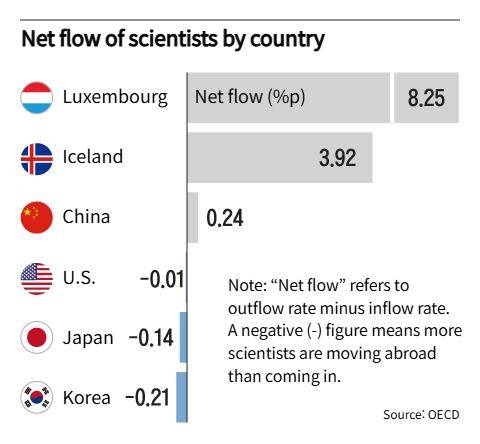
In the past four years, 56 professors have left SNU for overseas institutions. The brain drain is particularly severe in science and engineering. A report released in June by the Korea Chamber of Commerce and Industry showed that in 2021, the share of scientists leaving South Korea (2.85%) exceeded those entering (2.64%), making the country a net exporter of talent. Seventeen years of frozen tuition fees have left universities financially strained, unable to raise most professors’ salaries or pursue aggressive talent recruitment.
Universities are crucial for carrying out long-term, high-risk research from basic science to applied technology and for supplying skilled researchers to industry. The United States, China, and other countries are achieving breakthroughs largely by attracting top talent.
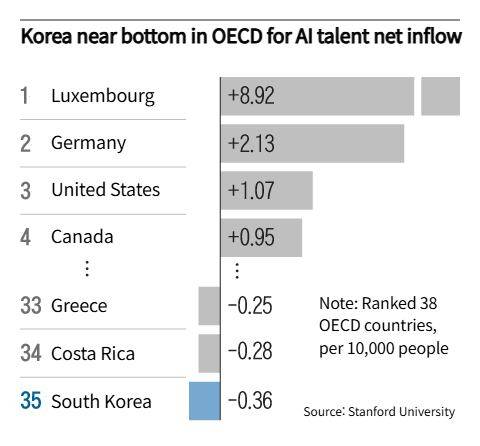
The problem is severe in advanced fields like artificial intelligence and autonomous driving. According to Stanford University’s AI Index 2025, South Korea ranks 35th out of 38 OECD countries for net inflow of AI talent with a master’s degree or higher, at minus 0.36 per 10,000 people. This means more AI experts are leaving South Korea than entering. The gap is much wider than in technology leaders like the United States (+1.07) and Japan (+0.54), and even exceeds countries like Argentina (-0.22) and Greece (-0.25).
“If we don’t stop this talent exodus with bold investment and structural reforms now, the foundation of South Korea’s science and engineering research will collapse,” warned Kim Young-oh, dean of SNU’s College of Engineering.
Copyright © 조선일보. 무단전재 및 재배포 금지.
- 6연승 U-17 여자배구, 필리핀도 꺾고 세계선수권 8강
- 행안부, 수의계약 한도 기준 만들고 감시체계 구축
- 민주당 선관위, 대리투표 의혹 ‘친청’ 당원 제명 의결
- 문경 계곡서 물놀이하던 20대 사망
- 김민석 “조작기소 드러났는데 재판 계속하자면 나쁜 놈”
- 국교위, ‘수능 서·논술형 도입’ 1박 2일 토론회 연다
- 빌라 관리비 때문에...이웃 살해한 60대 징역 18년
- 장동혁 ‘광복절 동원령’? 원외위원장 40여명 올공으로
- 해경, 수상 오토바이 타고 금지구역 부산항 진입한 男 3명 적발
- KDB생명 인수 우선협상 대상자로 한국투자금융지주 선정