Labor reform under yellow envelope bill puts South Korea’s SMEs on edge
이 글자크기로 변경됩니다.
(예시) 가장 빠른 뉴스가 있고 다양한 정보, 쌍방향 소통이 숨쉬는 다음뉴스를 만나보세요. 다음뉴스는 국내외 주요이슈와 실시간 속보, 문화생활 및 다양한 분야의 뉴스를 입체적으로 전달하고 있습니다.
A labor dispute involving ENS, a subcontractor that cleans wafer transport containers for Samsung Electronics' semiconductor production, is drawing renewed attention to a controversial labor bill that many small and medium-sized enterprises (SMEs) warn could threaten their survival.
ENS, which employs roughly 230 workers, saw its union—affiliated with the Korean Metal Workers’ Union under the Korean Confederation of Trade Unions—demand that regular bonuses be factored into base wages after a Supreme Court ruling in late 2024 redefined ordinary wage criteria. The union also called for increases in various allowances.
Company officials responded that even if all operating profits were redirected to wages, the firm could only meet 40% of the union’s demands. They asked for time to negotiate, but the union filed a wage arrears complaint instead.
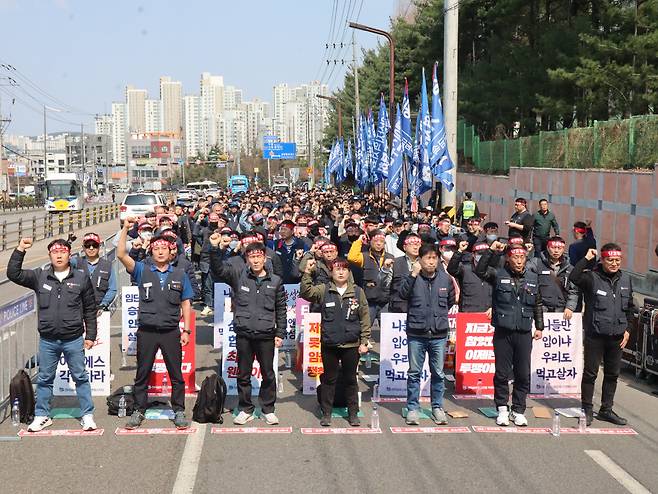
In June, the union joined the Democratic Party (DP) of Korea in a press conference at the National Assembly, calling on Samsung Electronics, the prime contractor, to step in directly. It also staged a sit-in at the main gate of Samsung’s Giheung campus. The company eventually accepted the union’s demands, and the metalworkers’ union declared a “victory” earlier this month.
Kim Ji-hoon, CEO of ENS, warned that the yellow envelope bill—revisions to Articles 2 and 3 of the Labor Union Act—would push major firms to shift contracts to non-union partners or move operations overseas. “Many SMEs will face an existential crisis,” he said.
One executive at a small manufacturing firm emphasized that having no union presence is no guarantee of protection. “When the main contractor goes on strike, we’re forced to halt production because we can’t deliver or operate,” he said. Under South Korea’s 52-hour workweek cap, he added, it’s nearly impossible to recover from delays. “This is already difficult enough—if the law passes, strikes will only become more frequent and drawn-out.”
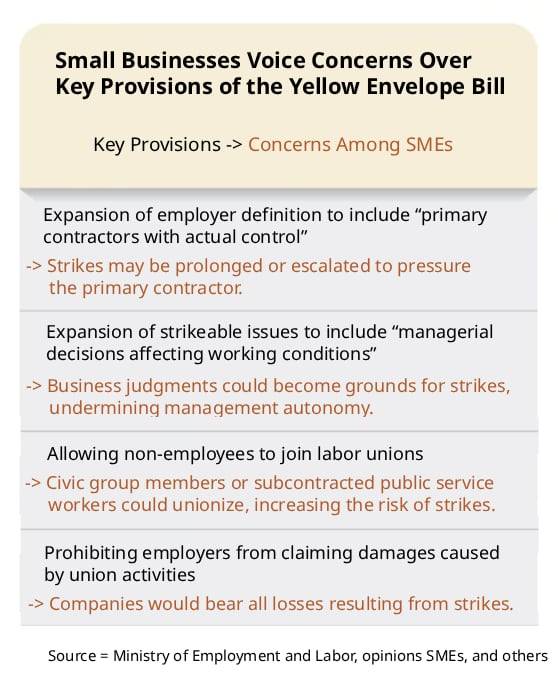
The proposed legislation would significantly expand the responsibilities of prime contractors for subcontracted workers and broaden the scope of legal strike activity to include managerial decisions. For many small firms, the potential impact is profound. “One large-company strike can put us on the edge of collapse. If this passes, shutting down may be our only option,” one business owner said.
The CEO of a construction subcontractor echoed those concerns. “There are times when the prime contractor delays payments, and unions threaten to strike or report us for wage arrears,” he said. “If this law goes into effect, union demands will intensify on-site, and we’ll be trapped between labor and the top-tier client.”
Company C, which supplies auto parts and relies on global automakers for over 80% of its revenue, is increasingly worried the law could drive major customers out of the South Korean market altogether.
One of the most contentious provisions of the bill allows third-party individuals—those not directly employed by a company—to join unions. That change, SMEs warn, could lead to an explosion in union activity and legal disputes. According to the Ministry of Employment and Labor, unions with fewer than 30 members account for 2,455 organizations, or roughly 40% of all unions—most of them operating in small business sectors.
“For small and midsize manufacturers that depend on large-firm contracts, the legal exposure under this bill will be far greater,” said Lim Chae-un, emeritus professor at Sogang University.
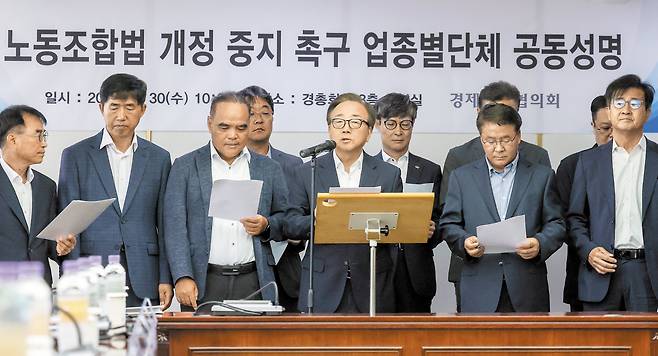
Meanwhile, the DP is urging major corporations to drop lawsuits previously filed against unionized workers. According to industry sources on July 30, the party recently called on Hyundai Motor Company and Hyundai Steel to withdraw four pending lawsuits seeking damages from subcontracted temporary workers.
Hyundai Motor filed suits in 2010, 2013, and 2023 against workers who occupied its Ulsan plant; those cases remain in litigation. Hyundai Steel filed a 20 billion won ($14 million) lawsuit in 2021 against 180 irregular workers who staged an occupation of its Dangjin Steel Plant. That case is currently under appeal. The party has also pressed Hanwha Ocean to drop a 47 billion won ($33 million) damages claim filed in 2022 against subcontractors involved in an illegal strike.
On July 28, the National Assembly’s Environment and Labor Committee approved a version of the Yellow Envelope bill that includes retroactive immunity for union-led damages and exempts unions from liability entirely. Even before a final vote in the full Assembly, the Democratic Party has begun brokering settlements between labor and management.
Business leaders have voiced strong objections. “Barring employers from seeking damages sets a dangerous precedent,” one industry official said. “It risks encouraging illegal strikes and turning worksites into legal voids. There’s also serious concern that it could infringe on constitutionally protected property rights.”
Copyright © 조선일보. 무단전재 및 재배포 금지.
- 팔순 맞은 부시 前대통령… 클린턴 “당신과의 우정, 내 인생에 큰 선물”
- 尹 “호주는 군사 파트너, 국방장관 출신이 적임자 아니냐”
- 인플루언서 양정원 남편 “경찰과 술자리, 아내 사건 때문 아냐”
- 잠수함 수주 불발 한화오션 “나토 벽 못 넘어... K방산 도약 길 찾겠다”
- 방사청, 캐나다 잠수함 수주 탈락에 “결과 존중…‘방산 4강’ 위한 교훈 삼을 것"
- 폭우와 강풍에 끄떡 없는 108 살대 3단 자동 우산, 1만4000원 초특가
- [더 한장] 장마가 오기 전 서울 하늘은?
- [함영준의 마음PT] 한국인의 인생을 바꾼 영성책 Best 50
- 수퍼개미 “삼전닉스 단타 위험… 폭락장엔 지수 ETF가 진가”
- 이 6가지 견과류를 매일 아침 먹기 시작한 후 몸에 온 변화