Campaign to call migrant workers by name spreads in southwest
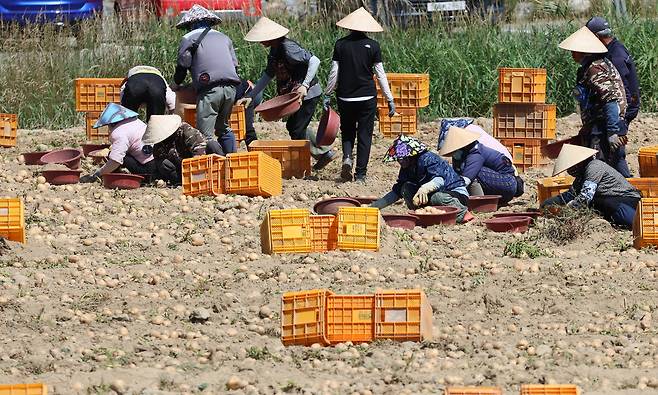
Regions across the southern part of Korea are joining a growing campaign to encourage calling migrant workers by their names, rather than using disrespectful terms such as “ya” (hey).
The campaign is part of broader efforts to promote a culture of respect toward residents with diverse ethnic backgrounds.
The initiative was launched by the Jeollanamdo Contingent Workers Center, a human rights group based in South Jeolla Province. Since last year, the center has worked with local corporations and groups to run the campaign, which mostly involves encouraging Korean employers and workers to address their colleagues from other countries by name. One common practice is placing name stickers on the workers’ hard hats to support this effort.
Korea has long been considered a homogeneous society. But the latest data by Statistics Korea shows that in 2023, 1.19 million of the country's 51 million population were people from "multicultural families," which refers to families with members who are not ethnic Koreans.
Despite the growing presence of foreign nationals and Korean nationals with diverse cultural backgrounds, many migrant workers in the country are believed to be subject to discrimination based on their race. Last week, a video of a Sri Lankan worker tied to a forklift and being mocked by his colleagues went viral, sparking public outrage over the mistreatment of migrant workers.
The 31-year-old victim of the recent forklift incident said that he had rarely been called by his name by his Korean colleagues, who instead used pronouns and even profanity to refer to him. This practice of not referring to migrant workers by their names is thought to be detrimental to establishing a culture of mutual respect in an ethnically diverse working environment.
Officials from the JCWC said that addressing someone by their name is a starting point for building a relationship based on respect, which will not only help the migrant workers feel more comfortable but also prevent industrial accidents.
South Jeolla Province has one of the highest populations of foreign residents in the country. This figure jumped in 2023 to 86,729, an 18.5 percent increase from the previous year. The provincial government has kicked off a number of policies for the well-being of migrant workers in the region this year, including medical clinics for foreign nationals who are not subscribed to the state-run health insurance program.
It was reported that five companies in Haenam-gun, South Jeolla Province, are currently participating in the campaign, and that hundreds of name tags have been distributed to migrant workers in Jangseong-gun and Muan-gun in the same province.
The campaign has spread to other regions as well, with factories in Ulsan reportedly taking part as well.
Copyright © 코리아헤럴드. 무단전재 및 재배포 금지.