Korea scrambles as U.S. cuts auto tariffs for rivals
이 글자크기로 변경됩니다.
(예시) 가장 빠른 뉴스가 있고 다양한 정보, 쌍방향 소통이 숨쉬는 다음뉴스를 만나보세요. 다음뉴스는 국내외 주요이슈와 실시간 속보, 문화생활 및 다양한 분야의 뉴스를 입체적으로 전달하고 있습니다.
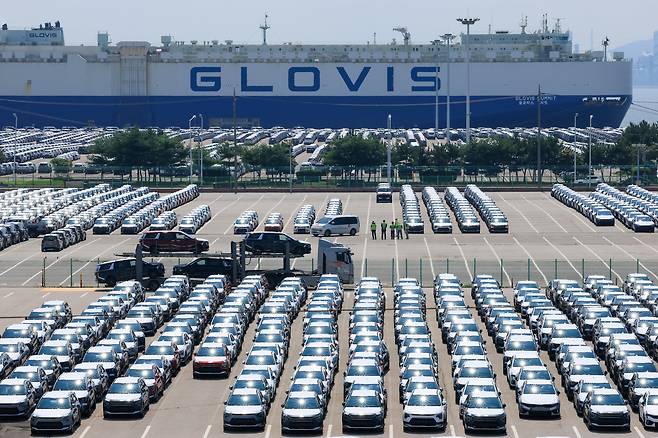
A sense of urgency grows in South Korea’s automotive industry following Japan and the European Union’s successful negotiation with the United States. The two biggest rivals have managed to lower mutual and auto tariffs to 15%, prompting the government to launch an all-out effort to secure a similar deal with the U.S. South Korean Industry Minister Kim Jung-kwan and Trade Minister Yeo Han-koo flew to Scotland from Washington for additional talks with U.S. officials. The two are set to join Finance Minister Koo Yun-cheol in Washington D.C., on July 29 for final negotiations. As shipbuilding emerges as a potential bargaining chip to lowering tariffs, Hanwha Vice Chairman Kim Dong-kwan reportedly boarded a flight to the U.S. on July 28. Hanwha owns a shipyard in the U.S. through its investments there, fueling speculation that the government may have requested the company’s cooperation.
Now that the Japan and the EU’s agreements have been made public, South Korea’s tariff negotiations with the U.S. have become clearer. Washington’s demands—such as large-scale investments, increased purchases of U.S.-made products, and market access for sensitive items are now well understood. Analysts say the negotiations come down to what the South Korean government is willing to concede to secure tariff reductions.
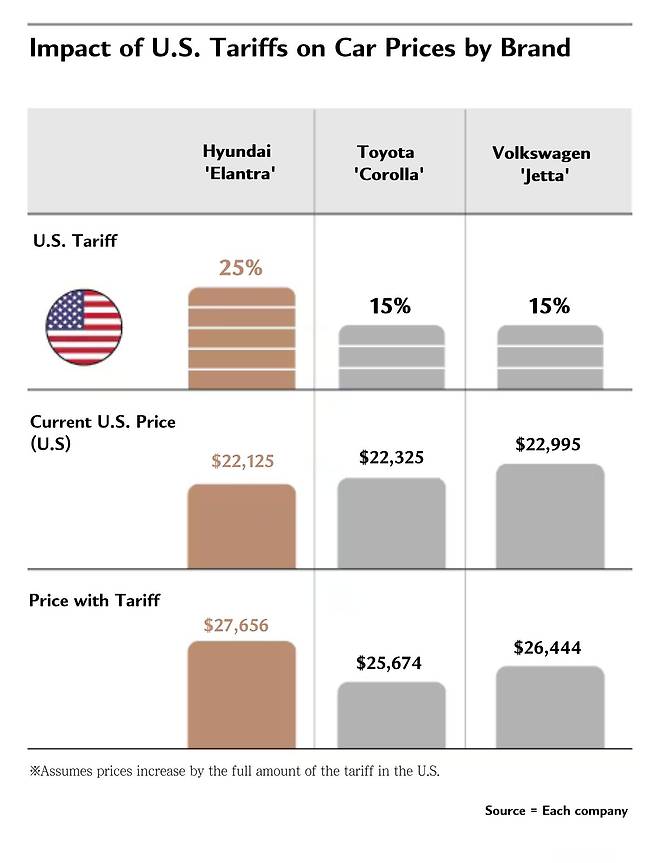
With the EU following Japan in concluding negotiations, South Korea’s automotive industry—a key export sector—is getting cornered. Korean-made cars will face a 10% higher tariff rate than their Japanese and European counterparts beginning next month if they are unable to lower the current 25% U.S. import tariff on automobiles.
Prior to U.S. President Donald Trump’s decision to impose a 25% tariff, Korean-made cars had no tariffs in the U.S. thanks to the U.S.-Korea Free Trade Agreement (KORUS FTA). Japanese and European cars, who had no FTAs, were subject to a 2.5% tariff. Although the difference was small, it solidified Korean cars for their value-for-money in the U.S. automotive market. An industry insider noted, “Even if the 15% tariff is applied, Korea will lose the FTA benefits and end up in a worse position. If the rates go above 15%, the impacts could be severe.”
Currently, the Hyundai Elantra sedan has a starting price of $22,125 in the U.S., which is cheaper than its counterparts—the Toyota Corolla ($22,325) and Volkswagen Jetta ($22,995). However, if all three automakers have their prices adjusted to reflect the current tariff percentages, the Elantra would become $27,656. It will be more expensive than the Corolla ($25,674) and the Jetta ($26,444).
Tariff shocks are evident for Hyundai Motor Group, which released its second-quarter (April to June) earnings. Burden from tariffs are estimated at 1.6142 trillion won for the quarter alone (approximately $1.2 billion). As a result, operating profit plunged 19.6% compared to the same period last year.
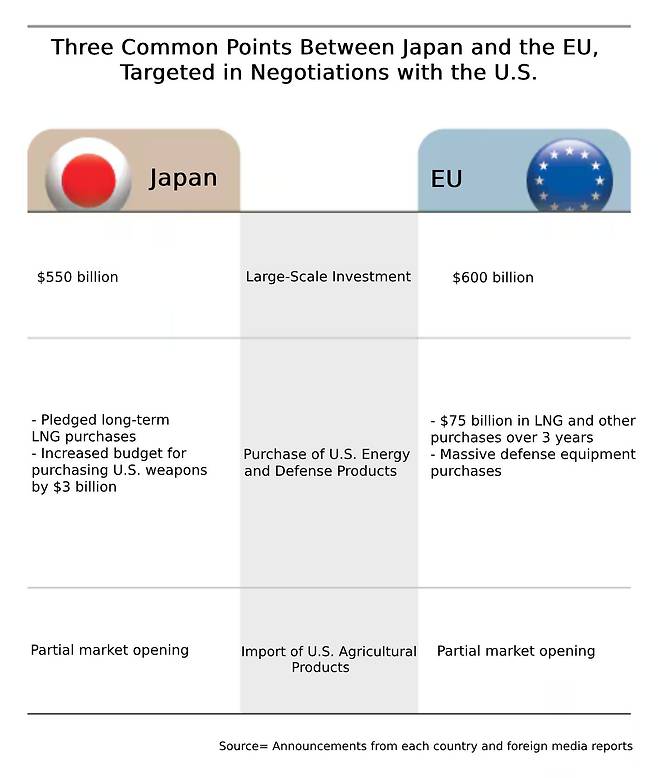
Trade experts say three key decisions must be made to secure a minimum tariff rate of 15%. Based on the outcomes of the Japan and EU negotiations, the government must determine the scale of investment to be made in the U.S., decide which U.S.-made products to purchase in greater volumes, and how much trade barriers need to be lowered for sensitive items.
Japan has established a $550 billion investment fund for the U.S., pledging to invest in key strategic industries such as energy, semiconductors, critical minerals, pharmaceuticals, and shipbuilding. The EU, while not disclosing specific sectors, announced plans to invest $600 billion. As for U.S. energy imports, Japan has agreed to purchase more liquefied natural gas (LNG), while the EU committed to purchasing $750 billion of LNG over the next three years. Both Japan and the EU also included agreements to purchase U.S.-made defense equipment and Boeing aircraft.
Copyright © 조선일보. 무단전재 및 재배포 금지.
- 반도체·AI 폭등 장세…월스트리트의 5가지 폭락 대비법
- 정원오 ‘GTX 공사 중지’ 예고에... 오세훈 “박원순 판박이, 만행 답습”
- ‘반포대교 포르쉐 추락’ 운전자, 반성문 32건 쓰고 재판서 “진심으로 반성”
- 가짜 검찰·증권사 사원증 내밀고 “돈 받으러 왔다”… ㅊ10명 구속
- BTS 정국, 대기업 임원 22명도 털렸다... 국제 해킹조직 일당 검거
- 봄비 그치고 다시 기온 상승...주말 최고 29도
- 최애 트로트 멤버한테 투표하려 ‘별’ 샀는데 환불은 어디서? 소비자원, 팬덤 투표 앱 개선 조
- 상위 10대 기업 수출액, 전체 50% 첫 돌파... 반도체 초호황에 역대급 수출 양극화
- 앞으로 담합 등 신고하면 최대 과징금 10%까지 상한없이 포상금 준다
- “은행 통해 ETF 투자하면 수수료 더 붙어요”...금감원, ETF 투자 유의사항 안내