Consumer spending surges as Korea’s relief coupon program kicks in
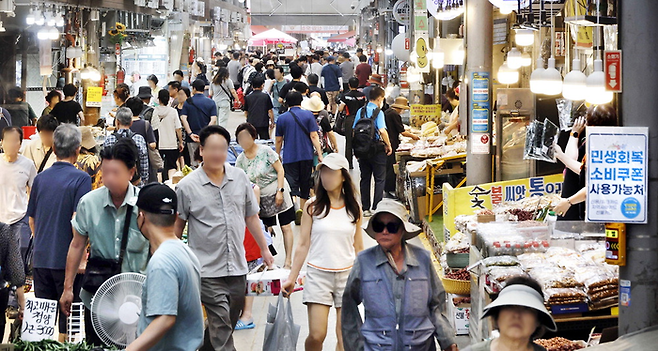
On Sunday, the first weekend since the coupon distribution began, popular neighborhoods like Seongsu-dong in eastern Seoul were bustling with young couples and shoppers enjoying their outings.
“I’ve been avoiding dining out due to rising prices, but I came out for a date with my girlfriend for the first time in a while,” said Kim Tae-ho, a 31-year-old office worker.
Across other trendy districts such as Ikseon-dong, Yongsan’s Yongridan-gil, and Sindang-dong, as well as traditional markets like Gwangjang Market and Cheongnyangni Market, signs reading “Relief Coupon Accepted Here” were prominently displayed at shop entrances.
According to the Ministry of the Interior and Safety on Monday, 78.4 percent of eligible recipients—39.67 million people—had applied for the first round of coupons within a week, totaling 7.12 trillion won ($5.1 billion) in disbursements.
The pace of applications far outpaced that of previous aid programs, with increases of 24 percentage points and 10.2 percentage points compared to the 2020 Emergency Disaster Relief Funds and 2021 National Support Fund, respectively.
The impact is being felt across both online and offline channels.
Shinhan Bank reported that sales through its delivery app Ddangyo jumped by about 120 percent from the previous week.
Usage on Baedal Minjok, another major food delivery platform, also surged. A representative from Woowa Brothers, which operates the app, said that in-person card payments via its Meet to Pay feature tripled week over week.
The boom extended to fried chicken chains as well.
According to chicken franchise brand BHC, sales on Saturday rose more than 10 percent from the prior week and about 21 percent from the same period last year.
Convenience store chains are also reporting sharp gains.
GS25 said sales of packaged soups and stews last week soared 337.6 percent compared to the same period a month earlier. CU noted that essential items like ready meals, instant rice, and bottled water saw sales jump over 30 percent.
Retailers in fashion and beauty also benefited.
Fashion Group Hyungji reported that sales from July 22 to 26 at its brands—Crocodile Lady, Olivia Hassler, and Chatelaine—rose by 32 percent, 60 percent, and 61 percent, respectively, from the previous week.
Some believe the coupon’s impact may be even greater than anticipated, as many consumers end up spending even when they find out certain stores are not eligible.
“I went to a family restaurant with my family, but found out the coupons weren’t accepted there,” said a man in his 40s. “I didn’t want to disappoint my son, so we dined anyway.”
Copyright © 매일경제 & mk.co.kr. 무단 전재, 재배포 및 AI학습 이용 금지
- 주가 100만원 돌파 노린다…다음 ‘황제주’에 쏠린 눈 - 매일경제
- 신평 변호사 “尹 전 대통령, 쭈그리고 앉아 식사…처참한 주거환경” - 매일경제
- “대출 규제가 불 지폈나”…처음으로 40억원 넘긴 ‘이 아파트’ - 매일경제
- 30억 아파트 벽에 금이 ‘쩍’, 입주민은 ‘불안불안’…‘올파포’ 전수조사 착수 - 매일경제
- “신체적 학대 하지 않았다”…2살 원아 얼굴 부상, 어린이집 교사 CCTV 보니 - 매일경제
- “韓 나 만나러 스코틀랜드로 날아와”…美상무장관이 말하는 한국인의 정체 - 매일경제
- 트럼프, 아직 무역합의 안한 국가에 “관세 15∼20%일 것” - 매일경제
- [속보] 법인세 인상 속도…민주당·정부 “尹정부 낮췄던 법인세·대주주 기준 원상복구” - 매일
- “카드값 못 막는 사람 너무 많아”…상반기 카드사 실적 타격, 순익 18% 감소 - 매일경제
- ‘英 단독!’ 손흥민, 결국 LA FC로 향하나? ‘556억원’ 사우디 관심 속 영입 협상 진전…“계약