North Korea won’t talk—but South still hopes to de-escalate
이 글자크기로 변경됩니다.
(예시) 가장 빠른 뉴스가 있고 다양한 정보, 쌍방향 소통이 숨쉬는 다음뉴스를 만나보세요. 다음뉴스는 국내외 주요이슈와 실시간 속보, 문화생활 및 다양한 분야의 뉴스를 입체적으로 전달하고 있습니다.
In a blunt message issued on July 28, Kim Yo-jong, the powerful sister of North Korean leader Kim Jong-un and a senior official in the ruling Workers’ Party, declared that Pyongyang had no intention of engaging with the South under the new Lee Jae-myung administration.
“We make it clear once again that we have no interest in any policy or proposal coming from Seoul, and that there will be no talks or issues to discuss with the South,” Kim said.
The statement—Pyongyang’s first direct message to Seoul since Lee took office—comes despite a series of overtures from the South Korean government, including the dismantling of military loudspeakers along the Demilitarized Zone and the suspension of National Intelligence Service-run propaganda broadcasts. Kim’s response made clear these gestures have done little to alter the North’s posture.
Entitled “Inter-Korean Relations Have Left Behind the Era of Kinship,” the statement also addressed recent speculation about Kim Jong-un potentially attending the upcoming Asia-Pacific Economic Cooperation (APEC) summit in Gyeongju. Kim dismissed the idea as “a ridiculous delusion.”
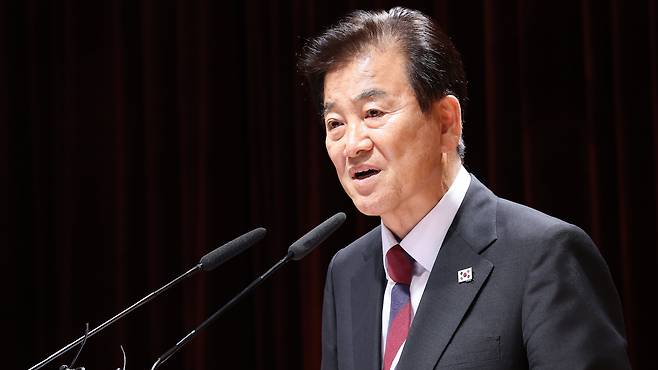
In response to the rebuff, Chung Dong-young, South Korea’s newly appointed Minister of Unification, announced that he would recommend President Lee consider adjusting next month’s scheduled U.S.–South Korea joint military exercises.
“I am considering making such a proposal,” Chung said, indicating the matter would be addressed at the July 29 working-level National Security Council meeting. “We can clarify the direction—whether delay or reduction—after the meeting,” he added.
Pressed on whether such adjustments remain feasible with fewer than three weeks before the Ulchi Freedom Shield drills, Chung responded, “If there is political will, adjustments can certainly be made.”
He also pointedly distinguished the Lee administration’s stance from that of its predecessor: “What is clear is that the policy direction of the Lee Jae-myung government is different from that of the Yoon Suk-yeol administration,” adding, “We will not simply inherit the previous government’s approach to military exercises but take a more cautious path.”
U.S. Forces Korea (USFK), in a response to The Chosun Ilbo, said it was “aware of Minister Chung’s comments” and reiterated that “as always, any decisions related to alliance exercises will be made through established consultation procedures.” As of July 28, the USFK had not received formal notification of potential adjustments from either the Unification Ministry or the South Korean Joint Chiefs of Staff.
Kim Yo-jong, for her part, left no ambiguity about Pyongyang’s stance. “No matter how hard the Lee government tries to mimic a brotherly tone or act as if it is pursuing righteous causes to gain international attention, our fundamental perception of South Korea as an adversary will not change,” she said. “The clock has irreversibly moved beyond the past framework of inter-Korean relations.”
Reflecting on the first 50 days of the Lee administration, Kim continued: “The administration has spoken of easing tensions and improving inter-Korean ties, but its blind faith in the U.S.–South Korea alliance and confrontational stance toward the North is no different from that of its predecessor.”
Since Kim Jong-un formally redefined North-South relations in 2023 as those between “two hostile states,” North Korea has accelerated efforts to institutionalize that divide—constructing barrier-like structures along the Military Demarcation Line and rejecting inter-Korean channels. Despite Seoul’s overtures, Pyongyang appears committed to its policy of disengagement. Analysts argue that North Korea, emboldened by growing ties with Russia, is increasingly inclined to pursue direct engagement with Washington, not Seoul.
Over recent months, South Korean officials have floated the possibility of inviting Kim Jong-un to the APEC summit in Gyeongju as an observer. While North Korea is not a member of APEC, Chung raised the idea at his July 14 confirmation hearing, saying, “It would be ideal if such a moment were to arise,” and “We must begin preparing now to make such attendance possible.”
Prime Minister Kim Min-seok echoed that sentiment in a July 22 interview, stating the government was preparing to accommodate “any scenario” involving Kim’s potential visit.
To further cultivate a climate for dialogue, the Lee administration has suspended anti-Pyongyang leaflet campaigns, halted military loudspeaker broadcasts, and reportedly begun exploring options for individual tourism to the North and limited legal distribution of North Korean media content in the South.
Yet the North has shown little interest. “These were self-inflicted issues by the South,” Kim said. “Any actions taken now are merely a reversal of things that should not have been done in the first place.”
In a carefully worded statement, the South Korean presidential office acknowledged the gravity of the remarks. “We take note of North Korea’s stance as expressed by a senior official in the first inter-Korean statement since the launch of the Lee administration,” it said. “We recognize that the wall of mistrust between the two Koreas remains very high due to years of hostility and confrontation.”
Still, the office reaffirmed its priorities. “Establishing peace is the firm philosophy of the Lee Jae-myung administration.” According to the presidential office, President Lee also raised Kim Yo-jong’s statement during Chung’s appointment ceremony, reiterating, “Restoring inter-Korean trust in a peaceful atmosphere is essential.”
Former Unification Minister Hong Yong-pyo warned against placing too much hope in dialogue. “Clinging to talks can lead to marginalization and a loss of negotiating power,” he said, urging the administration to pursue a North Korea policy grounded in principle and public mandate.
Copyright © 조선일보. 무단전재 및 재배포 금지.
- ‘비화폰 삭제’ 박종준 前 경호처장 1심 무죄...“증거인멸 의도 아냐”
- 서울시 적극행정 최우수상에 ‘킥보드 없는 거리’
- [단독] ‘김건희 계좌관리’ 이종호, 사기 혐의 송치에 검찰 “보완 수사하라”
- 트럼프 1기 비서실장 “美, 보호주의자만 남았다”
- 대법 “비의료인의 문신 시술, 무면허 의료 행위 아냐”
- 대법원 “HD현대重, 하청노조 사용자 아냐...구 노조법 적용”
- ‘중국서 北공작원 접선’ 혐의 민노총 전현직 간부 2명, 1심서 무죄
- 조훈현 대 이창호 : AI 복식 대국 라이브 중계
- [단독]부산 재선 박수영 “당 지도부, ‘특단의 조치’로 판을 바꿔달라”
- 이 대통령 “5·18 왜곡, 가용한 모든 수단으로 응징"