Korea seeks to safeguard rice while negotiating lower U.S. tariffs on cars
이 글자크기로 변경됩니다.
(예시) 가장 빠른 뉴스가 있고 다양한 정보, 쌍방향 소통이 숨쉬는 다음뉴스를 만나보세요. 다음뉴스는 국내외 주요이슈와 실시간 속보, 문화생활 및 다양한 분야의 뉴스를 입체적으로 전달하고 있습니다.
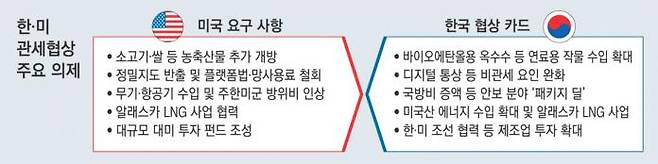
With just ten days left until U.S. President Donald Trump’s proposed retaliatory tariff implementation date of August 1, Japan has abruptly concluded a tariff deal with the U.S., drawing attention to how Korea will respond. This is particularly significant as Japan and Korea share similar positions in terms of their economic and security relationships with the U.S.
Observers say that Korea must first thoroughly analyze the details of the U.S.-Japan agreement and use those insights to negotiate more favorable terms in its own talks with Washington.
According to trade officials on July 23, reactions within Japan regarding the deal have been mixed, though relatively more positive overall. Japan managed to settle on a 15 percent tariff rate, the lowest among Asian countries that have reached such deals with the U.S., and succeeded in halving the tariff rate on automobiles, a key agenda item, from 25 percent to 12.5 percent.
However, experts caution that it is premature to make a full assessment, emphasizing the need to review the actual contents of the agreement beyond remarks made by President Trump on social media and by high-ranking Japanese officials.
Heo Jae-cheol, head of the Japan and East Asia team at the Korea Institute for International Economic Policy, said, “This deal may be the result of Japan’s ongoing diplomatic efforts, but it’s also worth noting that the agreement came immediately after the recent election.” Japan’s ruling party failed to secure a majority in the House of Councillors election on July 20, raising speculation that, had the terms been more favorable to Japan, the government would have announced the deal prior to the vote.
At the same time, some analysts interpret the swift conclusion of the deal as a sign of Washington’s impatience. With Prime Minister Shigeru Ishiba’s political future uncertain following the election, the U.S. may have feared further delays in negotiations if it did not concede to Japan’s requests on tariff reductions.
As of today, only four Asian countries and the U.K. have finalized reciprocal tariff deals with the U.S. The urgency for a diplomatic win on Trump’s side and the risk of a leadership change in Japan are seen as factors driving the agreement.
For Korea, which has been focusing its negotiations on reducing tariffs on items like automobiles and steel, the U.S.-Japan deal now provides a “reference point.”
Korean companies are urging the government to ensure that they are not placed at a competitive disadvantage compared to other countries. With Japan having secured concessions on auto tariffs, Korean exporters see potential for similar outcomes.
However, concerns remain over the scale of Japan’s promised investment in the U.S., which Trump cited as US$550 billion (about 759 trillion won). One unnamed expert commented, “It’s unclear whether Japan can actually deliver on that $550 billion figure, but what’s clear is that Korea will need to come up with strong cards of its own.”
The Korean government is expected to present a range of offers, including participation in the Alaskan LNG project, a consistent U.S. request, as well as increased defense spending, a larger contribution to U.S. Forces Korea, and easing of regulations on the transfer of location-based data and imported vehicles.
Other bargaining chips under discussion include deeper cooperation in manufacturing sectors like shipbuilding and semiconductors, and a major expansion in LNG and other energy imports.
However, Korea is reportedly determined not to concede further on rice or beef market access. These items are currently excluded from the negotiation table, with discussions instead focusing on expanding imports of fuel crops like bioethanol corn. Since fuel crops are already being imported and are considered separate from food crops, the government believes they have little impact on food security.
Still, Japan’s agreement to open its rice market could lead the U.S. to push harder on agricultural access in its talks with Korea. If Washington brings up farm products as a formal negotiation item, Seoul may find it difficult to ignore, complicating the talks further.
A Korean government official said cautiously, “It’s too early to say definitively whether rice and beef are ‘red lines.’”
※This article was translated by an AI tool and edited by a professional translator.
Copyright © 경향신문. 무단전재 및 재배포 금지.
- [속보]노동부 장관이 직접 주재···삼성전자 노사, 오후 4시 교섭 재개
- [속보] 호르무즈 갇혀있던 한국 선박 '첫 통과'···정부 "이란과 협의 하에 빠져나오고 있다"
- 스벅 ‘탱크데이’ 곳곳 숨은 숫자, 용량 503㎖는 박근혜 수인번호?…“우연치고는 치밀”
- [속보]이 대통령 “노조 이익 관철, 적정선 있지 않나…세금 떼기 전 영업이익 나눠갖기 이해 안
- 국토장관 “400쪽 보고에 내용은 두줄? 징계감”···GTX 삼성역 철근 누락건 ‘서울시 질타’
- 유정복 국힘 인천시장 후보, ‘1억 상당’ 해외 코인 신고 누락 의혹···“수사 의뢰 검토”
- 이 대통령 “구호선 마구 나포한 이스라엘 비인도적…‘전범’ 네타냐후 체포영장 판단해봐야
- 정용진의 신속한 사과, 이유는 ‘스벅 경영권’ 때문?
- 윤석열·김용현, ‘내란재판부 기피’ 냈으나…모두 기각
- [단독]삼성역 공사 철근 누락 알고도, 감리회사는 ‘합격’ 표시했다