S. Korean tech firms target AI infrastructure for future growth
이 글자크기로 변경됩니다.
(예시) 가장 빠른 뉴스가 있고 다양한 정보, 쌍방향 소통이 숨쉬는 다음뉴스를 만나보세요. 다음뉴스는 국내외 주요이슈와 실시간 속보, 문화생활 및 다양한 분야의 뉴스를 입체적으로 전달하고 있습니다.
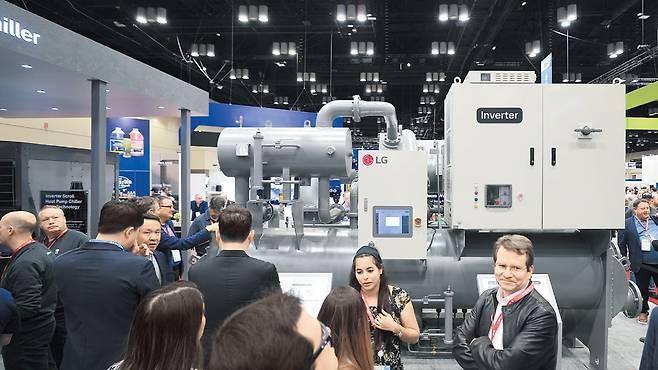
LG Electronics has started supplying chillers, or large-scale cooling systems, to an 800-megawatt artificial intelligence (AI) data center being built by global tech companies in the Middle East. Scheduled for completion in 2027, the facility is nearly eight times larger than the 103MW data center that SK Group and Amazon Web Services are constructing in Ulsan. As AI fuels a global wave of data center construction, LG’s HVAC business, including chillers, is becoming an important source of revenue.
Tech companies are targeting the AI infrastructure that supports the development and operation of AI models used by businesses and consumers. This includes data center cooling, semiconductor materials, components, and equipment. While these sectors have been smaller than companies’ core businesses, they are expected to grow rapidly alongside the AI boom, driving firms to secure an early lead.
Cooling technology has become a major part of the AI ecosystem as AI chips generate more heat with higher performance. For example, NVIDIA’s H100 chip produces 700 watts of heat, while the newer and more powerful GB200 generates up to 2,700 watts.
As cooling becomes essential in the AI era, the market is growing fast. According to Grand View Research, the global data center cooling market is expected to grow from $22.13 billion in 2024 to $56.15 billion by 2030.
Big tech companies such as Microsoft, Google, and Meta are applying cooling technologies that use air or liquid to regulate server temperatures. Super Micro, which uses liquid immersion to cool servers, has seen its stock rise by about 65% this year. Vertiv Holdings, a partner of Nvidia, has risen around 40% over the past year. Microsoft is working on an underwater data center project.
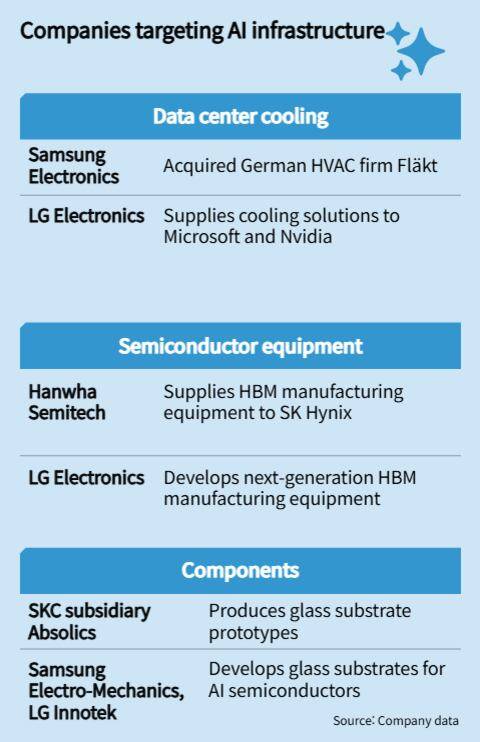
South Korean companies are entering the market as well. Samsung Electronics recently acquired German HVAC firm FläktGroup for 1.5 billion euros. Fläkt supplies energy-efficient cooling systems to data centers in the U.K., the Netherlands, and other countries. Samsung said it expects demand for data centers to continue growing and acquired Fläkt in response. LG Electronics has agreed to supply chillers to Microsoft and is in talks with Nvidia to provide liquid cooling systems for AI servers.
As advanced chip packaging becomes more important for high-performance AI chips, the semiconductor equipment market is heating up. South Korean companies are expanding into the high-bandwidth memory (HBM) sector, where they already lead.
Hanwha Precision Machinery recently changed its name to Hanwha Semitech and is now focusing on semiconductor equipment. The HBM equipment market had been led by Hanmi Semiconductor, but Hanwha is now entering the competition. Hanwha Semitech signed a deal to supply 80.5 billion won worth of HBM equipment to SK Hynix. LG Electronics has also started developing hybrid bonding equipment for next-generation HBM, aiming for mass production in 2028. An industry official said, “Hybrid bonders are high-priced equipment, costing more than twice as much as existing tools. Once production begins, they could make a major contribution to earnings.”
Component makers are also exploring new opportunities in AI infrastructure. One example is glass substrates, which offer better energy efficiency than silicon and are key to producing high-performance AI chips. SKC is building a plant in the U.S. through its glass substrate subsidiary Absolics and has begun producing prototypes. The company is reportedly negotiating supply deals with major tech firms. Samsung Electro-Mechanics and LG Innotek have also started research and development on glass substrates.
Copyright © 조선일보. 무단전재 및 재배포 금지.
- 李 “네타냐후 체포영장 검토하라”
- 삼성, 성과급 시한부 봉합… 勞勞 갈등도 여전
- “北, 우크라전 끝나면 美에 손 내밀 것”
- “트럼프에겐 동맹 명분 안 통해… 결정적 순간 미국 편인지만 본다”
- “한일은 경제 운명 공동체, 공급망 협력 땐 안보도 큰 시너지”
- “이 연사들을 직접 보다니…” 대학생 700명 참관
- “이건희 회장, 눈앞의 이익 대신 ‘5년 뒤 먹고 살 기술 있나’만 물어”
- “어떤 선택 하느냐에 국가 운명 달려… 남북 보면 알 수 있어”
- 이재 “너무 빨리 먹으면 배탈나듯… 모든 위대함엔 시간이 걸리죠”
- “균열의 시대, 새로운 균형 찾아낼 지혜 필요”