For 1st time, more jobless college grads than middle school grads in South Korea
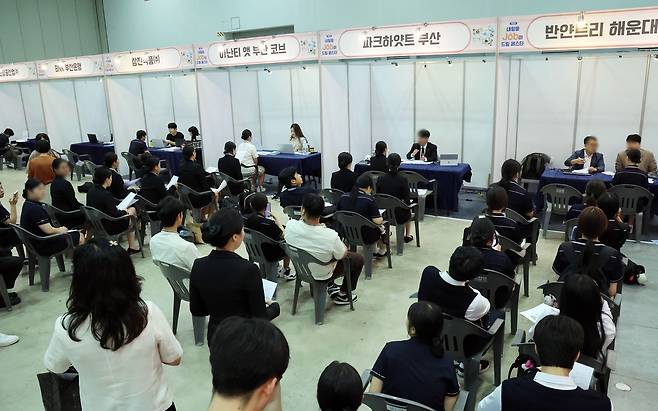
More South Koreans with college degrees are now out of the workforce than those who only finished middle school. It is the first time this has happened, and it reveals a growing fault line in the country’s labor market.
New data released by Statistics Korea on Tuesday showed that 3.048 million people aged 15 and older with a four-year university degree or higher are not working and not looking for work. That number now slightly surpasses the 3.03 million among those whose education stopped at middle school.
Just 10 years ago, the gap between these groups was more than 1 million in the opposite direction.
The shift reflects a wider imbalance. South Korea has one of the world’s highest university enrollment rates, but the job market has not kept up. Many recent graduates are preparing for exams, stuck waiting for job openings or have left the labor market entirely. They are statistically classified as “non-economically active,” meaning they are not employed or actively seeking a job.
Behind the numbers is a tight hiring environment. According to a 2025 survey by the Korea Enterprises Federation, only 60.8 percent of large companies said they planned to hire new staff this year. That is the lowest share since 2022.
College-educated job seekers tend to target high-value sectors like tech or finance. But growth in these areas has slowed. That slowdown is forcing many graduates into limbo, especially as entry-level positions shrink.
South Korea’s service industry offers little relief.
A July report from the Bank of Korea found that labor productivity in domestic services, including IT and retail, was just 39.7 percent of the manufacturing sector in 2024. That ratio has barely moved in 20 years.
Compared to other countries, the gap is just as wide. According to the BOK report, South Korea’s service-sector productivity measured only 51.1 when indexed against the United States at 100. The OECD average was 59.9. Germany reached 59.2. Japan stood at 56.
Copyright © 코리아헤럴드. 무단전재 및 재배포 금지.