Constitution day after crisis: Honoring civic power that defended democracy
이 글자크기로 변경됩니다.
(예시) 가장 빠른 뉴스가 있고 다양한 정보, 쌍방향 소통이 숨쉬는 다음뉴스를 만나보세요. 다음뉴스는 국내외 주요이슈와 실시간 속보, 문화생활 및 다양한 분야의 뉴스를 입체적으로 전달하고 있습니다.
At 10:28 p.m. on December 3 last year, like all Koreans, constitutional scholars watched live on television as former President Yoon Suk-yeol declared martial law. Instinctively, they recognized that “constitutional time” had begun. They could not connect the dots between what they knew about the constitutional requirements for declaring martial law and what Yoon said. His announcement contravened both the substance and procedures of constitutional martial law, they immediately labeled it unconstitutional and tantamount to rebellion. Citizens flocked to Yeouido in front of the National Assembly, while scholars answered reporters’ calls, thinkingit’s their duty to publicize the illegality of martial law.
Responding to their sense of duty, constitutional scholars formed the Constitutional Scholars’ Conference for the Restoration of the Constitution on December 25. Around 100 constitutional scholars held debates and roundtables, and submitted a formal opinion to the Constitutional Court. Their message was clear: the declaration was unconstitutional, and Yoon should be impeached.
At long last, on April 4, Yoon was removed from office, and on June 3, a new president was elected. The Constitutional Scholars' Conference is planning to disband after a final meeting later this month. Yet the question remains, 'Has the constitution been fully restored?’
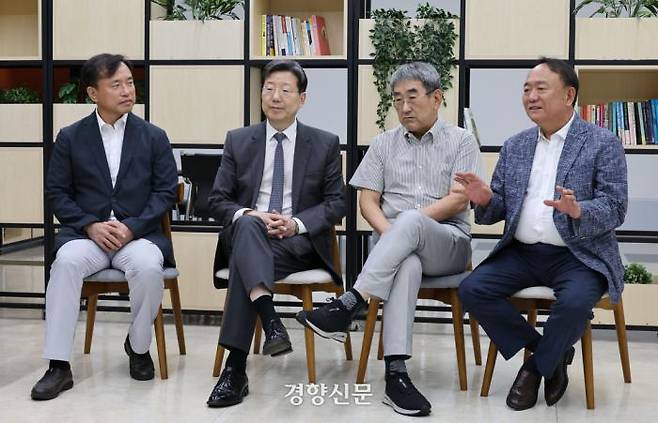
On July 16, a day before Constitution Day, the co-chairs of the Constitutional Scholars' Conference, Professor Kim Seon-taek, Professor Emeritus of Korea University Graduate School of Law, Professor Jeon Kwang-seok, Professor Emeritus of Yonsei University Graduate School of Law, Professor Lee Heon-hwan, Professor of Ajou University Graduate School of Law, and Professor Kim Jong-cheol, Professor of Yonsei University Graduate School of Law, met at the Kyunghyang Shinmun in Jung-gu, Seoul. “This year's Constitution Day is the first birthday after overcoming the constitutional crisis, and the restoration of the constitution is just beginning,” the constitutional scholars said, “We need to come up with measures to further strengthen the power of citizens who have overcome the constitutional crisis.”
More than 100 constitutional scholars gather to provide information for people to decide who owns Constitution
The Constitutional Scholars' Conference was attended by more than 100 constitutional researchers. They all agreed that Yoon's illegal declaration of emergency martial law had created a constitutional crisis and that an urgent response was needed. Therefore, the main focus was to prepare and submit a written opinion to the Constitutional Court stating that Yoon's illegal martial law did not meet the requirements to trigger emergency martial law, both substantively and procedurally, and that the degree of constitutional violations was so serious that he should be removed from office. They created a task force (TF) and gathered opinions through several discussions and roundtables and delivered them to the Constitutional Court in February. When the acting president does not appoint a constitutional court justice, when the acting president vetoes a bill, or when the National Assembly excludes the crime of rebellion under the Criminal Code from the grounds for an impeachment trial, they have published their opinions publicly. “The main purpose is to provide information for the people, who are the owners of the Constitution, to make judgments and to help them make the right judgment through deliberation,” said Professor Kim Jong-cheol.
Many constitutional scholars felt a chill run down their spine when they heard that martial law had been declared. Based on past experiences, it could be another ‘era of darkness’ for constitutional scholars. "After the unconstitutional declaration of martial law in the past, constitutional scholars were mobilized to create a logic to justify a successful coup. The ‘state of emergency’ had arrived in the constitutional law community,” said Professor Lee. ”I also have a personal debt for not having been able to fight the authoritarian government, so I actively spoke out against the illegal martial law on December 3."
Constitutional scholars said South Korean society has now taken the first step toward “restoring the constitution,” but there is a long way to go. “The emergency martial law situation confirmed that the democratic foundation of Korean society is weak,” said Jeon. “It cannot be said that the constitution has been restored just because a ‘decision to impeach’ has been issued while the weak foundation remains intact.” The president, prime minister, ministers, and even lawmakers, who are supposed to represent the people, lacked the will to uphold the constitution.
Nevertheless, the Constitutional Scholars’ Conference decided to end its activities. “The emergency martial law was a collapse of the system of ‘democratic republic’ itself, regardless of political party,” said Professor Kim, adding, “We had no choice but to step forward to defend the constitutional system, but now the emergency is over.” “It will always be like a ‘dormant volcano’ in the constitutional law community, even if it is not active on the surface for the time being,” Lee said.
Meaning of constitution day
Constitutional scholars said this year's Constitution Day should be celebrated with "extraordinary significance. The emergency martial law was created by a president who “denied the constitution,” but it was the citizens who “embodied the constitution” who restored it. “The emergency martial law was also an example of the power of the constitution,” said Jeon. “Unlike the constitution that was ‘given’ by the state in the past, the 1987 constitutional system, which was created by the power of the citizens, was defended by the citizens who could not stand the collapse of the constitution.” Professor Kim Jong-cheol interpreted the constitution as being “shaped” through a “constitutional dialogue process” after the emergency martial law. “The fact that Yoon's declaration of emergency martial law was unconstitutional was also shaped by the citizens who came out to the square and raised their voices,” Kim said.
Constitutional scholars cited the “illegal martial law declaration” and the “attempt to establish an emergency legislative body” as “unconstitutional” measures that should be remembered from the Dec. 3 declaration to today. “The country that the decree sought to create is a country that the ‘Constitution of the Republic of Korea’ cannot imagine,” Kim said, reiterating the unconstitutionality of the decree. Jeon pointed to the attempt to establish an “emergency legislative body” by former Defense Minister Kim Yong-hyun to former Minister of Planning and Finance Choi Sang-mok. “They tried to move toward ‘dictatorship’ by seizing the right to dissolve the National Assembly, which the Constitution does not give the president,” he said. “Former Prime Minister Han Deok-soo sabotaged the presidential impeachment process by withholding the appointment of constitutional judges,” said Professor Kim Jong-cheol, “sympathizing with the insurgency and disturbing the constitutional order.”
Among the constitutional provisions he hopes citizens will take to heart are Article 1, “The Republic of Korea is a democratic republic,” and Article 7, “The sovereignty of the Republic of Korea resides in the people and all power comes from the people.” He added Article 7 of the Constitution, which states, “Public servants serve the people as a whole and are responsible to the people.” “As ‘public servants’ who are supposed to serve the people, members of the National Assembly only partially participated in the lifting of martial law, and they collectively abstained from voting to impeach President Yoon Suk-yeol,” said Jeon. “This shows that the National Assembly had no respect for the interests of the people as a whole.”
'Rise of the far right' is concern, but we need to harden civic soil
Now that the state of emergency is over and the constitution appears to have been restored, many risks remain in South Korean society. In particular, supporters of former President Yoon still refuse to recognize the Constitutional Court's decision and continue to chant "Yoon Again. “It seems inevitable that extremist forces will emerge due to social and economic inequality,” says Jeon, “and a healthy majority will have no choice but to prevent their expansion.” “We need to think about what to do to safeguard the democratic constitutional system when extreme minority forces grow,” said Professor Kim.
However, constitutional scholars cautioned against using legal measures such as ‘unconstitutional party dissolution.’“Dissolving an unconstitutional political party should be a highly exceptional measure,” said Jeon, adding that it should be limited to one-time incidents and ‘persistent’ unconstitutionality of the entire political party rather than individuals within the party. “It will be possible only if there are sufficient facts and evidence to meet the requirements for dissolving an unconstitutional political party,” Kim said, “and it is right for the people to judge through elections.”
Constitutional scholars emphasized the need to find ways to solidify citizens' "constitutional foundations.” “I hope that we can create a ‘Constitution Day,’ whether it's renaming the Constitution Day or designating a new day on December 3, and create an opportunity to constantly remind ourselves of the ‘limits’ that Yoon tried to destroy by imposing martial law,” Kim said. “We need to create constitutional education centers in various places and strengthen constitutional education as part of civic education,” Jeon said.
In particular, he said, efforts should be made to improve the system so that public officials can realize the values of the Constitution. “While the military's passive resistance is positive, we should continue to strengthen constitutional education for military personnel to ensure that the military's identity as the people's army is clear,” said Professor Kim. “The National Human Rights Commission's ‘Yoon Suk-yeol's right to defend himself’ agenda is due to the appointment of a person who goes against the nature of the institution that is supposed to monitor the ‘duty to comply with the constitution,’” said Jeon, adding that the National Human Rights Commission of Korea needs to be normalized.
※This article was translated by an AI tool and edited by a professional translator.
Copyright © 경향신문. 무단전재 및 재배포 금지.
- [단독]“불교계 눈물나게 고마워”···‘1박 90만원’ 부산 BTS 공연 바가지 숙박비에 절에서 팔
- 배우 김규리씨 주택 침입해 강도질 40대 검거
- 뉴스타파 “김두겸, 취재진 폭행”…김두겸 “사실 왜곡, 고발할 것”
- ‘삼전·닉스’ 6억~7억 성과급 풀리면, 동탄 집값 들썩일듯
- 삼성전자 성과급 6억원이면 실수령은 얼마?···세금만 2억4700만원 달해
- 이 대통령, ‘강남 아파트 중국인 싹쓸이’ 보도에 “가짜뉴스 엄중 책임 물어야”
- “건보료 피하려 가짜 직장인 행세, 못 찾을 줄 알았죠? AI가 다 잡아냅니다”
- “끔찍” “경악” “비열”···조롱 일삼는 이스라엘 극우 장관에 전 세계서 십자포화 쏟아져
- 하정우·박민식·한동훈 나란히 콩국수 행사 참석…보수 단일화 변수 속 박민식 ‘삭발’
- [속보]“미용 문신, 무면허 의료 행위 아냐”···‘불법’ 굴레 벗은 문신, 대법도 34년 만에 판