Father of five left brain-dead after Incheon manhole accident donates organs before final farewell
이 글자크기로 변경됩니다.
(예시) 가장 빠른 뉴스가 있고 다양한 정보, 쌍방향 소통이 숨쉬는 다음뉴스를 만나보세요. 다음뉴스는 국내외 주요이슈와 실시간 속보, 문화생활 및 다양한 분야의 뉴스를 입체적으로 전달하고 있습니다.
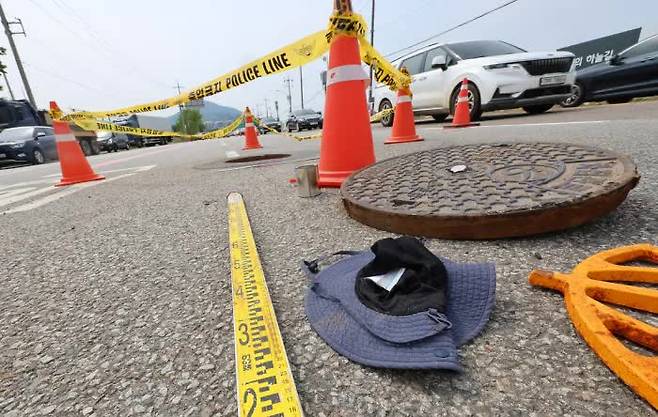
The representative of Company A, Mr. Lee, 48, who was rescued in a state of cardiac arrest and unconsciousness due to a manhole accident in Incheon, was declared brain dead after eight days and donated his organs. He left behind five children, including a 4-month-old infant. The bereaved family has demanded that the Environmental Corporation of Incheon, which is the de facto entity responsible for management and oversight, take full responsibility.
According to reports on July 14, Lee was declared brain dead earlier that day while receiving treatment in the emergency intensive care unit at Inha University Hospital in Incheon. On the morning of the 6th, Lee was found in a manhole on a road in Byeongbang-dong, Gyeyang District, Incheon, in a state of cardiac arrest, and he never regained consciousness. His family expressed their intention to donate his organs, and the surgery was scheduled for 3 p.m. that same day.
On the 6th, Lee traveled from Daegu to Incheon for work. He had been married to his Filipino spouse for nine years and had five children. Following his death, the remaining family consists only of his spouse, who is not fluent in Korean, and their minor children. Lee and his spouse had three biological children: an 8-year-old, a 6-year-old, and a 4-month-old infant, and were preparing to adopt his spouse's two children, aged 11 and 10. Lee’s sister, 50, said, “My sister-in-law used to visit the Philippines to see the kids and brought them back to raise together. After my brother passed, I went to his office and found that two-thirds of the adoption paperwork had been prepared. He worked even on holidays to take care of his five young children, which is so heartbreaking.”
Lee was involved in a subcontracted project to build a geographic information system (GIS) database for the Environmental Corporation of Incheon. He had entered the manhole to rescue a colleague who had collapsed and lost consciousness. His colleague was found dead on the 7th. The bereaved family criticized the lack of safety measures in the manhole, such as the absence of a gas detector, oxygen mask, or ladder, and the failure to provide protective gear. They pointed out issues with the subcontracting system that the Environmental Corporation of Incheon had given the contract to Korea KGT Consultants, which subcontracted it to J-Tech, and J-Tech further subcontracted it to Company A. Lee was the sole representative of Company A. The Environmental Corporation of Incheon said that while they had included a clause prohibiting subcontracting in the contract, they were unaware of any further subcontracting or the work plans. Although subcontracting was explicitly prohibited, the contracted company breached the agreement by not only subcontracting the work but also allowing it to be further subcontracted.
The bereaved family criticized the contracting authority for failing to fulfill its role in overseeing the workers’ affiliations. Lee’s sister said, “If subcontracting was prohibited, they should have confirmed who the workers were employed by. Is it enough to just put 'no subcontracting' in the contract and wash their hands of the responsibility?” She added, “My brother was meticulous, especially because he had many children, and he tried to do his job thoroughly. It’s already tragic that he died, but I’m afraid they’ll blame him for the accident as if he was at fault.”
Despite their grief, the bereaved family decided to donate Lee’s organs. His sister said, “Considering his good character and his desire to raise his spouse’s children as his own, I thought that if he could leave this world in a meaningful way, his children might eventually benefit from his generosity.”
Lee had not subscribed to industrial accident insurance as he was running a one-person company. If his employment status as a worker is not recognized, his family cannot receive survivor benefits from the Korea Workers’ Compensation and Welfare Service. If the relationship between his death and work-related accidents is clarified, the bereaved family can claim survivor benefits. The family has expressed their position, saying that the Environmental Corporation of Incheon, as the actual contracting and supervising entity, should offer a sincere apology and take responsibility for compensation. Lee’s sister said, “We will find ways to provide at least basic livelihood support for the remaining children.”
The Environmental Corporation of Incheon responded, saying, “The first-tier contractor will take responsibility for hospital expenses. Once the investigation into the accident is complete, we will provide as much support as possible for compensation. As for the contracting authority’s responsibility, we will cooperate fully with investigations by the police and the Ministry of Employment and Labor.”
※This article was translated by an AI tool and edited by a professional translator.
Copyright © 경향신문. 무단전재 및 재배포 금지.
- 세계 최빈국에 날아든 이토록 혹독한 청구서···무너진 히말라야에 네팔이 운다
- 트럼프 행정부 이민 단속에 ‘맥도날드’ ‘서브웨이’ 사라지는 이유는?
- 이 대통령, ‘레버리지 ETF 논란’ 김용범 유임···장관 바꾸고 참모는 지켰다
- 2027년생부터 18세까지 최대 1억4천만원···정부 청년 정책, 재원 지속 가능할까
- ‘공취모’ 대표 김승원, 법무장관 후보에…이 대통령 공소취소 시도할까
- [영상]SF영화가 따로 없네···50cm 막대기서 프로펠러 4개가 쫙, 범죄 현장 출동하는 ‘휴대용 자
- “밤잠이 안 온다면? 아침에 단백질을…” 수면 전문가가 추천하는 아침 식단
- 149t급 유조선 몰면서 ‘비틀비틀’···해경 음주 측정 거부 60대, 징역형 집행유예
- “배, 상온에 두면 더 달아질까?”…비싼 배 사자마자 ‘이렇게’ 보관하세요
- “대만에서 들고다니면 다 알아봐” 한국 3000원 쇼핑백이 여행 필수품 된 이유