Hong Kong finance chief courts Korean firms for listings, ETF partnerships
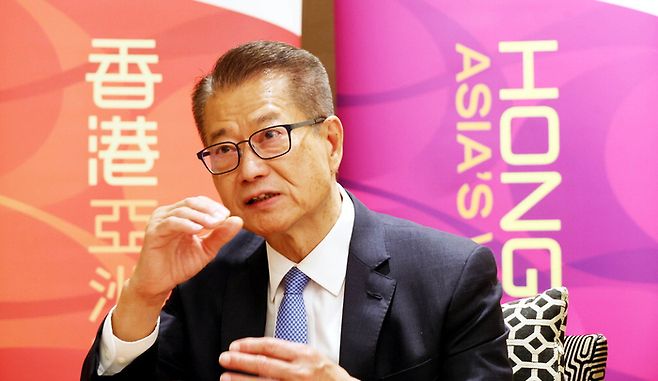
“We welcome Korean companies to list on the Hong Kong Stock Exchange, and I hope we can launch ETFs that are traded in both Korea and Hong Kong,” said Paul Chan Mo-po, Hong Kong’s Financial Secretary, in a recent interview with Maeil Business Newspaper.
He emphasized Hong Kong’s strength as an international financial hub and extended a direct invitation to Korean businesses and financial institutions.
Chan said he is particularly interested in Korean firms in technology, consumer goods, and animation, and expressed readiness to establish regulatory frameworks that would support dual or secondary listings of Korean companies in Hong Kong.
His comments come amid a resurgence in Hong Kong’s IPO market.
In the first half of 2025, the city recorded the world’s largest IPO volume among single exchanges, buoyed by secondary listings from major Chinese firms such as CATL.
The benchmark Hang Seng Index has climbed 23 percent so far this year.
Chan stressed that beyond Chinese companies, firms from across Asia—including Korea—could benefit from listing in Hong Kong, gaining exposure to both mainland Chinese capital and global investors. He also noted that Hong Kong offers multiple fundraising channels including angel investment, venture capital, private equity, and bond markets.
He dismissed concerns about the National Security Law, which has been cited as a potential risk by some foreign investors.
“I would encourage skeptics to come and see Hong Kong for themselves,” Chan said. “According to a recent survey by the American Chamber of Commerce, over 70 percent of members currently operating in Hong Kong said the law has had no impact on their business.”
As part of deeper financial integration, Chan proposed creating cross-listed ETFs that track Korean equities.
One example he cited was Invesco QQQ Trust (QQQ), the world’s fifth-largest ETF, which began cross-trading in Hong Kong in February this year in HKD and RMB, while continuing to trade in USD on Nasdaq.
“If an ETF tracking Korean stocks were listed in Hong Kong, it could attract substantial capital inflows from mainland China into the Korean market,” he said.
Chan added that ETFs reflecting market trends—such as those with 2x leverage on Samsung Electronics—could further boost investor interest and bilateral financial ties.
Chan also outlined Hong Kong’s ambition to become the world’s leading asset management hub by 2028, bolstered by initiatives to attract family offices managing at least $50 million in assets.
Regarding the territory’s soon-to-be-enforced stablecoin regulations, Chan underscored the importance of balancing fintech innovation with financial stability and investor protection.
Copyright © 매일경제 & mk.co.kr. 무단 전재, 재배포 및 AI학습 이용 금지
- “삼성·현대차 거르고 샀더니 2배 벌었네요”...수익률 113% 대기업 그룹주 ETF는 - 매일경제
- “명품도 아닌데 오픈런” 신라호텔, 전설의 에코백 리뉴얼했다는데 - 매일경제
- 조합원 절반이 이주비대출 ‘0원’···재개발 대혼란 - 매일경제
- 변압기·전선 … K그리드 24조 수주 美전력산업 '슈퍼사이클' 올라탔다 - 매일경제
- “은퇴하면 한 푼이 절실한데”…1036조 국민연금 고비용 논란, 뭐길래 - 매일경제
- “양양 가면 믿고 거른다”…‘선정적 루머’ 확산에 고통받는 지역주민들 - 매일경제
- “언제까지 서류준비만 할래?”...구직자들 정곡 찌른 ‘면접왕’ 조언은 - 매일경제
- “3개월전에 샀으면 이게 다 얼마야”…로켓처럼 튀어오르는 쿠팡 주가 - 매일경제
- 올 여름엔 전기요금 폭탄 안 맞을까 …당정 “7~8월 누진제 구간 완화” - 매일경제
- ‘최하위’ 키움, 홍원기 감독·고형욱 단장 동반 경질 충격 결단 [공식발표] - MK스포츠