Trump announces 25 percent tariff on all Korean products starting August 1
이 글자크기로 변경됩니다.
(예시) 가장 빠른 뉴스가 있고 다양한 정보, 쌍방향 소통이 숨쉬는 다음뉴스를 만나보세요. 다음뉴스는 국내외 주요이슈와 실시간 속보, 문화생활 및 다양한 분야의 뉴스를 입체적으로 전달하고 있습니다.
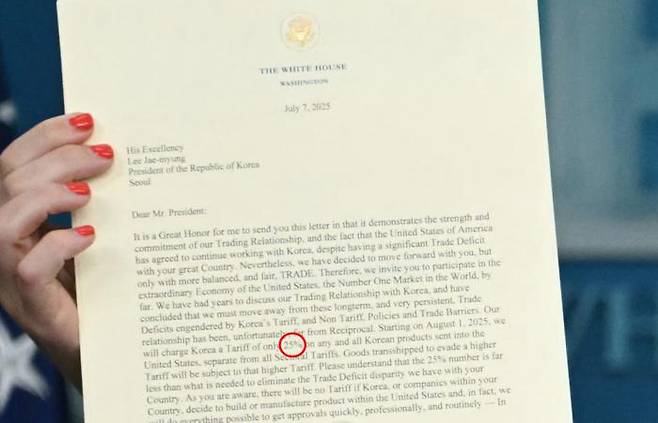
U.S. President Donald Trump announced on July 7 (local time), just one day before the deadline for the reciprocal tariff suspension, that a 25 percent tariff will be imposed on all Korean products starting August 1. This puts pressure on the Korean government, which had dispatched its top security and trade officials to Washington for last-minute negotiations, to strike a trade deal with the U.S. within the remaining three weeks before the tariffs take effect.
President Trump posted a letter on Truth Social addressed to President Lee Jae-myung, saying, “Starting August 1, we will impose a modest 25 percent tariff on all products from Korea.” He emphasized that “this tariff is separate from all existing item-specific tariffs,” and added, “a 25 percent tariff falls far short of the level needed to correct our trade imbalance with Korea.” The proposed tariff matches the 25 percent reciprocal rate Trump previously announced on April 2.
Trump also warned of retaliatory measures if Korea responds with higher tariffs on American goods. “No matter how much you raise tariffs on U.S. imports,” he wrote, “we will increase our 25 percent tariff on Korea by the same amount. Products transshipped through third countries to avoid tariffs will face even higher duties.”
However, Trump left the door open for negotiations, saying the tariffs “could be adjusted” if Korea opens its markets and removes tariff and non-tariff barriers. This suggests there is still room for a deal before the implementation date of August 1. Later, during a dinner with Israeli Prime Minister Benjamin Netanyahu, when asked by reporters whether the letter represented the U.S.’s final offer, Trump replied, “If they call with another offer and I like it,” suggesting the tariff rate could be subject to change.
Trump also stated that “the tariff may be adjusted upward or downward depending on the relationship between your country and ours.” This is interpreted to mean that the tariff rate could be determined not only based on trade negotiations but also by taking into account the broader state of bilateral relations, including security issues.
Korea’s National Security Adviser Wi Sung-lac met in Washington that day with U.S. Secretary of State Marco Rubio, who also serves as the White House National Security Advisor, to discuss bilateral issues including tariffs.
The presidential office in Seoul said, “Our side expressed hope that an early summit between the two leaders would help advance mutually beneficial outcomes on pending issues,” and added that “the U.S. side responded positively.” Presidential Chief of Staff for Policy Kim Yong-beom also convened an interagency meeting on trade issues that afternoon, stressing, “While prompt negotiations are important, securing the national interest is an even more vital value.”
※This article has undergone review by a professional translator after being translated by an AI translation tool.
Copyright © 경향신문. 무단전재 및 재배포 금지.
- 용산땅부터 ‘받들어총’ ‘철근누락’까지 국토부·서울시 갈등, ‘보고 누락’ 사태 키웠나
- 프라다 재킷, 1번 입고 수십개 흰색 반점···“변색 하자, 프라다가 전액 배상해야”
- ‘스벅 탱크 텀블러’ 든 전두환?…조롱 패러디까지 만든 ‘극우’ 누리꾼
- 컬럼비아대 학사모 쓴 ‘신세계 손녀’ 올데프 애니···졸업식서 카메라 향해 “데이원 사랑해
- 이 대통령, ‘김용범 발언’ 블룸버그 정정기사 공유…“조작·왜곡 보도 일삼는 국내 언론이 귀
- 이달에만 두 번째···하동 레일바이크 추돌 사고로 1명 사망·3명 부상
- “오늘은 쀼의날” “남편, 잘 생겼네 하하”···이 대통령·김혜경 여사, 부부의날 ‘달달 부부
- 삼성전자 반도체 사업성과 10.5% 상한 없이 전액 자사주 지급···임금인상률 6.2%
- [단독]이스라엘에 붙잡힌 ‘가자지구 항해’ 한국인들 “팔레스타인과 더 깊이 연대해야”
- 호르무즈서 한국 선박 1척 빠져나왔지만···발 묶인 한국인 선원 ‘116명’ 남았다