Seoul grapples with massive lovebug swarms this summer
이 글자크기로 변경됩니다.
(예시) 가장 빠른 뉴스가 있고 다양한 정보, 쌍방향 소통이 숨쉬는 다음뉴스를 만나보세요. 다음뉴스는 국내외 주요이슈와 실시간 속보, 문화생활 및 다양한 분야의 뉴스를 입체적으로 전달하고 있습니다.
“Bugs keep landing on my face wherever I go. I cannot live like this.”
Park, a 26-year-old office worker in Seoul’s Eunpyeong district, recently decided to move. Park’s officetel window screen is covered with lovebugs, or Plecia nearctica, preventing the 26-year-old from opening the window even in summer. Some bugs enter the home, making it difficult to sleep. “Imagine bugs coming in even at dawn. It gives me chills,” Park said.
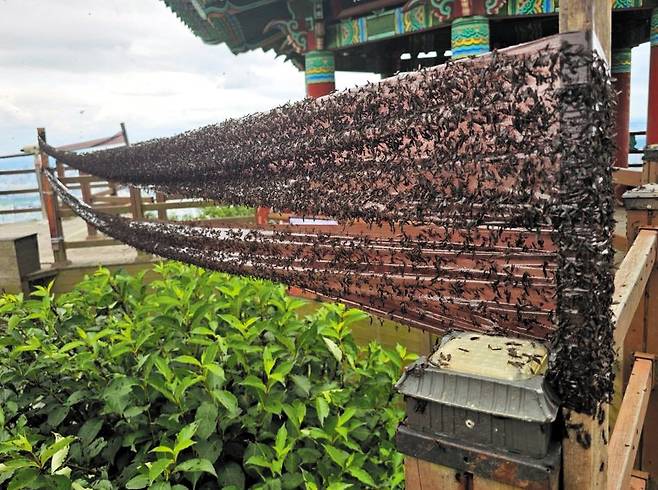
Lovebugs are once again swarming residential areas and hiking trails across the capital region. These insects appear in large numbers in June and July, just before the rainy season, when temperatures and humidity rise. This year, their spread began earlier than usual, prompting complaints from residents and business owners. Some are demanding extermination, but authorities are cautious. The insects are harmless to humans and feed on pests like mites.
Choi Min-seok, 28, who enjoyed running along the Han River after work, recently joined a gym. Lovebugs sticking to his body and face have made running outside difficult. “When I run in light clothes and accidentally swallow a lovebug, I lose all motivation to keep going,” he said.
At Daejo Market in Eunpyeong district on July 1, the ground was black with thousands of dead bugs. Park Gyun-sang, 77, who has operated a mill there for 45 years, was swatting bugs away from his display. “A few days ago, bugs got into a bowl of powdered soybeans, and I had to throw it all out,” he said. Lee Sang-chul, 50, who owns a fishcake stall, said, “Even with a glass cover, the bugs find their way in. I’m always worried about how this bothers customers.”
At nearby Jeil Market, 68-year-old fruit vendor Cho Ki-jun was constantly fanning away lovebugs swarming his fruit display. Two small fans were directed at the produce rather than at him “It’s so hot that I should be cooling myself, but I’m using the fans to chase away bugs. It’s ironic.”
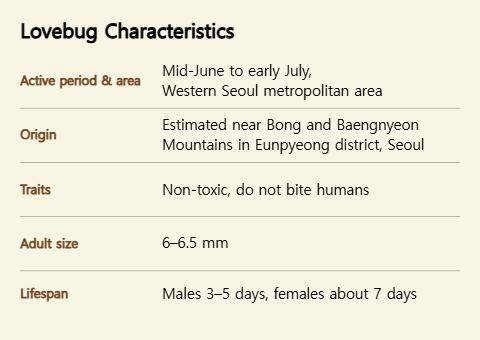
Lovebugs are an invasive species first found in South Korea in 2015, when eggs were discovered in Incheon. Their numbers began to rise sharply in 2022. They are believed to have come from northern China, as genetic tests show similarities to bugs found in areas like Shandong. They are called “lovebugs” because the male and female stay joined together while flying and mating.
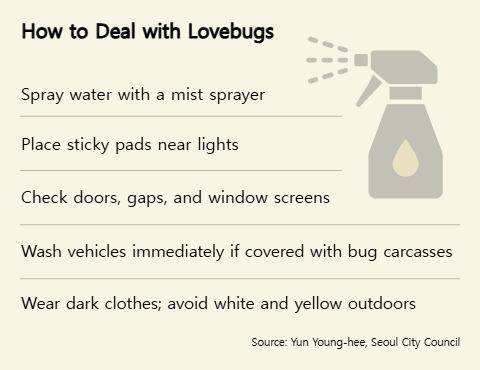
The larvae decompose organic matter in the soil and help enrich it, so the species is classified as beneficial and excluded from pest control. Adult bugs secrete an acidic substance that deters predators like frogs and toads. Some districts, such as Mapo, have chosen to spray water instead of using insecticides.
According to Seoul city data, complaints involving lovebugs are rising rapidly, from 4,418 in 2022 to 5,600 in 2023, and 9,296 last year. Recently, photos and videos showing piles of dead bugs more than 10 centimeters high on trails in Incheon’s Gyeyang Mountain area have circulated online. However, the exact cause of these dense local outbreaks remains unclear.
Copyright © 조선일보. 무단전재 및 재배포 금지.
- 누가 청년들에게 총을 쐈나 ‘3·1절 남대문 총격 사건' [호준석의 역사전쟁]
- ‘북측’ 발언에 긁힌 北축구팀… 탈북민 “살기 위해 저러는 것”
- 어쩌면 가문의 영광?… 메이저리그 김하성 경기에 시구자로 나선 이 외교관
- 이란 “종전 합의 근접... 핵 논의 30~60일 유예 논의 중”
- 나홀로 임윤찬 공연 보고 싶다면...티켓 300장 26일 11시 오픈
- 트럼프 시대의 역설...더 가까워진 한일 관계
- “앞으로 주가 좌우할 미국 금리, 70년대 미국의 실수가 지금 떠오르는 이유”
- 40만개 판매 돌파, 생수 속 미세플라스틱 걸러주는 간편한 필터
- 美 대박 한국 레이저 동전 파스, 기자가 써보니 “근육통 절반으로 줄어”
- 美·이란, 종전 협상 급물살… 트럼프 “협정 최종 사안 논의중, 조만간 발표”