Korea's been trying to win Tonys for decades. 'Maybe Happy Ending' did one thing differently.
전체 맥락을 이해하기 위해서는 본문 보기를 권장합니다.
Meanwhile, Korea's musical production houses were vying for their chance to enter the global market with less Korea-centric shows. Musicals licensed from Broadway and the West End began flooding in and tended to sell well. Korean producers, as a consequence, began staging more large-scale productions featuring Western characters with sets and costumes that mimicked Broadway's razzle-dazzle, like "The Man of La Mancha," "Jekyll and Hyde" and "The Man Who Laughs."
From the outset, the goal was to adapt "the most American novel" into a musical, Shin told reporters last year upon the Broadway opening of "The Great Gatsby."
이 글자크기로 변경됩니다.
(예시) 가장 빠른 뉴스가 있고 다양한 정보, 쌍방향 소통이 숨쉬는 다음뉴스를 만나보세요. 다음뉴스는 국내외 주요이슈와 실시간 속보, 문화생활 및 다양한 분야의 뉴스를 입체적으로 전달하고 있습니다.
![Helen J Shen, left, and Darren Criss in the Broadway production of "Maybe Happy Ending" [YONHAP]](https://img2.daumcdn.net/thumb/R658x0.q70/?fname=https://t1.daumcdn.net/news/202506/10/koreajoongangdaily/20250610150432635oxef.jpg)
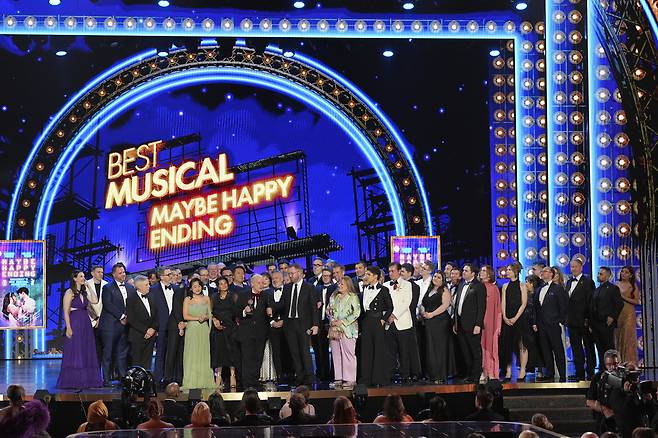
The path from central Seoul’s theater district, Daehak-ro, to Broadway has long felt out of reach for Korean musicals — virtually unthinkable. But “Maybe Happy Ending” defied the odds on Monday, winning six Tony Awards and offering a glimpse of what’s possible.
That success didn't come overnight. “Maybe Happy Ending” started as a workshop in 2015. Its final Korean performances, before it took off for the billboards of Broadway, took place in a small venue in Daehak-ro. And for decades before that, a steady wave of Korean musicals has been making steady inroads overseas, diligently paving the way for an eventual breakout success. “This project represents, arguably, one of the biggest outputs to come out of a long line of musicals that have gone through that scene,” said musical critic Lee Su-jin.
The nearly 30-year trajectory is filled with small wins and failures that go less noticed but are still essential parts of the framework supporting Korea's cultural soft power. “Maybe Happy Ending” followed in the footsteps of the many giants that came before it — but also broke the mold in one important way.
Overseas K-musicals begin with history
![A scene from the 2024 Korean production of musical "Maybe Happy Ending" [CJ ENM]](https://img2.daumcdn.net/thumb/R658x0.q70/?fname=https://t1.daumcdn.net/news/202506/10/koreajoongangdaily/20250610150436853qwss.jpg)
The first homegrown musical to make a meaningful mark abroad was “The Last Empress” in 1997, staged as a limited run at New York City’s Lincoln Center.
![A scene from the musical ″Last Empress″ [JOONGANG ILBO]](https://img2.daumcdn.net/thumb/R658x0.q70/?fname=https://t1.daumcdn.net/news/202506/10/koreajoongangdaily/20250610150438985wzne.jpg)
“I knew Korea was late in the race to make musicals. I did believe, though, that if we could put something out into the world that was uniquely ours, it might work,” artistic director Yoon Ho-jin told reporters in February, when the musical opened for its 21st run in Seoul. The same month, the show became the first homegrown musical to draw over 2 million viewers.
“Last Empress,” titled “Empress Myeongseong” in Korean, is about the namesake queen (1851-1895), her marriage to Emperor Gojong (1852-1919), leadership in diplomacy and eventual assassination by Japan, which viewed her as an obstacle to expansion.
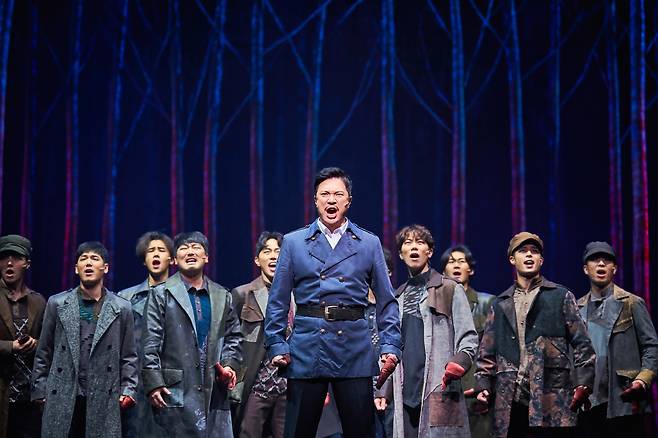
“Hero,” an agitprop, patriotic drama that depicts independence activist Ahn Jung-geun's feats, was the second Korean new musical to be recognized abroad.
It also played a limited run at the Lincoln Center. The New York Times gave it a lukewarm review at the time, describing the show’s drama as “awfully Soviet for a South Korean production” and that “The songs, with their swelling choruses and throbbing emotions, sound like Asian pop with hints of Andrew Lloyd Webber and American Top 40.”
The show is still popular in Korea, having staged its 10th run last May and becoming the first Korean musical to be adapted into a film. The movie version of the same title opened in theaters in December 2022 and sold 3.26 million tickets, according to the Korean Film Council. It stars Jung Sung-hwa and Kim Go-eun. Both “Hero” and “Last Empress” are considered proud pillars of the domestic musical industry and must-see shows for Koreans. But neither managed to achieve long-term runs or commercial success abroad.
Bringing Broadway's razzle-dazzle to Korean shows
![A scene of Broadway's "The Great Gatsby" [OD COMPANY]](https://img4.daumcdn.net/thumb/R658x0.q70/?fname=https://t1.daumcdn.net/news/202506/10/koreajoongangdaily/20250610150442804ocwb.jpg)
Meanwhile, Korea’s musical production houses were vying for their chance to enter the global market with less Korea-centric shows. Musicals licensed from Broadway and the West End began flooding in and tended to sell well. Korean producers, as a consequence, began staging more large-scale productions featuring Western characters with sets and costumes that mimicked Broadway’s razzle-dazzle, like “The Man of La Mancha,” “Jekyll and Hyde” and “The Man Who Laughs.” One of the first producers to try their hand on Broadway was Shin Chun-soo, CEO of the production house OD Company. He took part in producing Broadway’s “Dream Girls” in 2009, “Holler if Ya Hear Me” in 2014 and “Doctor Zhivago” in 2015 — none of which were commercially successful. But he recently tasted the fruits of his efforts with “The Great Gatsby,” which set sail on Broadway in April of last year after a tryout in October 2023 at Paper Mill Playhouse in New Jersey. The production featured a high-profile team, including Grammy-winning composer Jason Howland and Tony nominees Eva Noblezada and Jeremy Jordan. From the outset, the goal was to adapt “the most American novel” into a musical, Shin told reporters last year upon the Broadway opening of “The Great Gatsby.” The JoongAng Ilbo reported that OD Company covered half the show’s $25 million budget, with the rest raised through outside investment. The musical broke into the coveted “million club” — Broadway’s benchmark for commercial success, defined by weekly ticket sales exceeding $1 million. The show also received the Tony Award for Best Costume Design in a Musical in 2024.
The musical, however, wasn't well received by Broadway critics. Variety's review reads: “The creatives have committed wholeheartedly to the spectacle of the story, but forgot the substance.”
![A scene from the Asian touring production of the musical "Sister Act" [EMK MUSICAL COMPANY]](https://img1.daumcdn.net/thumb/R658x0.q70/?fname=https://t1.daumcdn.net/news/202506/10/koreajoongangdaily/20250610150444453mvoo.jpg)
EMK Musical Company, another major musical production house in Korea, proved its worth by becoming the nation's first to produce an international touring production of a Broadway show with “Sister Act” in 2023.
Blockbuster musicals “are staged all around the world, but only a handful of countries actually produce them, and with over a decade of experience in successfully producing shows, we think that EMK can do it too — heck, we can do it better!” Sophy Kim, vice president and producer of EMK, told press in 2023.
![Poster for the West End production of the Korean musical "Marie Curie," staged in 2024 at London's Charing Cross Theatre [LIVE]](https://img2.daumcdn.net/thumb/R658x0.q70/?fname=https://t1.daumcdn.net/news/202506/10/koreajoongangdaily/20250610150446180qxqb.jpg)
“Marie Curie,” following the life of its namesake scientist and her journey to find a cure for cancer, was produced by Korea's Live musical production house and premiered on London's West End in June 2024. It did not win any major awards, and local reviews were not incredibly sympathetic. The Guardian gave it two stars out of five, writing that the “fast and furious Korean show has high-voltage tunes,” but that it “suffers from schmaltz and a breathlessly hectic pace.” “From the very beginning, we've been working toward bringing this production overseas, and it received a positive response in Korea, Japan and Poland,” Live CEO Kang Byung-won said in a statement last year. “Our goal is to expand the beloved Korean work to resonate with audiences worldwide, transcending Asia.”
![A scene from the musical "Marie Curie" LIVE]](https://img1.daumcdn.net/thumb/R658x0.q70/?fname=https://t1.daumcdn.net/news/202506/10/koreajoongangdaily/20250610150447826jnoi.jpg)
'Maybe Happy Ending' finally gets its happy ending
![Helen J Shen, left, and Darren Criss perform ″Never Fly Away″ from ″Maybe Happy Ending″ during the 78th Tony Awards on Sunday, June 8, 2025, at Radio City Music Hall in New York. [AP/YONHAP]](https://img2.daumcdn.net/thumb/R658x0.q70/?fname=https://t1.daumcdn.net/news/202506/10/koreajoongangdaily/20250610150449731rhif.jpg)
“Maybe Happy Ending” did one thing differently: Its path to Broadway was driven by its writers, Hue Park and Will Aronson, rather than a production house.
Typically, a show's original Korean producers hold its rights. Live, for instance, produced “Marie Curie” on the West End while a British creative team oversaw the English-language adaptation. “The Great Gatsby” began with OD Company and Shin, who first conceived of the show and then put together a creative team in the United States to help realize their vision on Broadway.
But as more typical in the West, “Maybe Happy Ending” began and ended with its writers.
Park and Aronson developed the story from top to bottom and were involved in all aspects of the production, having followed it through countless sets, venues and casts. CJ ENM put on the show's most recent Seoul run, but the duo staged its U.S. previews in Atlanta, Georgia, in 2020 and sought out producers there, ultimately partnering with Jeffrey Richards and Hunter Arnold to bring the musical to Broadway.
Lee believes this was essential to the show’s global success.
![Hue Park, left, and Will Aronson pose with the Best Score award and Best Book of a Musical award for "Maybe Happy Ending" backstage at the 78th Annual Tony Awards at Radio City Music Hall on June 8, 2025, in New York City. [AP/YONHAP]](https://img2.daumcdn.net/thumb/R658x0.q70/?fname=https://t1.daumcdn.net/news/202506/10/koreajoongangdaily/20250610150451608iwti.jpg)
“Production companies have been knocking on Broadway’s door for years, hoping to win an award or gain recognition. But to be blunt, most of those attempts have failed,” the music critic said. "'Maybe Happy Ending' shows that when composers and writers develop a story and subject matter they truly care about and build it up from the ground, it’s ultimately more effective than a producer hiring a writer or composer just to chase an award.
“Works born from the creators’ authentic desire and vision,” Lee said, “are more likely to connect with audiences than those driven by a producer’s agenda.”
BY LEE JIAN [lee.jian@joongang.co.kr]
Copyright © 코리아중앙데일리. 무단전재 및 재배포 금지.
- 'We Are Back': HYBE marks BTS return with decorations at headquarters
- Abandoned dog rescued in mountains with 66-pound weight tied to neck
- Trump Jr. reshares 'Rooftop Korean' meme as protests over immigration crackdown rage in LA
- President Lee Jae-myung vows to relocate the presidency to Sejong. But should he?
- Busan booms with viral tourist hotspots as visitors look beyond Seoul
- K2 rifle mistakenly left in rental car raises alarm over military firearms management
- The Black Label to debut mixed-gender group Allday Project
- No longer soldiers, BTS's RM and V march back to ARMY
- Shocked by ramyeon prices, president calls for relief for costs of everyday goods
- Koreans in LA caught in the crossfire as Trump immigration crackdown protests intensify