[Interview] Shaping the soul, one bite at a time—Sushi Kanesaka comes to Seoul
이 글자크기로 변경됩니다.
(예시) 가장 빠른 뉴스가 있고 다양한 정보, 쌍방향 소통이 숨쉬는 다음뉴스를 만나보세요. 다음뉴스는 국내외 주요이슈와 실시간 속보, 문화생활 및 다양한 분야의 뉴스를 입체적으로 전달하고 있습니다.
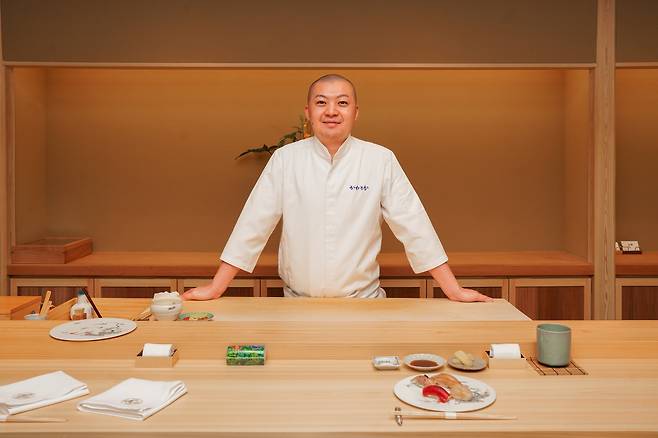
It takes about 30 seconds to form a single piece of sushi—cupping the shari (sushi rice) by hand, placing the neta (topping) on top, and laying it on the dish. Another 15 seconds to lift it with chopsticks and bring it to the mouth. In under a minute, the diner’s judgment is sealed. This fleeting moment may seem brutally short, especially for the sushi chefs who dedicate their lives to that one bite.
Even if one piece passes the test, the next is not guaranteed. Each sushi is judged anew. With every topping change, tension lingers. A hundred pieces can be perfect, but if one falters, the ideal of perfection the chef strives for falls apart. Sushi’s simplicity—rice, fish, wasabi—belies the depth of thought and precision it demands. Behind its minimalist form lies a complex philosophy and rigorous craftsmanship.
That’s why each piece must be crafted with meticulous care. Watching a master at work behind the counter, one can sense a quiet elegance in their hands. The way they adjust pressure to trap just the right amount of air in the rice is as delicate as pressing a piano key. Their movements resemble a silent dance—graceful, precise, and purposeful.
This philosophy is embodied by Sushi Kanesaka, the renowned two-Michelin-starred restaurant from Japan. Its creed—to pour one’s soul into every single piece—has made it a beacon of Edomae sushi.
In November last year, Sushi Kanesaka opened a branch in Grand InterContinental Seoul Parnas in Samseong-dong, bringing Edomae traditions to Korea. Edomae, originating in the Edo period (1603–1867), refers to sushi hand-formed in the classic Tokyo style.
This attention to authenticity is evident throughout the Seoul location. The design was overseen by Japanese firm Itai, which has worked on all Kanesaka locations worldwide. The sushi counter was crafted with Japanese hinoki wood and imported directly from Japan. But the true essence lies not in materials, but in the transmission of Kanesaka’s philosophy.
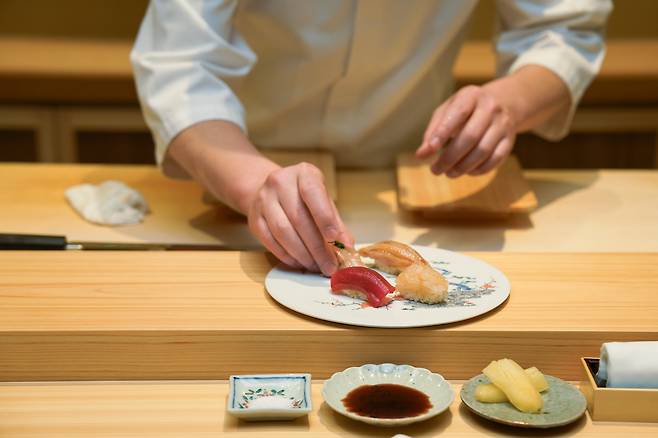
That philosophy rests on three pillars. First, staying true to the essence of sushi. At Kanesaka, this begins with the shari. The rice is treated as the foundation of the dish—its texture and temperature can define the entire experience.
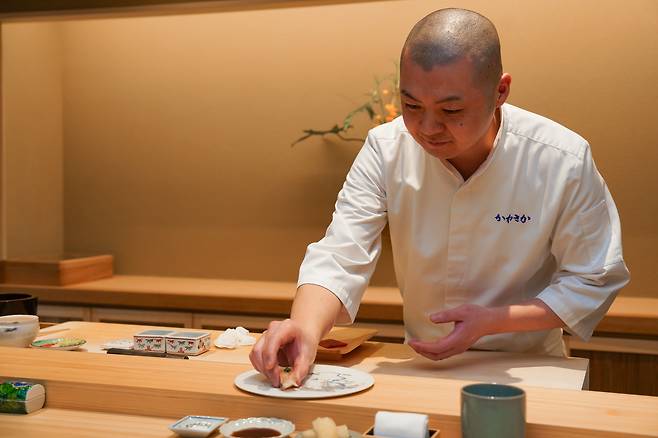
Second, delivering a perfect moment for the guest. The act of placing a piece of sushi on the plate is treated as a ritual. Kanesaka describes this as “0.5 seconds of elegance, 0.7 seconds of refinement”—the chef lingers half a second when presenting the sushi, and another brief pause after handing it over. These fractions of time create a lingering impression, designed to resonate long after the meal.
Lastly, every chef is trained to carry the spirit of craftsmanship. At Kanesaka, food is not simply nourishment—it’s a way to uplift and refine the person who partakes in it.
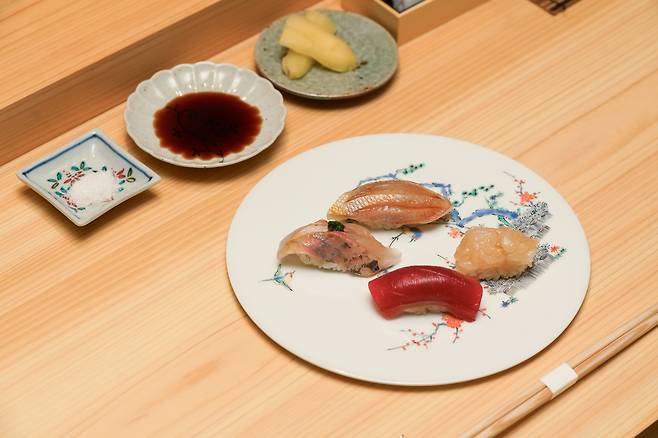
Of course, the appeal of Sushi Kanesaka also lies in the flavors. Seasonal Korean ingredients bring familiarity and freshness. Citrus notes from yuzu zest and young kabosu accent the pristine seafood, evoking the feeling of spring in bloom. The richly marbled tuna—properly aged and expertly sliced—reveals layers of iron and umami that melt delicately on the tongue. Few dishes express the changing seasons as gracefully as sushi.
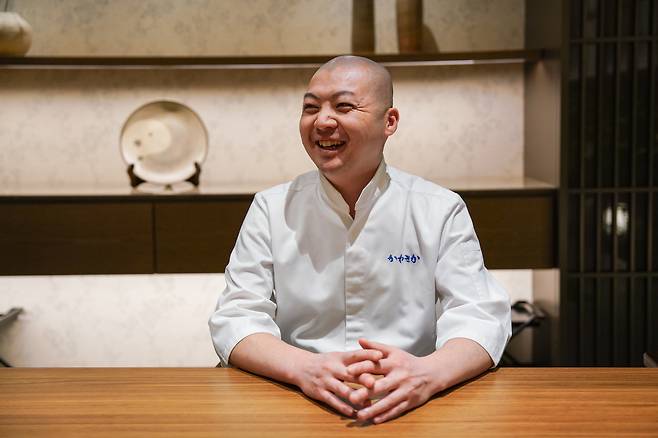
Tamaru Mitsuhiro, who helms the Seoul branch, carries the torch of Kanesaka’s philosophy. With over 20 years of experience in Japan, followed by time in Macau and Singapore, Tamaru arrived in Korea last year. He seeks to convey sincerity through his sushi—not only upholding tradition, but evolving with the times and context he now finds himself in.
―Could you briefly introduce Sushi Kanesaka?
“My name is Tamaru Mitsuhiro, and I lead the team at Sushi Kanesaka. Our restaurant is dedicated to preserving the essence of traditional Japanese sushi. Staying true to that essence is the direction we strive to uphold every day.”
―Sushi Kanesaka places great importance on its shari. Could you tell us more about that?
“We currently import the vinegar we use directly from Japan. Everything we do here is geared toward faithfully recreating the original recipes used at our flagship in Tokyo. Before opening the Grand InterContinental Parnas location, we tested ten different varieties of rice to find one closest to what we use in Japan. The rice we selected is slightly firmer, has less stickiness, and carries a more neutral aroma—all qualities we believe make it ideal for our sushi."
―What would you say is the unique strength of your Seoul location?
“First of all, we’re honored to be located inside such a prestigious hotel. I believe the InterContinental aligns perfectly with our goal of delivering complete guest satisfaction. The service provided by the hotel staff ensures that our guests already feel welcomed even before they take their seat.”
―What sushi best represents Sushi Kanesaka?
“In Japan, we’re known for our tuna (maguro), sea urchin (uni), and horse mackerel (aji). Securing top-quality tuna starts from early in the morning every day. The best cuts are those that retain color, carry a pleasant aroma, and have a balanced fat content. While it’s not easy to find the same quality tuna in Korea as we do in Japan, we’re constantly searching for the very best ingredients available locally. Korean horse mackerel, for example, is just as exceptional as what you’d find in Japan.”
―You’ve mentioned that the essence of sushi lies in the shari. What sets Sushi Kanesaka apart in that regard?
“Once we prepare a batch of sushi rice, we only use it for about two hours—anything leftover after that isn’t reused. That’s because the evaporation of vinegar over time affects the flavor. We season the rice using only salt and vinegar. Our goal isn’t to impress with extravagance, but to convey the depth of tradition."
―What is the core philosophy of Sushi Kanesaka?
“We believe in pouring our soul into every single piece. I shape each piece with that mindset. That also means paying close attention to each guest. Whether a guest is drinking water or sake, whether they are male or female, whether it’s a business meeting or a special occasion—all of these factors influence how I craft each piece. Ideally, sushi should not immediately fall apart in the mouth, but it shouldn’t be too firm either. And above all, the harmony between the fish and the rice must be preserved."
―Have you made any adaptations to suit local Korean preferences?
“Yes, I’ve noticed that many Korean guests prefer slightly smaller portions of rice. They also tend to enjoy bolder seasoning. So, we do adjust accordingly. We also try to incorporate seasonal Korean ingredients to better reflect local tastes and sensibilities.”
―The idea of “0.5 seconds of elegance and 0.7 seconds of grace” is fascinating. Could you explain what that means?
“That’s something our founder strongly believes in. By taking 0.5 seconds before placing the sushi on the plate and another 0.7 seconds after presenting it, we’re able to build a sense of anticipation and leave a lasting impression. Rather than placing it down abruptly, we do it with a sense of rhythm and pause, allowing the experience to linger just a little longer. It’s not something we measure with a stopwatch—but it’s something we aim to express intuitively."
―What do you consider most important in your craft?
“Hygiene. Because we handle raw ingredients, we must always be vigilant. I keep my fingernails short and my hair trimmed. We also use separate cutting boards depending on whether we’re descaling or prepping the fish. Each step is done with precision and care.”
―Which type of sushi do you personally find most captivating? And if you had to describe your life through a piece of sushi, what would it be?
“For me, it would be gizzard shad (kohada). Every restaurant has its own method of aging and preparing it. In Japan, there’s a saying: you can judge the level of a sushi restaurant by how they handle kohada. There’s something fascinating about how the flavor changes based on the curing technique. If I had to compare myself to a piece of sushi, I suppose I’d be like kohada—aged and seasoned over two decades of experience. (laughs)"
―Any final words for your guests?
“We are doing our utmost to faithfully recreate the flavors of our Tokyo flagship. From the interior to the plates, I personally selected every detail. I carry the spirit of Kanesaka in my heart every day. I would be truly grateful if you came and experienced it for yourself.”
Copyright © 조선일보. 무단전재 및 재배포 금지.
- 고환율·알테쉬 불안에 中 직구 주춤... 1분기 증가율 0.6%
- 장동혁 “공소 취소로 죄 안 없어져…감옥서 후회할 날 올 것”
- 외교부 “호르무즈 韓 선박 화재 진압 완료… 선원 피해 없어”
- 이홍구 전 국무총리 별세… 향년 92세
- 국힘, 부산 북갑 후보에 박민식... 무소속 한동훈과 단일화 주목
- 호르무즈해협 선박 화재 진압... 두바이항 예인 예정
- 정부, 호르무즈 韓 선박 폭발·화재 관련 대책회의 개최
- 與, 호르무즈 韓선사 운용 선박내 폭발에 “선원 안전 최우선”
- 광주에서 고등학생 2명 괴한에 흉기 피습 당해 1명 사망
- 너도나도 AI로 앱 만들어볼까? 저질 앱 쏟아진 쓰레기장 됐다