Editorial: Democratic Party’s judicial power grab threatens democracy
이 글자크기로 변경됩니다.
(예시) 가장 빠른 뉴스가 있고 다양한 정보, 쌍방향 소통이 숨쉬는 다음뉴스를 만나보세요. 다음뉴스는 국내외 주요이슈와 실시간 속보, 문화생활 및 다양한 분야의 뉴스를 입체적으로 전달하고 있습니다.
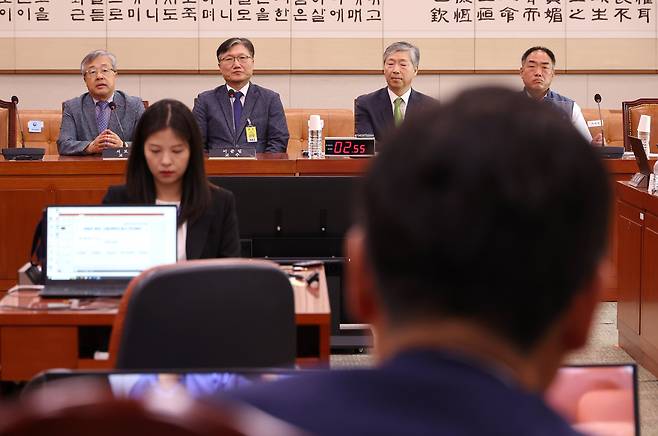
On May 14, the Democratic Party of Korea forced through a parliamentary hearing targeting Supreme Court Chief Justice Cho Hee-dae, fellow justices, and lower court judges. The move followed a Supreme Court decision to remand Democratic Party presidential candidate Lee Jae-myung’s election law case with guidance suggestive of a guilty verdict—an outcome the party is portraying as judicial interference in the presidential race.
When Chief Justice Cho and others declined to attend, National Assembly Legislation and Judiciary Committee Chair Jung Chung-rae responded by declaring, “They still haven’t come to their senses. They should be impeached.”
To accuse the judiciary of election interference for delivering a swift ruling in accordance with legal procedure is a baseless charge. Hauling the chief justice and multiple justices before the National Assembly gravely undermines the independence of the courts. Seeking to intimidate the judiciary over a ruling unfavorable to the party’s political interests betrays a fundamental disregard for constitutional norms.
The Democratic Party has since introduced a bill to appoint a special prosecutor to investigate Chief Justice Cho. Submitted to the judiciary committee, the proposal calls for a special counsel and 20 dispatched prosecutors, all recommended by the Democratic Party and the Rebuilding Korea Party, with a mandate lasting up to 140 days—matching the duration of the 2016 special counsel probe into Choi Soon-sil. What began as political rhetoric around impeachment and resignation has now escalated into calls for criminal prosecution. The message is unmistakable: any ruling adverse to Lee Jae-myung must be treated as illegal.
This political offensive extends beyond investigations. The Democratic Party is also pushing to revise the Court Organization Act to expand the number of Supreme Court justices from 14 to as many as 100. Simultaneously, it seeks to amend the Constitutional Court Act to allow constitutional complaints against Supreme Court rulings. The aim appears clear: to stack the courts with party-aligned judges and introduce what would amount to a fourth tier of judicial review—designed to produce politically favorable outcomes. These are not reforms; they are retaliatory acts against the nation’s highest court.
In parallel, the party is working to revise election law provisions to clear Lee of legal risk under newly tailored statutes. One bill, passed solely by the Democratic Party, would suspend all legal proceedings involving presidential candidates during the election period, allowing only acquittals in that window. Another measure would criminally punish judges for “distorting the law”—a dangerously subjective criterion.
Such measures have no place in a democracy grounded in the rule of law.
In countries where democratic systems have unraveled—Hungary, Poland, Peru—the pattern has often begun with coordinated attacks on the judiciary. By restructuring courts and constitutional bodies, regimes in those nations brought the judicial branch under political control. The Democratic Party’s current campaign—impeachment threats, criminal investigations, and sweeping institutional overhauls—bears troubling similarities.
This unconstitutional drive to subdue and politicize the judiciary must be stopped. The independence of the courts is not a partisan issue—it is the bedrock of any democratic society.
Copyright © 조선일보. 무단전재 및 재배포 금지.
- [만물상] 검열과 싸웠던 정당이 어쩌다
- ‘국힘 당원 강제 가입’ 이만희 신천지 총회장 추가 기소
- 인천 영종하늘도시 일대 정전…승강기 갇힘 신고 잇따라
- 박지성 위원장 “축구협회 회장 선출 기한 연장… 신뢰 되찾을 것”
- 중수청 출범 앞두고 견제 나선 경찰... “이첩 거부 조건 마련해달라”
- 홈플러스 전 점포 휴업…靑 향해 달려간 노조 지부장, 경찰이 제지
- 아주대병원 지하 음식점 화재 큰 불길 잡혀...인명피해 없어
- 金·宋, 출마 선언한 정청래 집중포화 “내 아들·딸도 鄭 안찍는다”
- 폭염 경보 속 실종 치매 노인…경찰특공대 수색견이 발견해 구조
- 인권위, ‘尹 방어권 보장 권고 폐기’ 결론 못 내려