‘I wanted to earn the title of Hedda Gabler’: Actress Lee Young-ae returns to stage
이 글자크기로 변경됩니다.
(예시) 가장 빠른 뉴스가 있고 다양한 정보, 쌍방향 소통이 숨쉬는 다음뉴스를 만나보세요. 다음뉴스는 국내외 주요이슈와 실시간 속보, 문화생활 및 다양한 분야의 뉴스를 입체적으로 전달하고 있습니다.
Despite her admired beauty, Hedda Gabler is a woman who lives with unresolved dissatisfaction and inner torment. This unfathomable character from Henrik Ibsen’s 1890 classic play has long inspired actresses to take on the challenge of portraying her complexity. This year, actresses Lee Young-ae and Lee Hye-young have both chosen to stage the play around the same time, sparking public interest.
Lee Young-ae was the first to take the stage. At the opening performance on May 7, she unveiled her interpretation of “Hedda Gabler.” Rather than emphasizing external intensity, she appeared to focus on portraying the quiet melancholy and deep inner pain of the character. On the 13th, about a week after the premiere, we met the actress, who is now performing live on stage instead of on screen, at LG Art Center Seoul in Gangseo-gu. “As an actress, I had a strong desire to earn the title of Hedda Gabler,” she said.
Has that desire been realized? “I wanted to show many different sides of myself as an actress,” she explained. “Through life experiences like childbirth and raising children, I’ve come to understand life more broadly. I think now, in my 50s, is the right time for me to portray Hedda.” Still, she added, “I feel like I’m carrying a ‘happy burden.’” Her words reflect the pressure of leading a play as a “title role” for the first time in 32 years, except for a brief stint on the theater stage at the beginning of her career.
The beautiful daughter of General Gabler, Hedda is the object of admiration. Seeking a stable life, she impulsively marries George Tesman, a dull scholar devoted solely to academia. But a sense of suffocation quickly sets in. Then her former lover and George’s academic rival, Eilert Lövborg, reappears, now a successful figure. Meanwhile, Judge Brack, a friend of her husband, takes an interest in Hedda and begins playing psychological games. When the three men, Eilert, Brack, and George, go out drinking together, a series of unexpected events unfolds. The story, which takes place over the course of about two days after the newlyweds return from their honeymoon, ends with Hedda’s death. The shocking conclusion and Hedda’s erratic behavior have long marked the play as a controversial work.
This production at LG Art Center is based not on Ibsen’s original script but on a modern adaptation by British writer and director Richard Eyre. Certain aspects of the original setting in 19th-century Europe, particularly the portrayal of a woman unable to conform to the institutions of marriage and childbirth, felt misaligned with contemporary sensibilities.
“If I present Hedda as just a woman trying to escape marriage, modern audiences might not relate. Nowadays, people might just say, ‘She could just get divorced,’” Lee said. “In this version, I tried to portray Hedda as a reflection of today’s individuals. I thought a lot about how to theatrically express the stress and pressure modern people face. I wanted to show a Hedda who could exist anywhere.” Director Jeon In-chul also noted in his program notes that the play contains the illness of modern life: loneliness, depression, and isolation.
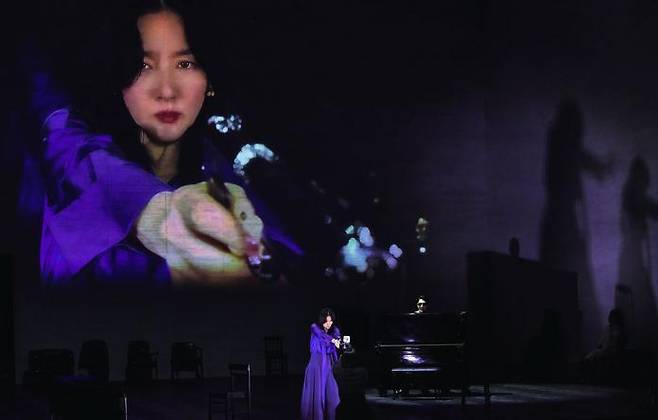
The play makes active use of Lee’s powerful stage presence. During the performance, cameras often zoom in on Hedda and project the close-ups onto a screen at the back of the stage. Lee’s presence in these moments is striking. Perhaps because of her long career in film and television, a single close-up conveys a wealth of emotion. “That was the director’s idea,” she said. “Since I’ve spent so much time acting in front of the camera, I think I was able to bring something meaningful to those shots. I even made a few suggestions to the director about how we could use the camera in the play.”
Lee also had a strong voice in costume decisions. “I proposed two things about the costume. I thought Hedda should wear purple, which is darker than red, and I felt purple best expressed her intensity within darkness. I also suggested culottes. While pants suit Hedda better than skirts, she’s still constrained by social norms, so culottes felt like the perfect in-between.”
Veteran actress Lee Hye-young’s “Hedda Gabler” will open on May 16. She previously starred in the same play in 2012 and received acclaim for her powerful performance. Though the two actresses have distinct styles, comparisons are inevitable. “I think Hedda is a character with no single ‘right’ answer,” said Lee Young-ae. “Lee Hye-young has her own unique charm, and I have mine. As shown on the poster, my Hedda smiles, but that smile hides a deep darkness. I hope audiences enjoy the performance.” The play runs through June 8.
※This article has undergone review by a professional translator after being translated by an AI translation tool.
Copyright © 경향신문. 무단전재 및 재배포 금지.
- [속보]정부 “호르무즈 해협 한국 선박서 폭발과 화재 발생···인명 피해 없어”
- [속보] 이란 매체 “미 호위함 호르무즈 해협 통과하려다 미사일 맞고 퇴각”
- 이란, 호르무즈 통제 범위 확대…이스라엘·헤즈볼라 교전 재개
- 한강 ‘채식주의자’, 독자가 좋아하는 부커상 수상작 1위로 꼽혔다···“1만 투표자 3분의 1이
- “아버지 기억 가물” 그럼에도 ‘국민 아버지’
- 관악산 ‘라면국물 웅덩이’ 논란에 화들짝 놀란 금천구··· “우리 아냐”
- [단독]쿠팡, ‘퇴직금 미지급’ 피해자에 30만~50만원 합의금 제시···“사과 없이 푼돈으로 입막
- “도대체 무슨 입시 전략이에요?”···대치동 영어 강사가 자식들 시골서 키우는 이유
- 기아차, 28년만에 국내 판매 현대차 추월…쏘렌토 가장 많이 팔렸다
- ‘사고 피해 선수 관련 부적절 발언’ 김나미 대한체육회 사무총장 사의