Restoring cultural heritage destroyed by wildfires to cost 48.8b won
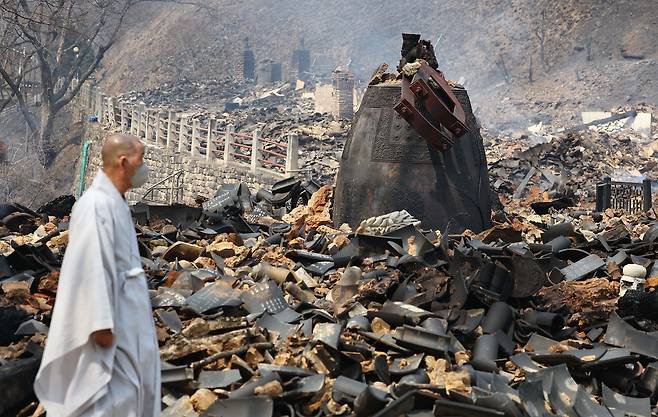
The restoration of government-designated cultural heritage sites damaged by the wildfires that ravaged across southeastern South Korea in March is expected to cost about 48.8 billion won ($34.9 million), the Korea Heritage Service said Thursday.
A joint investigation conducted by the agency and the Ministry of the Interior and Safety confirmed 36 instances of damage to cultural assets. Among these, 13 items and structures were state-designated national treasures, heritage sites or state-recognized cultural properties. The remaining cases involved heritage designated by municipal and provincial governments.
This included near-complete destruction of the 7th-century Buddhist temple Gounsa in Uiseong-gun, the epicenter of the Uiseong-Andong fires. which was by far the biggest wildfire in South Korea's recorded history. Nine of the temple's 30 buildings were destroyed, along with national treasures Gaun-ru, a pavillion, and Yeonsu-jeon, a hall, while another treasure Stone Seated Buddha statue sustained damage.
The fires also destroyed several centuries-old buildings, such as the Sanam House in Cheongsong-gun, North Gyeongsang Province, thought to have been built in late 18th century.
The state heritage agency said the restoration will be conducted in phases, beginning with urgent tasks such as securing structural components of the destroyed buildings, preserving partially damaged structures, and mapping out detailed restoration plans within this year. The prioritization of work will be based on the severity of the damage inflicted, and the extent to which the value of each item or structure has been compromised.
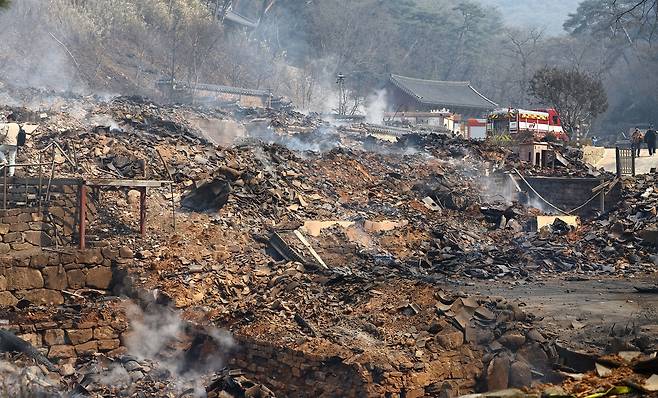
The budgets of both the central and regional governments will be used for the restoration, along with state lottery funds and donations. This includes 1 billion won donated by K-pop agency Hybe to the KHS-affiliated agency last month.
"Administrative and financial supports will be made so that the state heritage damaged by the fire can be restored to its original value," KHS chief Choi Eung-chon said.
The string of wildfires tore across the Gyeongsang provinces in the span of two weeks since mid-March, burning over 100,000 hectares of land while killing 33 and forcing the evacuation of tens of thousands living in the area. They inflicted more casualties and larger property damage than any other wildfire in the country's history.
Copyright © 코리아헤럴드. 무단전재 및 재배포 금지.