Interview: Yannick Alléno, the prince of sauces, rewrites the language of flavor
이 글자크기로 변경됩니다.
(예시) 가장 빠른 뉴스가 있고 다양한 정보, 쌍방향 소통이 숨쉬는 다음뉴스를 만나보세요. 다음뉴스는 국내외 주요이슈와 실시간 속보, 문화생활 및 다양한 분야의 뉴스를 입체적으로 전달하고 있습니다.
When Did Gastronomy Begin? Some trace the origins of gastronomy to the discovery of fire.
When humanity first harnessed flames, food ceased to be merely a tool for survival. As we moved beyond the age of eating things raw, we began to truly experience the sensation of flavor.
Fire did more than simply ensure hygiene by eliminating impurities—it added depth to taste.
The Maillard reaction transformed proteins, while techniques like reduction, smoking, and charring introduced new layers of flavor.
One might even say, with a hint of exaggeration, that from this moment on, we stopped merely consuming food and began to experience it. Fire was the key that unlocked the door to taste.
Yet the pinnacle of culinary evolution came with the invention of sauce.
Sauce is both a technique and an art form that enabled humans to actively shape and select their own flavor experiences.
It elevated food into the realm of art—not through singular notes of sweetness, bitterness, sourness, or saltiness, but through their combinations and balance. In creating sauces, humanity discovered that flavor could be "crafted."
Sauce may take up only a small portion of a dish, but greatness is never measured by volume. Sometimes the smallest components wield the greatest influence. Take salad, for example.
A single spoonful of a sauce made from yuzu and Japanese soy sauce can instantly give a salad a distinctly Eastern flair. Swap it for olive oil and lemon juice, and you have a Western vinaigrette. Sauce knows no boundaries. Whether it’s a rich steak or a delicate piece of tofu, sauce determines the character of whatever it touches.
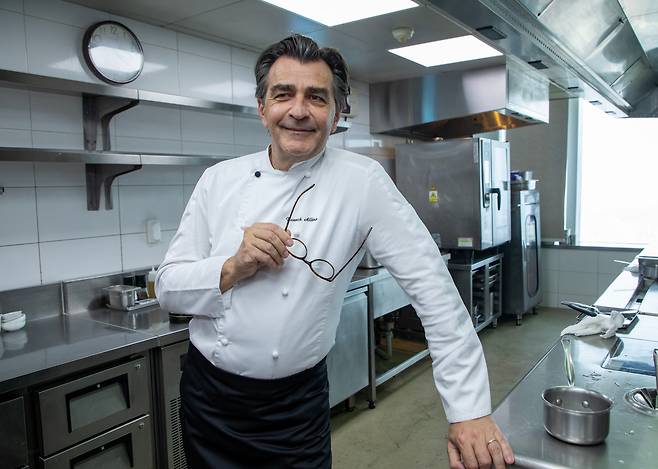
Most people think of sauce as something simmered over heat. However, one chef has upended this very notion: Yannick Alléno, the legendary French chef known as the “Prince of Sauces.”
His contributions to gastronomy are immense, marked by more than 15 Michelin stars across 17 countries, including France and South Korea. At the heart of his influence lies a revolutionary technique he developed—extraction.
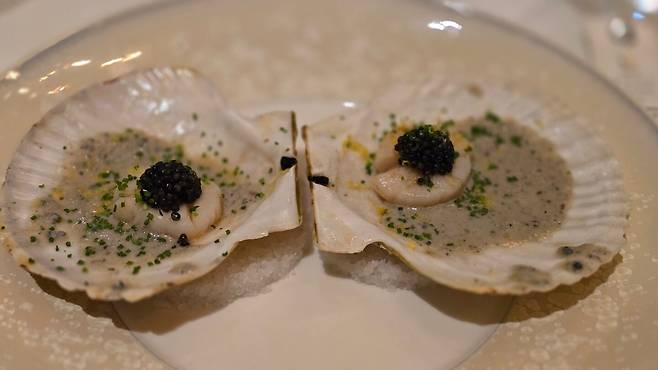
Alléno’s approach defies conventional thinking. Rather than relying on heat, he draws out the essence of ingredients through cold processes—water, freezing, and thawing.
According to him, heat inevitably causes destruction. Aromas evaporate, edges burn and impart bitterness, and textures become heavy even when flavors are intense.
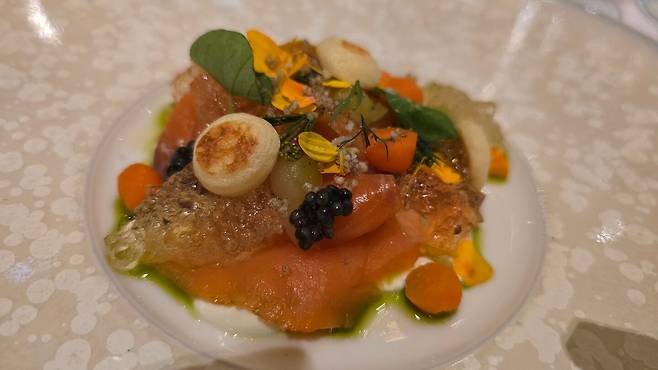
Extraction is different. Instead of fire, it uses low-temperature water baths and the alternating cycles of freezing and thawing.
If fire is destruction, then cooling is preservation. Through this method, he draws out the essence of each ingredient and isolates its purest layers of flavor without compromising structure, aroma, or nutrition. The result is a sauce that is clearer and more transparent—yet simultaneously deeper and more refined.
Traces of Alléno’s philosophy can be found in S. Korea at STAY, his modern French restaurant at Signiel Seoul.
STAY, a brand that blends tradition with modernity, has also established locations in global cities such as Dubai and Seoul.
According to Alléno, the restaurant’s appeal lies in its breathtaking views and the culinary standards that match them. For him, food becomes a truly extraordinary experience when shared with someone you love.
When asked if he had a message for the guests visiting STAY, his response was simple yet unforgettable: “Welcome to paradise.”
―Could you briefly introduce yourself?
“I’m Chef Yannick Alléno, from Paris, France. We opened STAY at Signiel Seoul eight years ago. I’ve been working to reimagine French gastronomy—respecting tradition, while incorporating modern techniques, refined sensibilities, and scientific thinking. For me, sauce lies at the heart of cuisine. It’s not just an accompaniment, but what I call the language of flavor."
―How would you describe STAY at Signiel Seoul?
“It’s a privilege to work in such a beautiful space like Signiel. It’s a true symbol of Seoul, which is part of what makes STAY so special.
STAY is a place for celebration—for life’s special moments, the kind of days you want to remember. The panoramic view of the city is breathtaking. At STAY, we present traditional French cuisine with a modern sensibility, all in a relaxed atmosphere."
―What are your thoughts on returning to Seoul? Have you noticed any changes?
“Every time I visit, Seoul moves me anew. Its gastronomic scene has grown remarkably. Mingles receiving three Michelin stars this year is proof of that.
Seoul is no longer just a city of good food—it now offers deep, immersive experiences. Food lovers—what you might call “foodies”—are exploring the restaurant landscape with real passion. S. Korea’s culinary map is becoming increasingly rich and complex."
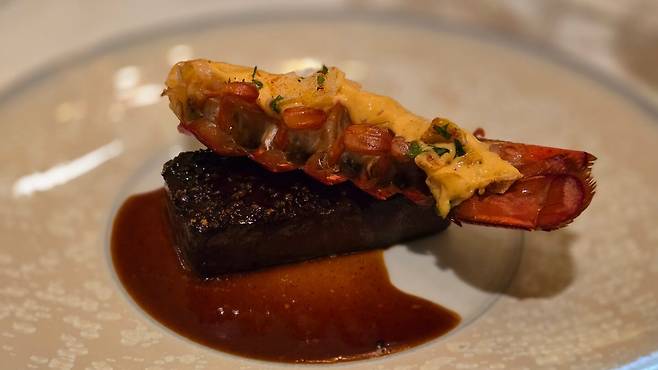
―Is there anything about Korean cuisine you find especially interesting?
“I love kimchi. And I’m fascinated by Korea’s entire tradition of fermented vegetables. As a chef, Korea’s culture of fermentation and aging has taught me a lot. Hanwoo beef has incredible depth of flavor, and the seafood here is outstanding as well.”
―Have any Korean ingredients recently left a strong impression on you?
“The abalone I had in Korea was fantastic. It gave me a sense of how Korean cuisine is evolving. For example, the dish I had at Bicena—abalone stuffed with rice—was exceptional. It’s a great example of how Korean chefs are giving their cuisine a contemporary interpretation.”
―Are there any dishes at STAY that showcase a fusion of Korean ingredients and French technique?
“Absolutely. At STAY, we apply French culinary methods to Korean vegetables, seafood, and meats. One example is our spinach salad with truffles—it reflects both Korean and French flavors in harmony.”
―What do you believe is the most important ingredient in great cooking?
“Love. Everything starts with love. Love for what you do, love for your team, and love for the ingredients you work with. When that’s present, better dishes follow. In the end, it’s all matter of love.”
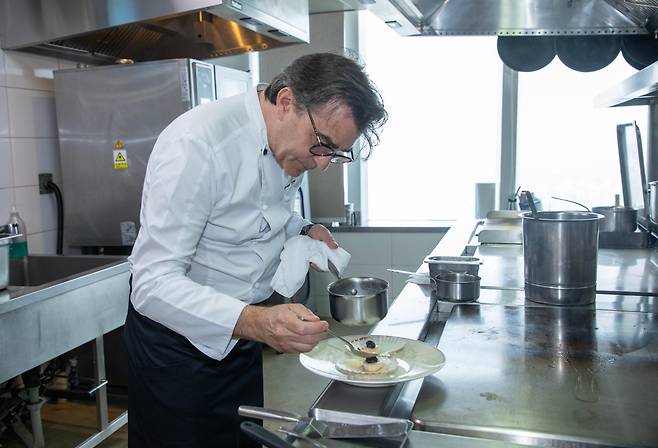
―How would you define your own cooking?
“It’s a balance between tradition and innovation. I respect the past, but I constantly question and push toward the present and the future. Modern French cuisine builds new interpretations upon the foundation of tradition. I focus especially on modernizing sauces.”
―What do you believe is the most essential element of French cuisine?
“Without question—sauce. Sauce is the verb of French cuisine. It brings dishes to life. It’s not just an addition—it is a dish in itself.
France is a country that grew up with sauces. The legendary chef Auguste Escoffier dedicated 71 pages of his cookbook to sauces alone.
You can’t understand French cuisine without understanding sauces. I believe sauce can change the structure of a dish—and of a kitchen. Grilling a steak well is important. But when you pair it with the right sauce, it becomes a life-changing experience."
―Do you remember the first sauce you ever made?
“Yes—Hollandaise sauce. I even remember the sound of the eggs clinking as I whisked them.”
―You’re well-known for developing the extraction technique. Can you explain what it is?
“Extraction is a method of capturing the pure essence of ingredients by cooking them at precise temperatures and times. Traditional techniques often rely on reduction. But I use freezing to preserve flavor.
Take celeriac, for example. If cooked at exactly 83 degrees Celsius for 12 hours, it produces the perfect taste. Go above that, and the minerality is lost. Below that, extraction is incomplete."
―What are the advantages of low-temperature cooking and freezing/thawing in the extraction process?
“Heat inevitably causes destruction. Aromas evaporate, edges burn, bitterness can develop, and textures are altered. Cooling, on the other hand, is the art of preservation.
Through low-temperature water baths and freeze-thaw cycles, nothing is destroyed. You can extract only the pure essence of the ingredient. The result is clean, deep, and intensely pure."
―How do you develop new dishes?
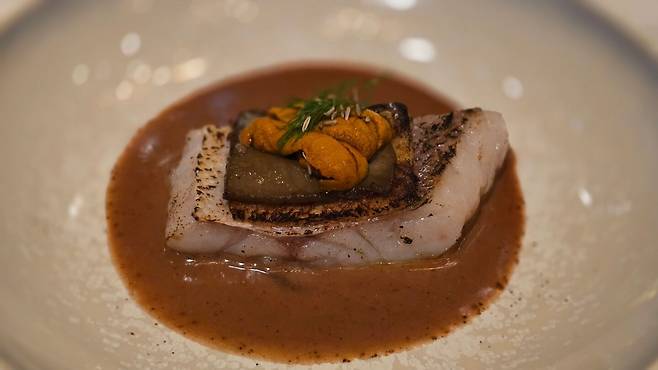
“It always starts with the products. Even the same fish—like tilefish—can taste completely different depending on the region. I taste the products, imagine the environment it came from, its terroir, and build a recipe around that. For example, the sea urchin I had this morning had notes of juniper berries. That opens the door to entirely new pairings."
―If your life were a dish or a sauce, what would it be?
“Impossible. But I hope to be remembered as someone who helped shape one of the many branches of sauce. I’d be grateful if people remembered me through my philosophy of sauce.”
―What are your goals for the future?
“I’m a very lucky person. I was a boy from nowhere, and this profession gave me everything. I believe the future will be shaped by the power of culture.”
Copyright © 조선일보. 무단전재 및 재배포 금지.