Hansae Yes24 Group to unveil librarian-like ‘Yes AI’ model
The group aims to develop a proprietary model optimized for the Korean language and content and expand it into a business-to-business (B2B) by supplying it to domestic and global companies.
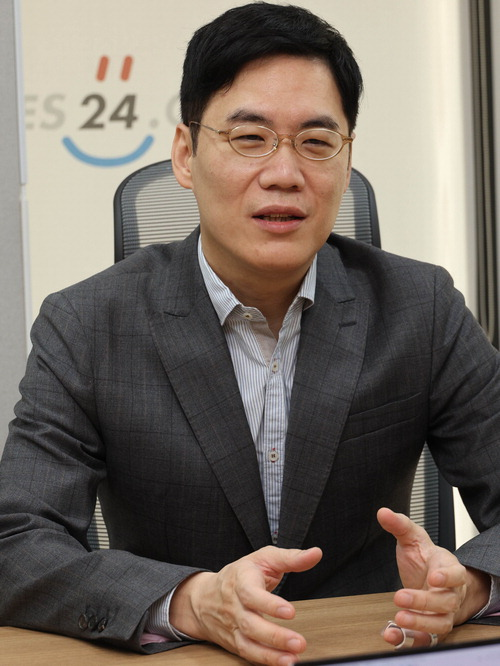
Kim Suk-hwan, vice chairman of Hansae Yes24 Holdings Co. and eldest son of Group Chairman Kim Dong-nyung, is spearheading the group’s AI transformation (AX). He has overseen entertainment and digital content operations and actively strengthened the group’s overall IT capabilities since joining the group in 2007 as head of Yes24’s entertainment business, drawing on his background in computer science.
The company saw the number of its in-house developers more than double since Kim took the helm in 2017, enabling Yes24 to roll out a variety of AI services.
“From a development capability and cost perspective, we believe now is the time to take on this challenge,” Kim said during a recent interview with Maeil Business Newspaper. “Our ambition is to build the best AI model for the Korean language.”
The following is a Q&A with Kim.
― Why are you developing a foundation model?
▷ Our goal is to create an AI that excels in Korean - and more broadly, in language understanding. It is still hard to find AIs that are truly strong in Korean while models like ChatGPT are improving.
As a content-focused company, Yes24 saw the need for a Korean-specialized model. We have already built about eight small language models (SLMs) based on open-source frameworks such as Llama and Qwen, so we now feel ready for this step.
― What services will the model be used for?
▷ We currently operate Crema AI, which recommends books to readers. I envision book-related AI acting like a tutor in the future - reading books with users and answering questions in real time. It could even write book reviews, although that will likely take another year or two. The ultimate goal is for it to become like a librarian who knows books better than anyone.
― What is the model called, and what stage is the development at?
▷ It is tentatively called Yes AI for now, and we plan to release the first model by the end of 2025. We are also in the process of purchasing Nvidia Corp.’s servers and have formed a dedicated 10-person development team.
We are acquiring training data by paying publishers who agree to participate. We estimate the specialized model we envision could be built for under 100 billion won ($70.11 million). We will start with 20 to 30 billion won and may scale up with outside investment depending on progress.
― Why is a manufacturing-origin group so focused on AI?
▷ Our group is very responsive to change. Hansae Co., which supplies large orders to buyers, relies heavily on accurate inventory predictions which is now powered by AI.
In ODM, design is key, and we are enhancing that with AI too. As a content company, Yes24 is even more sensitive to change so embracing AI is not optional. We have been trying to use AI even before large language models (LLMs) became mainstream. We have seen many companies lose customers because they failed to deliver new services in fast-moving tech cycles.
― What is the latest trend in AI?
▷ AI agents. Domain-specific expert AIs will collaborate moving forward while human interaction decreases. A user’s primary search AI assistant might query Yes24’s book-specialist AI for example, receive an answer, and deliver it to the user.
The second trend is robotics. Yes24 will open Korea’s first smart fulfillment center (SFC) in Paju in July 2026, which will feature over 500 autonomous guided vehicles (AGVs).
― How much do you study AI?
▷ Email was just introduced when I worked at court in the 1990s. Many of my colleagues dismissed it and later struggled. AI is similar - you must understand it from the ground up. I learned about 20 percent via expert conversations, 20 to 30 percent via YouTube, and the rest by reading academic papers. The more efficient someone is at work, the more AI multiplies that. It does not make sense not to study or use it.
― How do you use AI personally?
▷ I use AI to predict the future. I often use AI internally at workshops, new year’s parties, and weekly meetings to present insights. At home, I use it to create picture books with my children, which they love. I also use AI to create photos and videos as well as for calculations and research. My go-to tools are ChatGPT and Perplexity.
Copyright © 매일경제 & mk.co.kr. 무단 전재, 재배포 및 AI학습 이용 금지
- [단독] 현금 109억으로 한남더힐 매입한 인물...정체 알고보니 ‘끄덕’ - 매일경제
- “몸에 좋은 과일을 갈아 마시는 건 최악”…의학박사의 섬뜩 경고, 왜? - 매일경제
- 오늘의 운세 2025년 4월 14일 月(음력 3월 17일) - 매일경제
- “결혼식 했지만 혼인신고 NO”...김영철, 미모의 변호사와 소개팅 - 매일경제
- [속보] 출마설 일축했던 韓 대행 “제게 부여된 마지막 소명 다할 것” - 매일경제
- 그렇게 큰소리치더니…대통령 자존심 무너진 트럼프, 한발 물러선 까닭은 - 매일경제
- [속보] 윤석열 전 대통령 오전 재판 종료…오후 2시 15분 재개 - 매일경제
- 미국 주부 홀린 한국기업...1위 굳히기 위한 ‘비장의 수’ 던졌다 - 매일경제
- 박나래 ‘55억 집 도난’ 용의자 체포됐다···“내부 소행 아니다” - 매일경제
- 이정후, 이번에는 역전 스리런! 빅리그 첫 멀티 홈런 작렬 - MK스포츠