Seoul faces legal pressure over refusal to disclose ‘ground subsidence safety map’
이 글자크기로 변경됩니다.
(예시) 가장 빠른 뉴스가 있고 다양한 정보, 쌍방향 소통이 숨쉬는 다음뉴스를 만나보세요. 다음뉴스는 국내외 주요이슈와 실시간 속보, 문화생활 및 다양한 분야의 뉴스를 입체적으로 전달하고 있습니다.
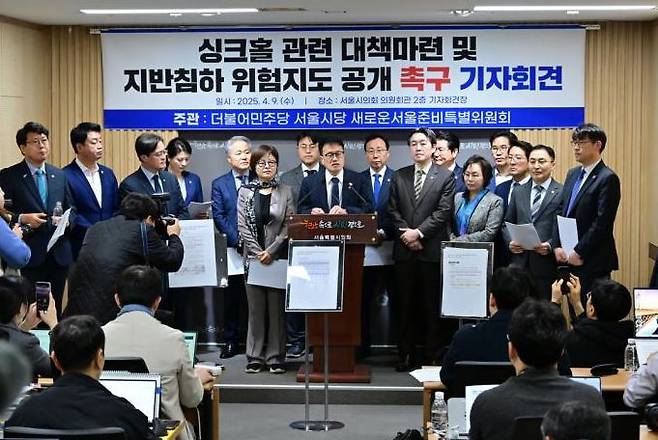
The issue of disclosing the Seoul Metropolitan Government's “ground subsidence safety map” in connection with last month's sinkhole accident in Gangdong-gu, Seoul, is expected to turn into a court battle. While civic groups are calling for the release of the map, the city maintains that “it cannot be released because it is classified and irrelevant to the sinkhole.”
On April 9, the New Seoul Preparation Special Committee of the Democratic Party of Korea (DPK) held a press conference, urging the city to “release the safety map in order to uncover the causes of the sinkhole incident in Gangdong-gu.”
According to the special committee, the Center for Freedom of Information and Transparent Society, the Korean Public & Social Services and Transport Workers' Union, and others requested the city to release the ground subsidence safety map on April 2, but was denied. The organizations filed an appeal on the 7th and plan to pursue administrative litigation if the city’s Information Disclosure Review Board upholds the non-disclosure decision. “The U.S. state of Florida releases its sinkhole map so that residents can identify sinkhole risk areas, and Tokyo, Japan, shares risk information on sewer pipes and underground spaces with citizens,” the special committee said, arguing that Seoul should also release the safety map.
Park Joo-min, head of the New Seoul Preparation Special Committee, said, “The U.K. and Germany also make geological data and maps of underground utilities publicly available. In Korea, the Ministry of the Interior and Safety discloses various public safety maps about flood-risk areas, crime-prone areas, and aging buildings. There’s no reason for Seoul to withhold the ground subsidence safety map.”
However, Seoul continues to maintain its stance against disclosure. The city argues that the map in question was not created to assess sinkhole risk and that it falls under the Basic Act on National Spatial Data, making it legally restricted from being made public.
“The map was created for internal management purposes to improve the efficiency of Ground Penetrating Radar (GPR) exploration, and does not represent a risk rating,” a city official said, adding that disclosure would create unnecessary misunderstanding and anxiety. The official added, “Underground spatial information is subject to disclosure under the ‘Seoul Metropolitan Government's Rules for Handling Geospatial Information Security Work’ under Article 35 (Security Management) of the Basic Act on National Spatial Data.”
However, experts agree that disclosure is necessary. “If you look at Japan, for example, they create safety maps for floods and actively inform villages, drawing residents' participation and attention to safety monitoring activities,” said Park Chang-geun, a professor of civil engineering at Catholic Kwandong University. “If there is sensitive information (as claimed by the city), it is possible to redact such parts and disclose the degree of danger, as citizens are anxious.”
“The prioritized maintenance zone map that the Seoul Metropolitan Government is talking about and the safety map requested by civil groups are virtually the same, with only a different name,” said Lee Chan-woo, president of the Korea Tunnel Environment Society. “GPR inspections are conducted to prevent possible ground subsidence risks, which is consistent with the safety map.” He added, “Sinkholes are accidents that can be prevented with proper construction and good management and supervision. The city’s tendency to conceal information is only heightening public anxiety.”
The New Seoul Preparation Special Committee also emphasized, “According to the Framework Act on the Management of Disasters and Safety, safety-related information must be made public and accessible to everyone.” It urged, “The Ministry of Land, Infrastructure and Transport, which oversees underground safety, should work with the city to reform laws and systems to mandate the disclosure of ground safety information.”
The sinkhole incident in Gangdong-gu has continued to spark controversy over whether it was a man-made disaster, as it occurred near a construction site of Seoul Subway Line 9. In 2021, the Korea Tunnel Environment Society sent an official letter to the city warning that the area required caution due to its proximity to the underground tunnel for the Seoul-Sejong Expressway in the district. At the time, the Seoul Metropolitan Government forwarded it to the contractor, but it is understood that no further preemptive measures were taken to prevent ground subsidence.
※This article has undergone review by a professional translator after being translated by an AI translation tool.
Copyright © 경향신문. 무단전재 및 재배포 금지.
- [속보] 이 대통령 “일부 조직 노동자들, 자신만 살겠다고 과도한 요구”…삼성전자 파업 겨냥?
- 이태원 참사 때 구조 나섰던 상인, 숨진 채 발견···민간 구조자 트라우마 대책 한계
- 국힘 “‘손 털기’ 하정우, 정치 기본 안 갖춰” 한동훈 “북구 시민 무시”···일제히 공세
- 나만 빼고 다 먹었대···‘연세우유 생크림빵’, 4년3개월 만에 1억개 판매 돌파
- 배우 박동빈, 개업 준비하던 식당에서 숨진 채 발견
- ‘의왕 아파트 화재’ 부부 사망·주민 6명 부상···신변 비관 내용 유서 발견
- [르포]이재용 자택 옆 천막농성 전삼노 “우리가 원하는 건 투명성···총수가 결단하라”
- [속보]김관영 전북지사 종합특검 출석···“12·3 내란 당일 청사 폐쇄 사실 없어”
- 정이한 부산시장 후보에 욕설하며 음료수 던진 30대 구속영장 기각
- 사귀는 남성들 수면제 먹인 후 자기 계좌로 이체···4명 상대 수천만원 범행 20대 여성 구속 송치