This is the country we'll inherit: 4 months of political unrest in eyes of Korean teens
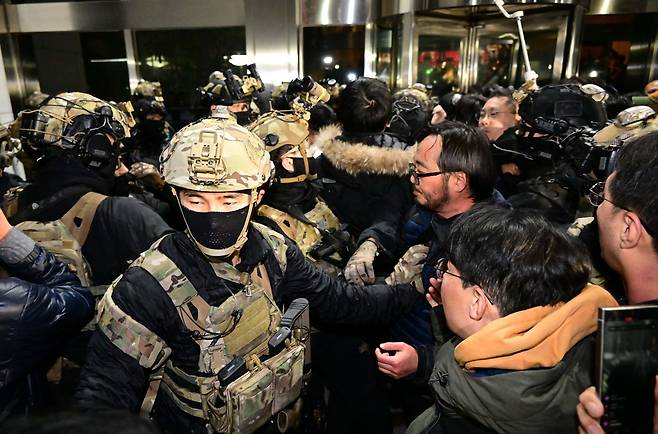
As helicopters carrying military troops descended on the National Assembly and an emergency decree restricting freedom of the press and political activities was declared, many South Koreans were reminded of some of the darkest chapters in their modern history decades ago. But for generations born well after the country’s last authoritarian regime in the 1980s, the turmoil sparked by former President Yoon Suk Yeol’s declaration of martial law was something entirely new — a collision between the democratic values they had learned at school and the stark reality unfolding before their eyes.
In the four months between Yoon’s sudden imposition of martial law on Dec. 3 last year, and his removal from office on April 4 when the Constitutional Court unanimously voted to uphold his impeachment, South Korea witnessed a whirlwind of political chaos and mass protests, while undergoing a reckoning with its values as a democracy.
Among those quietly — but attentively — watching, were teenagers still too young to cast a ballot, yet old enough to feel the shockwaves ripple through their lives.
“I was studying at a cafe, just like any other day, when I started seeing Instagram stories saying the country was collapsing,” said Cho Yoon-seo, 16, who described seeing panic spread online that evening. She raced home, fearful of rumors that soldiers were detaining citizens, her parents half-jokingly warning her not to get caught. “The students had to stay up all night, not for exams, but worrying about the destiny of our country in fear,” she said.
For many high school students, the chaos saw political theory from the pages of their textbooks become stark reality. The brief enforcement of martial law — which, under Korean law can include special measures such as military checkpoints, restricted movement for lawmakers and suppressed media — stunned students into confronting the fragility of democratic norms.
“It was terrifying,” said another student, surnamed Lee, also 16. “Seeing the military with guns, especially when the country saw Han Kang achieving the Nobel Prize for a book on similar history, I felt ashamed and couldn't believe this was really happening in 2024."
Lee, who has been interested in politics since witnessing the candlelight protests that led to the impeachment of former President Park Geun-hye in 2017, said this second impeachment was a sobering evolution of her civic awareness. “This wasn’t just about one person. It was about whether our entire system could still stand,” she said.
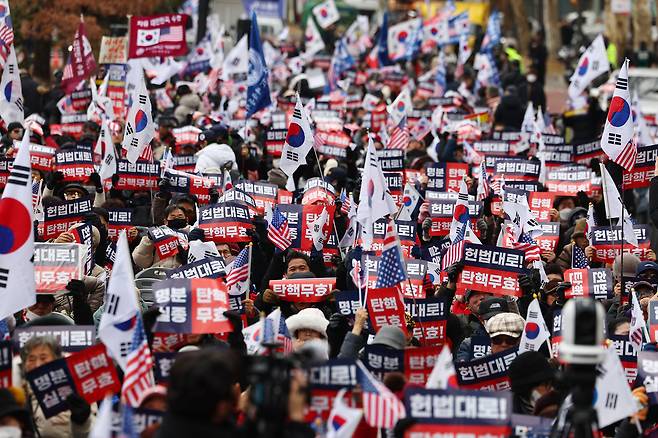
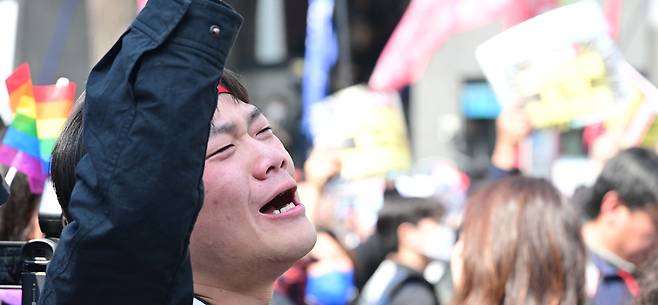
Over the winter, the streets of Seoul turned into battlegrounds over values.
Rallies for and against Yoon's impeachment surged in frequency and volume. In some instances, violence even broke out, such as in the Jan. 19 mob attack on the Seoul Western District Court by Yoon's supporters, resulting in 83 people injured. For some students, the public division was deeply unsettling.
“It felt like our country was breaking apart,” said a 16-year-old student who asked to go by her surname of Choi. “So much hate was being stirred up, not just against the president but among citizens. It was exhausting to watch.”
Yet amid that chaos, students also saw courage: in the protesters who stood firm to call for the president's removal in the freezing temperatures, in the military officials who questioned or passively carried out unlawful orders, and in the lawmakers who moved swiftly to annul the declaration.
“The courage of ordinary citizens and nameless soldiers made me feel proud,” said Lee. “They reminded us what real democracy looks like.”
She also noted that even among older conservatives — many of whom had lived through past military regimes — there was resistance to Yoon’s overreach. “Some of the most powerful opposition came from people who knew firsthand what martial law really meant,” she said.
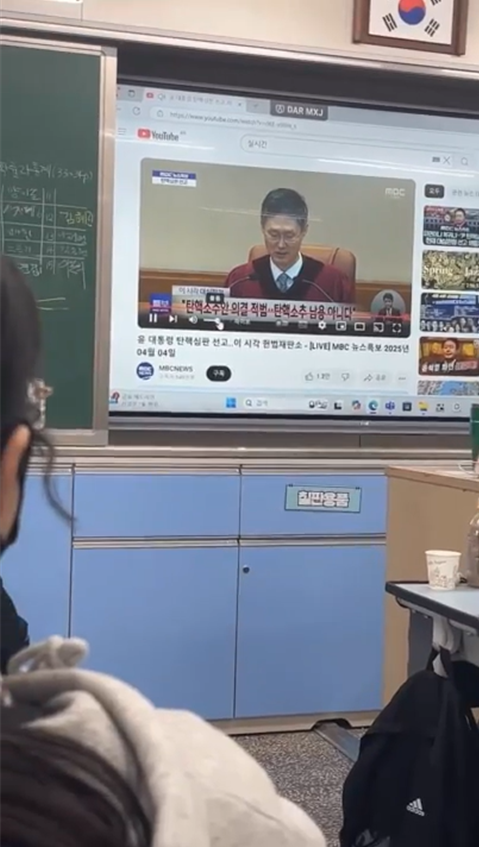
When the Constitutional Court finally ruled in favor of upholding Yoon's impeachment on April 4, many students were watching — some huddled around classroom screens, others gathered virtually in group chats.
“We were all holding our breath with every line of the verdict,” said Lee.
"Most of my friends expected the ruling to be in favor of (upholding) the impeachment. We thought if the impeachment was overturned, we would be living in a country with many problems," added Cho. “When the final decision came, you could hear cheers from the next classroom over.”
For Cho, the ruling restored some sense of order. “It was like seeing the Constitution speak out loud,” she said. “It reminded me that democracy is real — fragile, yes, but real.”
“This impeachment wasn’t just about one man,” Cho said. “It was about whether our institutions could still protect the public. I realized that democracy doesn’t just function on its own. It takes all of us — especially the younger generation — to keep it alive.”
Cho, who has served as student council president and a youth delegate to local government bodies, said the past four months convinced her more than ever that students must not remain silent.
“We’ve always been treated like spectators in political discussions, but we are part of this society, too,” she said. “Our voices deserve to be heard.”
She described an incident in which students from Yoon’s alma mater, Chungam High School, were harassed simply because of their school’s association with the impeached president. “They were threatened and even hit with eggs. That kind of blind hatred makes no sense. It was heartbreaking and infuriating,” she said.
The impeachment, for Cho, revealed both deep fractures in Korean society and the potential to overcome them. “We saw how anger could spill into cruelty, but also how civic participation could make a difference,” she said. “It showed us that we can’t afford to be indifferent.”
Many students said the experience changed how they view politics — not as something distant or reserved for adults, but as part of their everyday lives. “This was my second impeachment. And I realized: Korean politics is a space of both painful conflict and incredible possibility,” Cho said. “It reminded me that change is possible — but only if we work for it.”
The political turmoil also prompted teens to reflect on the kind of Korea they want to inherit.
The students’ reflections revealed a generation more politically aware than it is often given credit for. Their views carry a mixture of disillusionment, cautious optimism and a longing for a more reasonable, less polarized political culture.
“I hope we become a country where reason and compassion outweigh ideology,” said Choi. “Where people want to stay connected more than they want to cut each other off.”
“Politics shouldn’t just be about who wins or loses,” said Lee. “It should be about how we all live together.” Cho echoed this sentiment, hoping that despite inevitable divisions, “we can be a society where more people want to connect more than break apart.”
For Cho, that future starts with students: “I want a society where different voices are respected, not silenced. Where dialogue replaces division, and logic triumphs over rage.”
“Even if we can’t vote yet, we’re part of this democracy,” she said. “And we’re going to inherit whatever’s left of it.”
Copyright © 코리아헤럴드. 무단전재 및 재배포 금지.