How we look at Ah Q

Sung Min-yeop The author is a literary critic.
Lu Xun (1881-1936) is widely recognized as the representative figure of modern Chinese literature, and his most iconic work is the novella “The True Story of Ah Q.” First published in the early 1920s, it has now passed the century mark. Lu Xun is not only central to Chinese literature but also a towering presence across Asia. The Japanese Nobel laureate Kenzaburo Oe once praised him as “the greatest Asian writer of the 20th century.”
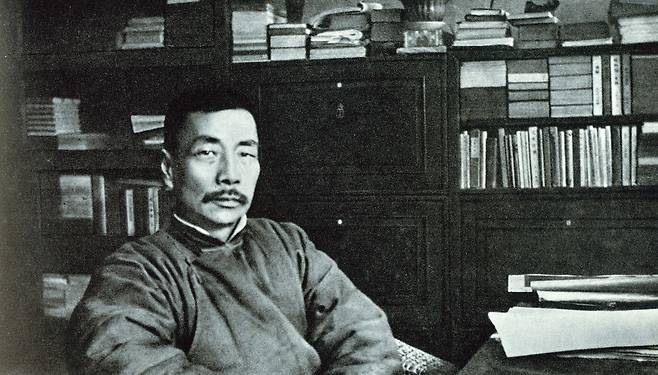
“The True Story of Ah Q” was first introduced to Korean readers in 1930 through a translation, and has since been read and interpreted in various ways. Broadly speaking, interpretations of the work have fallen into three categories.
One reading sees the novella as a critique of the Chinese national character. It highlights Ah Q’s self-deceptive tendency toward “spiritual victory,” his obsequiousness to the powerful, and his cruelty toward the weak.
Another reading focuses on the social conditions of the 1911 Xinhai Revolution. In this view, Ah Q’s wrongful execution is emblematic of a revolution that failed to dismantle the old social order and instead sacrificed innocents in the process.
A third reading considers the work a positive portrayal of the revolutionary potential of the peasantry. It centers on the moment when Ah Q, who initially regarded revolution with suspicion, comes to see it as something good.
I don’t believe one interpretation is right and the others are wrong. Each offers something valuable. All three can co-exist. Ah Q, immersed in the logic of spiritual victory, repeatedly confronts realities that his self-deception cannot overcome. His internal torment deepens. Eventually, when he sees the village elites grow fearful of revolution, he begins to think there might be something to it. But then, falsely accused of robbery, he is executed. Depending on which of these narrative moments one emphasizes, the story lends itself to different interpretations.
Taken as a whole, Ah Q is a foolish and pitiable figure. He possesses a latent capacity to perceive reality clearly and achieve a kind of awakening. He even experiences brief, muddled moments of clarity. But in the end, he fails to realize that potential and meets a tragic end. What strikes me now is that regardless of the interpretation, there is a commonality in the way readers look at Ah Q. That gaze is downward. The interpreter is situated in a place of enlightened awareness, looking down upon the foolish, pathetic Ah Q below. Even those who highlight his revolutionary potential are not immune to this.
I take issue with that gaze. I propose we meet Ah Q at eye level and form a level relationship with him. That, I believe, is a way to read this work anew.
![Korean author Han Kang answers questions from reporters at the Nobel Prize Museum in Sweden on Dec. 6, 2024. [YONHAP]](https://img2.daumcdn.net/thumb/R658x0.q70/?fname=https://t1.daumcdn.net/news/202504/03/koreajoongangdaily/20250403000350900equu.jpg)
This is not a matter of mere empathy for a fictional character. It is not about sympathy, but something more like connection or resonance. Han Kang has described this as an “electric current of connection,” and Lu Xun spoke of “acoustic resonance.” While both terms were originally used to describe the relationship between writer and reader, I believe we can apply them to the relationship between writer and character — and also between character and reader.
The essential recognition is that “I,” here and now, am just as foolish and pitiable as Ah Q in 1910s China. At the heart of this recognition lies a motive of self-reflection.
This same motive runs through Lu Xun’s own life. In his twenties, he devoted himself to the enlightenment movement, which ended in dismal failure. He began writing fiction at the age of 37, and his first short story, “Diary of a Madman” (1918), was a metaphorical rendering of that failed enlightenment through the figure of a madman. “The True Story of Ah Q” followed in that same line. Whether the madman — who came from the intellectual class — or Ah Q — who came from the peasantry — both are, in Lu Xun’s eyes, partners in horizontal reflection. The critical power of Lu Xun’s literature stems from this very impulse toward self-reflection.
What I find increasingly troubling today is the rejection of that critical spirit in Lu Xun’s work. For instance, from the standpoint of nationalism or Sinocentrism, some now denounce his critique of the national character and even go so far as to vilify it. This kind of backlash began more than two decades ago and appears to be growing more frequent. That Lu Xun’s literature — now a treasured part of not only Chinese but Asian and world literature — is being attacked in China of all places is both astonishing and deeply concerning. Translated from the JoongAng Ilbo using generative AI and edited by Korea JoongAng Daily staff.
Copyright © 코리아중앙데일리. 무단전재 및 재배포 금지.
- Actor Jung Hae-in becomes global ambassador for Dolce & Gabbana
- HYBE CEO said 'disciplined' NewJeans measures 'bearing fruit'
- Kim Soo-hyun addresses Kim Sae-ron relationship — as it happened
- Blackpink’s Jennie becomes first K-pop soloist honored at Billboard Women in Music Awards
- Kim Soo-hyun's agency tacks on charges against Hoverlab operator
- Kim Soo-hyun denies he dated, groomed underaged Kim Sae-ron in emotionally charged press conference
- Korea's inflation rises to 2.1% in March
- After record deliberation, President Yoon's impeachment ruling set for April 4
- BTS's J-Hope hits Billboard Hot 100 with 'Mona Lisa,' joins Jungkook with most K-pop solo singles to make chart
- Seoul on high alert as public safety measure start ahead of impeachment ruling