Will yearlong medical school standoff come to an end?
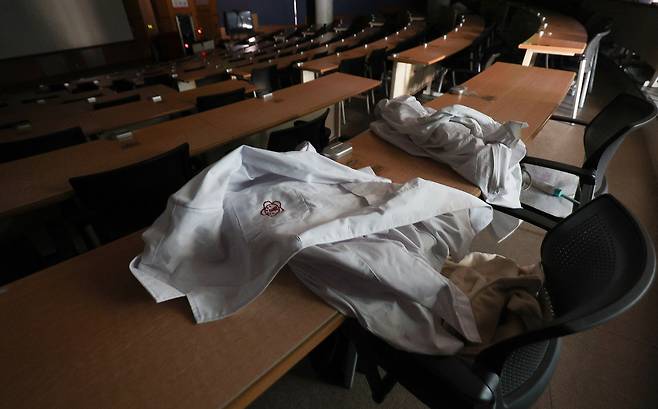
After more than a year of protests and walkouts, the coming week is expected to mark a crucial turning point in South Korea’s yearlong medical education crisis, with nearly half of the country’s 40 medical schools setting March 28 as the final deadline for students to return to class. The outcome could determine whether the standoff between the government and medical students over enrollment expansion can finally come to a close.
At five universities where registration has already closed — including Yonsei University, Korea University and Kyungpook National University — a significant number of students are known to have submitted reregistration applications, signaling a partial end to the mass walkout that began in February 2024.
While the government has withheld official return rates, Yonsei and Korea University reportedly saw about half of their medical students register by the March 21 deadline. The Ministry of Education emphasized that only a full return to normal class operations will fulfill the condition it set for freezing the 2026 medical school enrollment quota at 3,058 seats.
The students' return comes after the government announced it would freeze the 2026 medical school enrollment quota at 3,058 — the figure that has been maintained for nearly two decades — only if all students resume their studies by the end of the month.
Observers also point to fear of punitive action as a primary motivator behind the shift. Unlike last year, when mass leaves of absence were tacitly accepted, the Ministry of Education signaled it will no longer tolerate coordinated absenteeism. In an official directive issued on Feb. 18, the ministry instructed universities not to approve any leave requests that appear coordinated or collectively motivated, even if formally submitted as individual applications.
The government warned that students would face penalties ranging from academic probation to expulsion, with no leniency for leaves of absence submitted as part of collective protest.
Across the country, 18 medical schools will finalize their spring semester rosters by the end of this week. Institutions such as Seoul National University, Ewha Womans University and Pusan National University are also expected to close their registration windows by March 27 or 28, with most schools citing academic policies that automatically issue failing grades to students who miss more than 25 percent of classes.
Though expulsion requirements differ by university, generally those who repeatedly face probation or academic warning, or exceed the number of years one has been enrolled could be dismissed.
Reenrollment for expelled students would be nearly impossible due to limited vacancies, adding further pressure to act before the cutoff.
Adding to the stakes, the Ministry of Education has hinted that any resulting vacancies from expulsion could be filled through competitive transfer admissions, a route that has already seen application rates exceeding 100 to 1 in Seoul-based medical schools.
Under current rules, students who have completed at least two years at a domestic or foreign four-year university are eligible to transfer into medical programs, either into premedical years or the main medical curriculum depending on their prior studies.
Some worry that returning students may stage in-class forms of protest, such as refusing to complete coursework, as mistrust in the government lingers. The coming weeks are likely to determine not only the future of medical school quotas but also the direction of the broader standoff between South Korea’s medical community and the government.
Universities such as Yonsei have already announced that students who do not register by the deadline will begin receiving notices of expulsion as early as this week, with formal proceedings to begin on Mar. 28.
As schools await the end-of-March deadline, the Ministry of Education plans to collect final data on medical student reinstatement and assess whether the nation’s medical education system is finally returning to normal.
Copyright © 코리아헤럴드. 무단전재 및 재배포 금지.