Samsung's reliance on others for smartphone processors takes bite out of bottom line
![Samsung Electronics' booth at the MWC 2025 trade show in Barcelona, Spain, from March 3 to 6 [SAMSUNG ELECTRONICS]](https://img1.daumcdn.net/thumb/R658x0.q70/?fname=https://t1.daumcdn.net/news/202503/14/koreajoongangdaily/20250314163839320xewp.jpg)
Samsung Electronics, despite being an integrated semiconductor company with both chip design and manufacturing capabilities, has struggled with chip performance and yield issues, forcing it to rely on third-party processors from the likes of U.S.-based Qualcommand Taiwan’s MediaTek for its smartphone lineup.
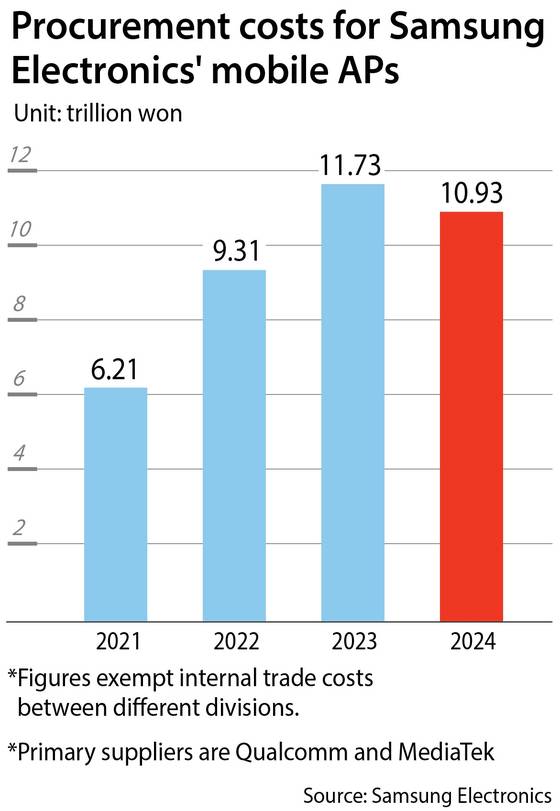
Rising procurement costs of mobile application processors (AP), which act as the “brain” of smartphones, surpassed the mobile division’s operating profit at 10.93 trillion won ($7.5 billion), according to the company's business report released on electronic disclosure on Tuesday. For its Galaxy S25 series, it purchased third-party processors designed by Qualcomm and produced by TSMC.
Industry experts caution that Samsung’s struggles in semiconductor design could further impact the profitability of its smartphone business, forecasting the Korean company’s AP procurement costs to increase even further in 2025.
Samsung’s System LSI division, in charge of chip design, has been undergoing a management review since January due to poor business performance.
Mobile APs are the most expensive components in smartphones, making them critical for cost efficiency. Industry sources estimate that the Snapdragon 8 Elite chip in the Galaxy S25 costs $190 per unit, more than four times the price of Apple’s A18 chip at $45.
The gap in chip prices derives from design capabilities, with Apple able to produce its chips more cheaply with a method known as chip binning, according to Prof. Kim Yong-seok of the Gachon University’s Semiconductor Education Institute.
“Apple effectively addresses yield issues by using chip binning while also designing its chips to be applied across multiple product lineups,” Kim said.
Chip binning is a method where chips that do not meet full performance standards during production are repurposed for lower-end models instead of being discarded. For instance, A18 chips are used across multiple iPhone models, but they have a different number of GPU cores, such as the iPhone 16 Pro with six core GPUs, the iPhone 15 with five and the iPhone 16e with four.
Since a higher number of GPU cores leads to better performance, this allows Apple to maximize production yield and cut costs. Apple is believed to have applied the same binning method in its M-series chips for the MacBook Pro and the MacBook Air.
Unlike Apple, Samsung cannot easily implement chip binning because it procures mass-produced chips from suppliers rather than designing its own for exclusive usage.
“Chip binning is a widely-used cost-saving technique by Intel and other CPU manufacturers, but since Samsung’s reliance on Exynos is low, it makes it difficult to apply this strategy effectively,” said an industry insider who wished to remain anonymous.
In response to these challenges, Samsung’s System LSI division outlined a plan to expand its supply of high-performance chips for on-device AI applications. The company is also actively working on securing 2-nanometer Exynos chip samples, the Exynos 2600 that will power the Galaxy S26 series, positioning itself for future growth in the advanced semiconductor market.
BY LEE GA-RAM [lee.jaelim@joongang.co.kr]
Copyright © 코리아중앙데일리. 무단전재 및 재배포 금지.
- Kim Soo-hyun admits to dating Kim Sae-ron, denies she was a minor at the time
- Brands pull Kim Soo-hyun ads amid Kim Sae-ron allegations
- Kim Soo-hyun to make statement about Kim Sae-ron allegations next week, agency says
- Impeached Korean President Yoon Suk Yeol released from prison — as it happened
- Private education spending hits all-time high of 29 trillion won despite fewer students, gov't measures
- BTS member Jimin's 'Who' breaks record for longest-charting K-pop solo song on Billboard Hot 100
- Online criticism of late Kim Sae-ron, Wheesung reignites legal debate over defamation of deceased
- Constitutional Court dismisses impeachment motions against four senior officials
- Samsung cancels planned relocation to Mexico with Trump tariffs in motion
- 'I go there twice a month': 70% of Korea's spending now happens in greater Seoul