Exclusive: North Korean landmines leave Janghang Wetland polluted and inaccessible
이 글자크기로 변경됩니다.
(예시) 가장 빠른 뉴스가 있고 다양한 정보, 쌍방향 소통이 숨쉬는 다음뉴스를 만나보세요. 다음뉴스는 국내외 주요이슈와 실시간 속보, 문화생활 및 다양한 분야의 뉴스를 입체적으로 전달하고 있습니다.
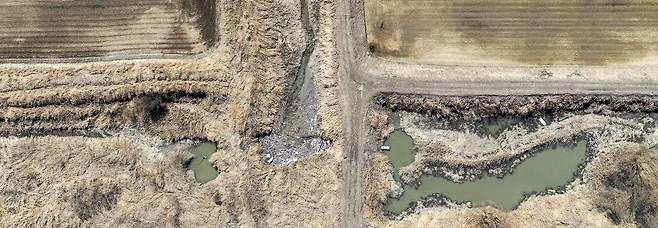
On the afternoon of Mar. 1, Janghang Wetland, located in the estuary of the Hangang River in Goyang, Gyeonggi-do, was blocked off by a barbed-wire fence at the entrance to the restricted area. Past the ecological center, which records the flora and fauna inhabiting the wetland, the path leading to the protected zone had been sealed. Previously accessible to visitors, entry has been prohibited since a landmine explosion in 2021. A sign on the fence warned, “Visitors must exercise caution due to the risk of landmine-related accidents.” On Mar. 6, a drone survey conducted by The Chosunilbo revealed that waterways connecting the Hangang River to the wetland were clogged with debris, including plastic, Styrofoam, and branches. An official from the Hangang River Basin Environmental Office noted that urban waste continues to accumulate in the wetland, but cleanup efforts have been hindered by the presence of landmines.
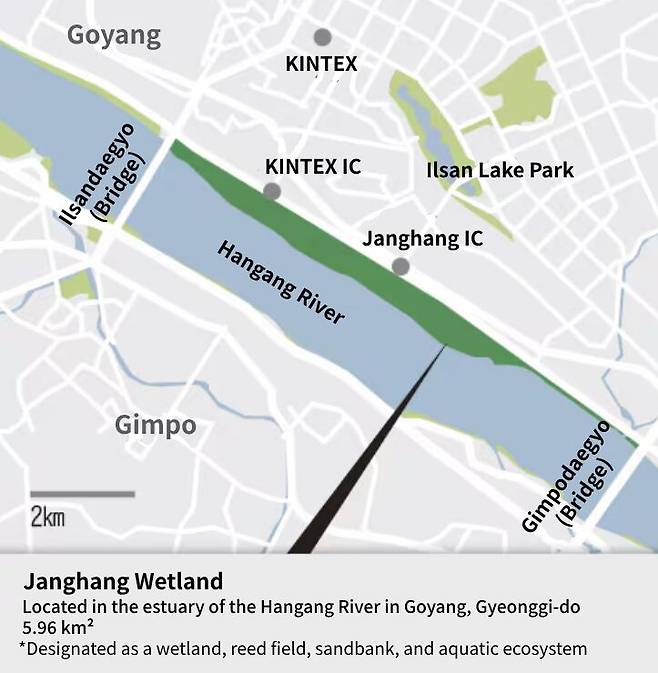
Spanning 5.96 square kilometers (about 1.8 million pyeong), Janghang Wetland serves as both a stopover and habitat for migratory birds traveling between continents. Formed by the significant tidal variations of the West Sea, the estuary is ecologically valuable and has been designated as a Ramsar wetland, recognizing the necessity of international conservation efforts. As an estuary, it naturally accumulates both urban and marine waste. However, cleanup operations have been at a standstill since 2021 due to the presence of landmines believed to have drifted from North Korea.
Previously designated as a military facility protection zone, Janghang Wetland was opened in 2018 to approved visitors, including farmers, environmental cleanup workers, and ecological tour participants. Before the opening, accumulated waste had no means of removal, but cleanup efforts were implemented following public access. The Ministry of Environment allocated an annual budget of 2 billion won for cleanup operations. However, these efforts ceased after the 2021 landmine explosion.
The landmine explosion occurred in June 2021, a month after the wetland was designated a Ramsar site. An environmental group conducting cleanup activities triggered an anti-personnel mine, resulting in a severe injury that led to an amputation. A Hangang River Basin Environmental Office official noted that in addition to that incident, plastic-encased leaf mines are believed to be scattered throughout the area, preventing further cleanup operations. Currently, only authorized farmers are permitted limited access to the site.
The South Korean military conducts periodic landmine detection and removal operations. However, as landmines continue to drift from North Korea, access remains restricted due to safety concerns. The types of landmines suspected to be in Janghang Wetland, including wooden box mines and leaf mines, are difficult to detect with standard mine detectors. Consequently, the military has been unable to determine the number of mines in the area, and data on cleared mines remains classified. The Ministry of Environment estimates that hundreds of tons of waste have accumulated in Janghang Wetland. Uncollected waste threatens the wetland’s ecosystem and could pollute the Hangang River.
Janghang Wetland is also home to the endangered black-faced spoonbill, a Class I endangered species. A 2022 ecological monitoring report on the Hangang River estuary’s protected wetland identified a total of 1,092 species recorded in Janghang Wetland from 2005 to 2021, including 455 plant species, 192 bird species, and 16 mammal species. Among them were several endangered species, such as the black-faced spoonbill, swan goose, greater white-fronted goose, red-crowned crane, white-tailed eagle, gold-spotted pond frog, and leopard cat.
Under Ramsar designation, the Ministry of Environment is responsible for establishing a conservation plan, while local governments are required to implement it. In the case of Janghang Wetland, the cities of Goyang, Gimpo, and Paju are responsible for formulating cleanup plans. The Ministry of Environment has announced that it will release the fourth Hangang River estuary wetland conservation plan this month, which includes waste removal efforts. However, without addressing the landmine issue, implementation remains a challenge. A Hangang River Basin Environmental Office official acknowledged the necessity of managing the wetland but stated that concerns over landmine accidents make intervention difficult. As a result, despite its Ramsar designation, Janghang Wetland continues to suffer from pollution without effective countermeasures in place.
Copyright © 조선일보. 무단전재 및 재배포 금지.
- 72세 은퇴자가 직접 겪은 내 노후가 생각보다 비참해진 2가지 이유
- 나이 들어서도 건강한 치아 가진 사람들은 반드시 하는 습관, 1만원대 단독 특가
- [단독] 동복댐 높여 반도체 물 공급? 지금 강수량으론 역부족
- [단독] 여고생 꿈 앗아간 장윤기, 장래희망 경찰관이었다
- [단독] 4개 특검, 사무실 ‘방값’으로만 64억 지출
- 이란 문제를 어찌할까… 美상원의원 “최근 20년 內 가장 큰 외교 재앙”
- 트럼프, 또 ‘부정선거’ 꺼내나...“제발 경제만” 공화당 전전긍긍
- ‘미끄럽다’는 ‘slippery’와 ’slick’의 미묘한 차이
- 한입 먹으면 살살 녹는 뱃살, 도로 먹고 싶어지는 ‘토로(とろ)’
- 25년째 하루도 안 거르고 카드 복기한다… 극한의 두뇌 스포츠 82세 ‘브리지’ 현역