Some go to see winter birds to celebrate UN’s World Wildlife Day on March 3
이 글자크기로 변경됩니다.
(예시) 가장 빠른 뉴스가 있고 다양한 정보, 쌍방향 소통이 숨쉬는 다음뉴스를 만나보세요. 다음뉴스는 국내외 주요이슈와 실시간 속보, 문화생활 및 다양한 분야의 뉴스를 입체적으로 전달하고 있습니다.
On the 3rd of March, when the advertisement alarm “March 3! Special Discount Event Celebrating Pork belly Day” went off, some people headed to a river instead of a pork belly restaurant. They brought binoculars, telescopes, a “bird book” with 30 species of winter migratory birds, and ballpoint pens.
March 3 is known as “Pork belly Day” and is also “World Wildlife Day,” designated by the United Nations (UN).
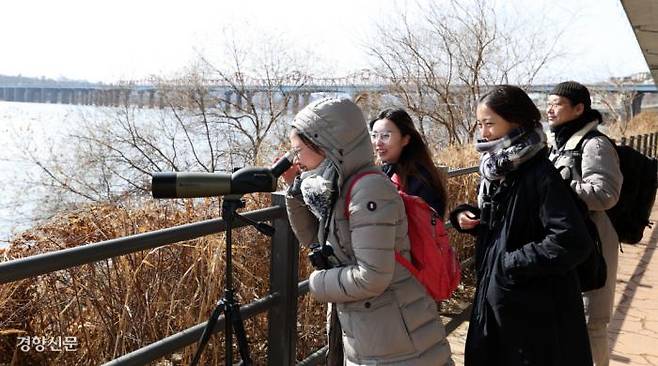
The planning team and participants of “Animal Church” traveled to Jungnangcheon Stream, Seongdong-gu, Seoul, for a vigil. A vigil originally means staying overnight to protect something, such as a night watch and an overnight prayer, and among animal rights activists, it mainly refers to activities, such as visiting farms and slaughterhouses to record and share the reality of the sites and what is going on there. The word church means “ecclesia” in Latin, which means “to gather.” So “Animal Church” visits slaughterhouses and the center of Gangnam, Seoul, once a month for a vigil.
“Pork Belly Day is a day that accelerates and celebrates the exploitation of farm animals by humans,” said Bori (29), a member of the Animal Church planning team. ”Rather than joining in, we want to pay attention to non-human beings around us through birdwatching.”
On the day of the gathering, there were only a few pochards near Dongho Bridge in Jungnangcheon Stream, where there are usually 200 to 300 of them. “It rained last night and it was very windy, so there weren't many of them,” said Sai (44). The number of winter birds staying near the river was observed to be lower than usual as the river rose due to the rain from the night before until dawn.
River management that does not take animal life into account also reduces the number of winter visitors. Sai said, "If a pile of dirt in the water is removed by dredging, it may look clean to humans, but birds will lose space to avoid natural enemies." She also said, “Those who come here regularly can feel how much the stream has been destroyed and the number of creatures on the stream is plummeting,” adding, ”Jungnangcheon Stream is a place that proves extinction.”
The group walked about 2 kilometers from Oksu subway station to Eungbong station, observing white pochards and black canvasbacks, mallards with turquoise heads, and coots with white beaks and plump bodies through binoculars and telescopes. A magpie perched on a branch peeked out at them. "It's because it bothers the bird when we look at it," said Sai. The magpie turned her head again and again, and cried.
She said, "When we forget that humans and wildlife are connected beings, we don't see the unsustainable system of modern society. "The violence of killing and consuming large amounts of non-human animals does not occur simply because humans are cruel, but because there is a structure in which killing them becomes an industry.” She added, “Meeting nonhuman, indigenous wildlife through a vigil is part of breaking the structure we've become accustomed to.”
“I wanted to feel that many of our neighbors and residents in the city are not limited to humans, and that there are other animals such as birds,” said Kim Tae-rang (23), a graduate student who participated in the vigil. ”When we recognize their presence next to us, we will be able to see our relationship with many animals that are hidden by the Pork Belly Day.”
※This article has undergone review by a professional translator after being translated by an AI translation tool.
Copyright © 경향신문. 무단전재 및 재배포 금지.
- 유시민 “검찰개혁 지연은 이 대통령이 수사·기소 분리 원하지 않기 때문…실패로 끝날 것”
- [속보]MBK·메리츠, 홈플러스 2000억원 지원 방안 극적 합의
- ‘양평 고속도로’ 원희룡 신체·차량 압색 ‘휴대전화 확보’···종합특검 ‘직권남용 피의자
- ‘큰 실망 10가지 중 하나’ 손흥민···“한국 대표팀 심장과 같던 선수, 초능력 잃었다”
- 황우석에게 준 최고과학기술인상 22년 만에 박탈…상금 3억원 환수는 어려워
- 대만 매체 “트와이스 쯔위, JYP 떠날 수도”···본명 저우쯔위로 이달 초 활동도
- 유네스코 세계유산위 “사도광산, 전체 역사 다뤄라” 일본에 또 권고···정부 “우리 입장 반
- 이 대통령 “대통령 ‘지 혼자 최신 소총 자랑’ 엉터리 기사, 즉각 팩트체크 시스템” 주문
- 급거 귀국한 강경화 주미대사 “쿠팡, 제 생각보다 훨씬 오래가는 이슈”
- “다이소 선크림 10개 중 8개가 기준 미달” 유튜버 주장에 다이소 반박 ‘진실 공방’