Rare gas supply in question as Trump seeks control over Ukraine’s resources
이 글자크기로 변경됩니다.
(예시) 가장 빠른 뉴스가 있고 다양한 정보, 쌍방향 소통이 숨쉬는 다음뉴스를 만나보세요. 다음뉴스는 국내외 주요이슈와 실시간 속보, 문화생활 및 다양한 분야의 뉴스를 입체적으로 전달하고 있습니다.
As U.S. President Donald Trump pushes for a share of Ukraine’s natural resource revenues—including minerals—in exchange for military and economic aid against Russia, analysts warn the move could disrupt South Korea’s rare gas supply chain, a critical component in semiconductor production.
South Korea has relied on Ukraine for a significant portion of its rare gas imports. While domestic companies are working to localize high-purity rare gas production, full self-sufficiency remains a long-term goal. Meanwhile, a recent meeting between Trump and Ukrainian President Volodymyr Zelenskyy ended without progress, raising concerns that peace negotiations could fall apart.
According to The New York Times and other major outlets, the U.S. and Ukraine had initially agreed to allocate 50% of revenues from state-owned natural resource extraction—including minerals, hydrocarbons, oil, natural gas, and liquefied natural gas (LNG) infrastructure—into a joint Reconstruction Investment Fund. Reports estimated Ukraine’s required contribution at $500 billion, with U.S. insistence on controlling both the fund and Ukraine’s natural resources emerging as a key sticking point. Zelenskyy had been expected to sign the agreement during his U.S. visit on Feb. 28.
Before Russia’s invasion in 2022, South Korea sourced 20–30% of its semiconductor-grade rare gases—neon (Ne), xenon (Xe), and krypton (Kr)—from Ukraine. In 2021, 23% of its neon gas imports came from Ukraine, along with 30% of krypton and 18% of xenon. After the war disrupted supply, South Korean semiconductor companies turned to China for alternatives but continued to face supply instability.
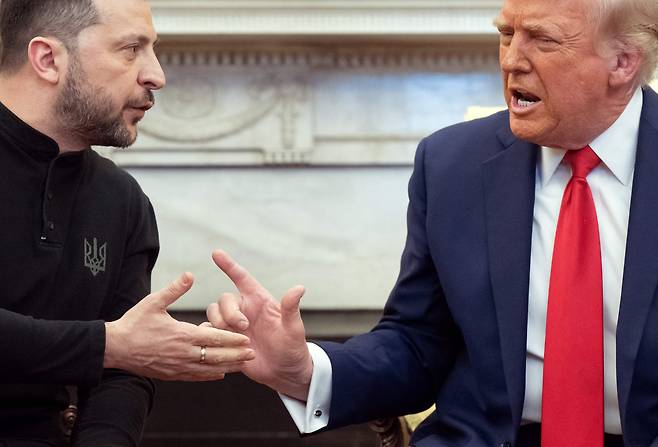
With the Trump administration eyeing strategic minerals such as rare earth elements, experts predict the U.S. could also seek leverage over Ukraine’s rare gas production and exports. The U.S. has historically sourced 90% of its high-purity neon gas from Ukraine. As Washington aims to secure semiconductor dominance while countering China, control over semiconductor materials and rare gas supply chains could become a geopolitical tool. Some analysts warn the U.S. may pressure allies to avoid Chinese-sourced minerals.
South Korea’s government and industry are working to localize high-purity rare gas production, which remains largely import-dependent. In 2023, the Ministry of Trade, Industry and Energy designated semiconductor rare gases as a key sector in its eight major supply chain initiatives, aiming to strengthen domestic production and stabilize supply. The government has set a goal of achieving full self-sufficiency in neon gas by 2028.
POSCO Holdings, the parent company of steel giant POSCO, has partnered with China’s Zhongtai Cryogenic Technology to establish POSCO Zhongtai Air Solution. In November 2024, the joint venture began construction of a high-purity (99.999%) rare gas production plant in Gwangyang, South Jeolla Province, with completion expected by year’s end.
Currently, POSCO’s steel division produces crude rare gases—neon, xenon, and krypton with a purity below 41%—at its Gwangyang steel plant’s oxygen facility. These are supplied to specialty gas manufacturer TEMC, which refines them into high-purity rare gases for semiconductor and display panel applications. Given the extremely low concentration of rare gases in the air, large-scale air separation facilities like those in steel mills are necessary for production.
Copyright © 조선일보. 무단전재 및 재배포 금지.
- 본격화된 ‘뉴홈 지우기’...특례 대출 삭제 이어 홈페이지도 폐쇄
- [단독] “초대형 국정농단 의심된다”더니… 특검, 박상용 출국금지 연장 안 해
- 비싸서 못 먹던 갯장어 샤부샤부, 한 접시 2만원대 특별 공동구매
- 한병도 “올림픽공원 투표지 247만장, 재검표·수개표 추진 적극 검토”
- 수도권 때리는 장맛비...8~9일 서울 최대 100㎜
- WSJ “한국 증시, 삼전 하닉 레버리지 상품에 ‘카지노’, ‘오징어게임’처럼 될 위기”
- 후진 차량에 접근해 ‘쾅’…보험금 노린 50대 송치
- 폭우에 北 지뢰 내려올라...합참 “北 유실지뢰 주의”
- 野 대안과미래 “張 징계 정치, 좌시하지 않을 것”
- 개정 정통망법 시행 첫날...국힘, ‘입틀막법’ 헌법소원 청구할 것